Building the GTM Team of 2026: Fewer Humans, Higher Leverage
The traditional sales org chart is obsolete. Here’s what’s replacing it.
The most important hiring decision in go-to-market right now is the one you do not make.
We have spent the last decade building revenue organizations the same way: identify a function, write a job description, fill the seat. Need more pipeline? Hire more SDRs. Need better operations? Hire a RevOps manager. Need to scale outbound? Add headcount. The org chart grew in proportion to the revenue target, and nobody questioned whether that relationship was structurally necessary or just inherited from a world where humans were the only option.
That world ended sometime in 2024. Most organizations have not caught up yet.
What we are seeing across the best-performing GTM teams is a shift from headcount-based capacity planning to capability-based systems design. The question is no longer “how many people do we need?” but “what capabilities does this revenue engine require, and what is the best way to provision them?” Sometimes the answer is a person. Increasingly, the answer is an agent, a workflow, or a system that a single person can build and operate. The teams producing the most pipeline per dollar spent are the ones that understood this shift eighteen months ago and redesigned accordingly, not the largest ones.
The talent density argument, revisited

Capacity planning moved from seats to systems..
The idea that small teams of exceptional people outperform large teams of adequate people is not new. What is new is how dramatically the ratio has shifted. In 2020, a high-performing SDR team of ten might book forty qualified meetings per month. In 2026, we are watching two-person teams equipped with the right agent infrastructure book that same number in a week. Not because the two people are five times better. Because the system surrounding them handles research, personalization, sequencing, response classification, and follow-up scheduling while the humans focus on the fifteen percent of the process that still requires judgment and genuine connection.
This changes what “talent density” means in practice. It used to mean hiring people who were individually productive. Now it means hiring people who can make systems productive. The distinction sounds minor but it changes everything about who you look for, how you evaluate them, and what you pay them.
The mediocre SDR who sends a hundred templated emails a day has become structurally obsolete, not merely an underperformer. A well-configured agent handles that volume before lunch, with better personalization and zero deliverability risk from human error. The person worth hiring is the one who can design the system, train the agents, interpret the signals, and step in for the conversations that actually require a human on the other end. That is a fundamentally different skill set than what sales hiring has selected for over the past twenty years.
The GTM engineer as the new core hire

The GTM engineer connects the revenue system..
If you are building a revenue team from scratch today, the first hire should not be an SDR, an AE, or even a VP of Sales. It should be a GTM Engineer.
This is a role that did not meaningfully exist three years ago, and it is now the single highest-leverage position in a modern revenue organization. A GTM Engineer designs and builds the systems that generate pipeline. They wire together the data layer, the enrichment workflows, the scoring logic, the agent orchestration, the outbound infrastructure, and the feedback loops that allow the whole thing to improve over time. They think in systems architecture, not sales playbooks.
The best GTM Engineers we have observed share a specific profile. They have enough technical depth to build automations and configure APIs without depending on engineering resources. They have enough commercial awareness to understand what a qualified opportunity actually looks like and why certain messaging angles work. And they have the judgment to know when a system needs a human touchpoint versus when automation is sufficient. They are systems thinkers who happen to work in revenue, not salespeople who learned to code.
Hiring one GTM Engineer before hiring any traditional sales roles might feel counterintuitive. It is also the single decision that determines whether your revenue engine compounds or stalls. The GTM Engineer builds the infrastructure that makes every subsequent hire three to five times more productive. Without that infrastructure, every new hire is just another person sending emails manually.
The 2+8 model

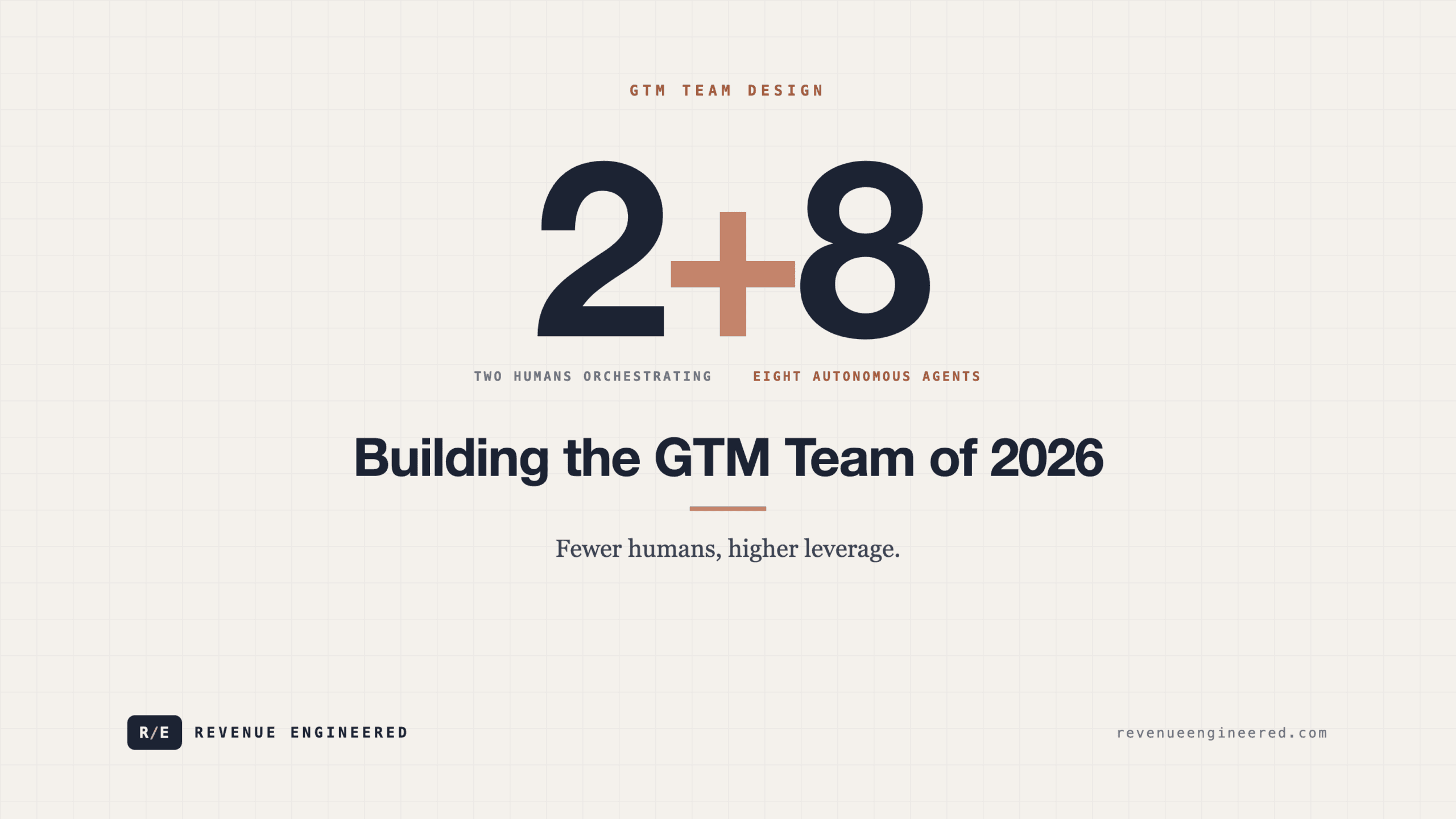
The 2+8 model is people plus agent infrastructure..
The team architecture that keeps producing outsized results follows a pattern we think of as 2+8. Two humans orchestrating eight agents.
The two humans are typically a GTM Engineer and someone with commercial judgment, whether that is a founder, an AE, or a growth lead. The GTM Engineer builds and maintains the system. The commercial person handles live conversations, makes judgment calls on deal strategy, and provides the feedback that trains the agents to improve. Between the two of them, they cover the full revenue cycle from signal detection to closed deal.
The eight agents are autonomous systems, each responsible for a distinct function in the revenue process, not eight separate tools with AI features bolted on. A research agent that produces account intelligence. A scoring agent that evaluates fit and prioritizes outreach. A personalization agent that crafts messaging tailored to specific accounts and personas. An orchestration agent that sequences touches across email, LinkedIn, and phone. A response agent that classifies inbound replies and routes them appropriately. A meeting prep agent that generates briefings before every call. A data quality agent that monitors and maintains the integrity of the underlying information. An optimization agent that identifies what is working, what is not, and what to test next.
Each of these agents runs continuously, handles thousands of accounts simultaneously, and operates with minimal human oversight once properly configured. The two humans are tuning the system, interpreting edge cases, and handling the interactions that require genuine human presence, not supervising agents in the traditional management sense.
A 2+8 team operating well generates pipeline at a rate that would have required fifteen to twenty people two years ago. The economics are obvious. The organizational implications are less obvious but equally significant.
Hiring for brain in a systems world
The old framework of hiring for “brain versus hands” takes on a different meaning when agents handle most of the hands-level work. What remains is the part of the job that requires actual thinking. Pattern recognition across messy data. Judgment about which accounts to prioritize when the scoring model produces ambiguous results. The ability to read a conversation and know whether the prospect needs more information or a direct ask. Creative problem-solving when a channel stops performing and the playbook has no answer.
These skills do not show up on resumes. A seven-round interview process will not surface them. What surfaces them is proof of work: show me a system you built, walk me through how you diagnosed a pipeline problem, explain a decision you made that went against the data. The paid trial, where a candidate works on a real problem for a week, remains the most information-dense hiring signal available. In a world where the wrong hire is not just unproductive but actively slows down a system designed for speed, the cost of a bad hire has gone up, not down.
The backgrounds that produce the best GTM Engineers and systems-oriented revenue people are often nontraditional. Former developers who got interested in business problems. Operations people who taught themselves to code. Career-changers from data science or product management who realized the revenue function was underbuilt relative to its importance. The candidate with the linear sales career path, great quota attainment, and polished interview presence may be exactly the wrong hire for a systems-first team. They were trained for a world that is disappearing.
Why traditional sales org charts are obsolete
The standard enterprise sales org chart was designed for a volume-based world. VP of Sales at the top. Directors underneath, each managing a team of AEs. SDR managers running outbound teams. RevOps somewhere off to the side. The structure assumed that revenue scaled linearly with headcount, that each layer of management added coordination value, and that specialization across the sales process (prospecting, qualifying, closing, expanding) required separate humans in separate roles.
Every one of those assumptions is breaking down. Revenue no longer scales linearly with headcount because agents provide nonlinear leverage. Middle management layers that existed to coordinate activity between humans add latency in a system where agents coordinate autonomously. Role specialization across the sales process made sense when each step required manual execution, but when agents handle prospecting, research, and qualification, the remaining human work does not divide neatly along those lines.
The org chart that replaces this is flatter, smaller, and organized around systems rather than functions. Instead of an SDR team, an AE team, and a RevOps team, you get a small number of GTM Engineers who build and maintain the revenue system, a small number of commercial operators who handle live interactions and strategic accounts, and a layer of agent infrastructure that handles everything between signal detection and meeting booking. The management overhead drops because there are fewer humans to manage and the agents do not need one-on-ones.
What this means for the next twelve months
The window for this transition is not infinite. Organizations that redesign their GTM teams around systems and agents in 2026 will build compounding advantages that become structurally difficult to replicate. The data their systems accumulate, the feedback loops they establish, the institutional knowledge embedded in their agent configurations — all of this compounds. An organization that starts twelve months later does not just need to build the same system. They need to close the gap created by twelve months of compounding improvement.
For founders building GTM teams right now, the practical implications are straightforward. Hire a GTM Engineer before hiring SDRs. Build the agent infrastructure before scaling headcount. Invest in systems that compound rather than people who add linearly. Evaluate every role on the org chart by asking whether the work that role does can be provisioned through a system rather than a seat.
The organizations that will win the next era of revenue generation are the ones that figured out they needed fewer people and better systems, and acted on it while the rest of the market was still hiring. Headcount was never the winning variable.
Enjoying this essay?
Written by

Elom
GTM, growth, and revenue systems operator with 12 years across Fortune 500s, fintech, and B2B startups. Building at the intersection of AI, data, demand, and revenue.
Get the next deep-dive in your inbox
Essays on demand creation, GTM, growth engineering, and revenue systems. Free.