From $0 to $200M ARR in Under a Year
AI revenue velocity is rewriting every GTM benchmark we have. The question is whether any of it sticks.
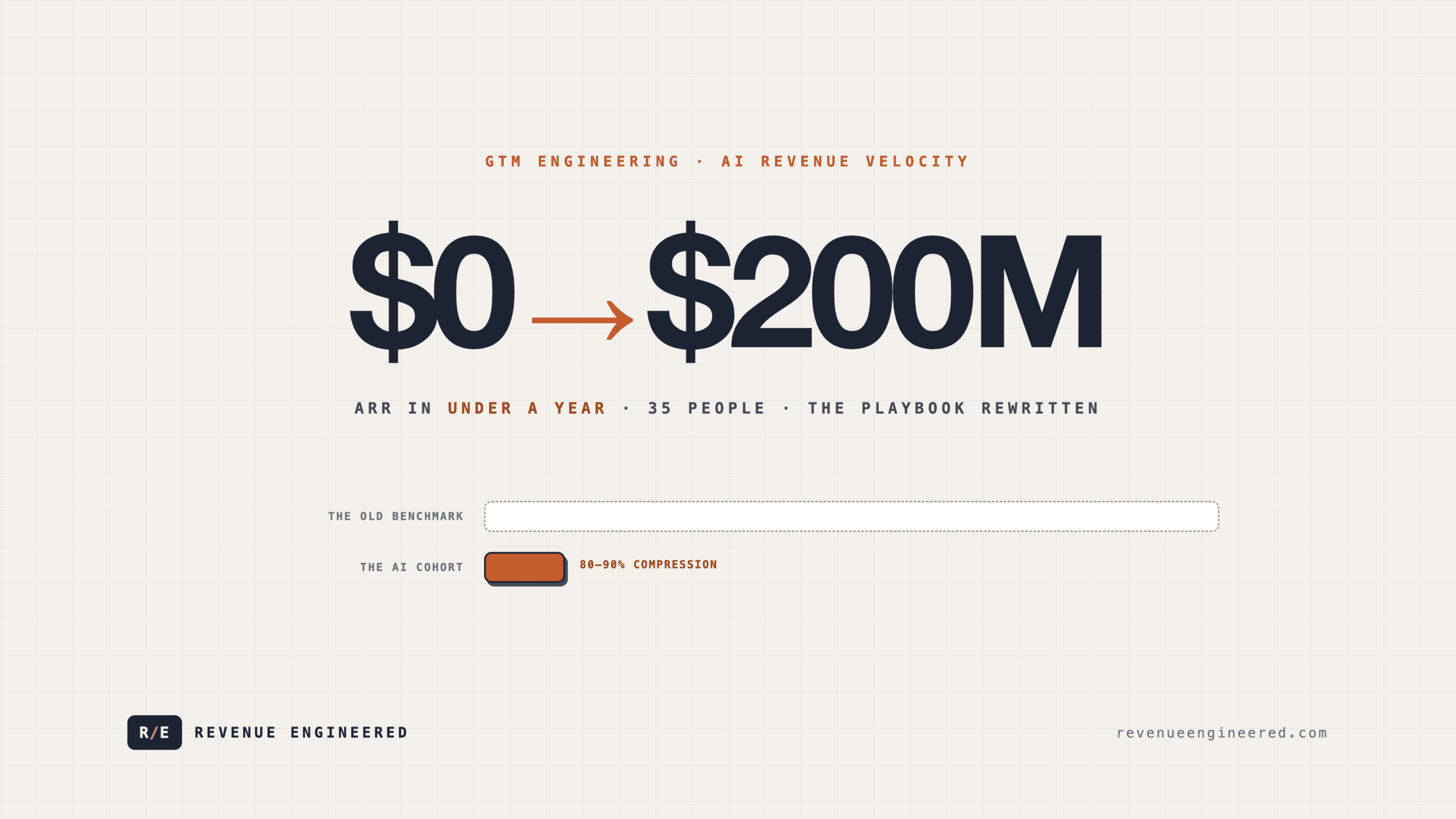
Lovable hit $80M ARR in seven months with 35 people. Then it kept going. As of early 2026, the company is approaching a $200M annualized run rate, still with a team that would barely fill a mid-size conference room. Cursor crossed $300M ARR as an AI-native developer tool and is the fastest-ramping SaaS company in recorded history by most measures. These are nothing like normal numbers. They sit far outside the category we used to celebrate.
The traditional SaaS growth benchmarks were built over two decades of pattern-matching. A “fast” B2B company reached $1M ARR in 12-15 months and hit $100M in 7-10 years. The best of the best, the Slacks and Zooms of the world, compressed that timeline by maybe 30-40%. What is happening now is a compression of 80-90%. Companies are reaching revenue milestones in months that used to take years, and they are doing it with headcounts that would have been laughable for a Series A company five years ago.
I have been tracking these trajectories closely, and the pattern is consistent enough to name. I am calling it AI revenue velocity, and it is the single most important dynamic in GTM right now. Not because the growth rates are exciting, although they are. Because the growth rates change the logic of everything downstream: how you build teams, how you price, how you think about retention, and whether the playbooks that built the last generation of SaaS companies are even relevant anymore.
The speed is real, and it is structural

speed is real, and it is structural reframed as system design.
The temptation is to dismiss these numbers as outliers. Every generation of tech has its rocketships. Slack grew fast. Zoom grew fast during COVID. But the AI cohort is structurally different in ways that matter for GTM operators.
First, the cost to build and ship product has collapsed. Cursor is a developer tool built by developers using the same AI-assisted coding workflows they sell. The feedback loop between product development and product usage is almost instantaneous. When your build cycle drops from months to days, you can iterate on product-market fit at a speed that was previously impossible. Lovable ships features weekly. Some weeks, daily. This means the product that exists today is measurably different from the product that existed last month, and that constant evolution is itself a growth driver.
Second, distribution has changed. These companies skip the 50-person sales teams and the enterprise procurement grind. They grow through bottoms-up adoption, word of mouth, and community. Cursor spread through engineering teams organically. Developers tried it, told other developers, and entire companies adopted it before anyone in procurement knew it existed. Lovable grew through a similar pattern among non-technical founders who discovered they could build software products themselves.
Third, the monetization model is direct. Usage-based pricing means there is no 30-day free trial followed by a conversion funnel followed by an onboarding sequence followed by an expansion play. People start using the product, hit a usage threshold, and start paying. The time between first touch and first dollar is measured in hours, not weeks. Revenue starts accumulating almost immediately because the product delivers value almost immediately.
These three factors, compressed build cycles, organic distribution, and instant monetization, are no accident. They are built into how AI-native products work. And they create a growth velocity that the existing GTM playbook was not designed for.
The growth maze, not the growth funnel
Most founders and growth leaders think about go-to-market as a funnel. You optimize each stage: awareness, consideration, trial, conversion, expansion. The funnel metaphor assumes a relatively stable product in a relatively stable market, and the job of the GTM team is to improve conversion rates at each stage.
AI revenue velocity breaks that metaphor. The better mental model is a maze.
In a maze, you are making navigation decisions at every turn, and most of the paths are dead ends. The companies growing at these speeds are navigating a maze of strategic decisions, not optimizing a linear funnel. The wrong path leads to rapid decline just as easily as the right path leads to rapid growth. Should you price by seat or by usage? Should you sell to developers or business users? Should you invest in enterprise sales now or double down on self-serve? Should you build a platform or stay focused on a single use case?
You cannot A/B test your way through these decisions. They are directional choices that compound over time, and the speed of AI means the consequences of each choice manifest faster. A traditional SaaS company that chose the wrong pricing model had 18 months to realize the mistake and course-correct. An AI company operating at this velocity has maybe three months before the wrong choice starts showing up in the numbers.
The companies that are winning the AI revenue velocity race are the ones that have an internal compass for navigating the maze. They make decisions quickly, learn from the data quickly, and change direction quickly when the evidence says they are on the wrong path. The companies that stall are the ones that treat growth like a funnel optimization problem and spend six months running experiments on their onboarding flow while the market shifts underneath them.
The churn problem nobody wants to talk about
Here is where the story gets complicated. AI companies are hitting revenue milestones faster than any previous generation of software. They are also churning customers faster.
The retention data across AI-native companies is consistently worse than traditional SaaS. Median gross retention for AI products sits around 40%. That means the typical AI company loses 60% of its customer base every year. Compare that to B2B SaaS, where median gross retention is around 82%, and the gap is hard to ignore.
The reason is straightforward. Switching costs in AI-native products approach zero. If I am using one AI coding tool and a better one launches next month, switching requires no data migration, no workflow restructuring, no retraining. I just start using the new thing. The same applies to AI writing tools, AI design tools, AI research tools. The product does not embed itself into my operating rhythm the way a CRM or an ERP does. It sits on top of my workflow rather than inside it.
This creates a paradox at the heart of AI revenue velocity. The same characteristics that make these products grow fast, low friction adoption, instant value delivery, simple pricing, are the same characteristics that make customers easy to lose. Fast up, fast down.
Lovable’s growth is impressive, but the question hanging over every AI company growing at this pace is: what happens when a credible alternative ships a comparable product at a lower price point? When switching takes five minutes and costs nothing, customer loyalty is a function of whether you are the best option right now, not whether you were the best option six months ago.
The growth curve looks like a rocketship on the way up. The churn math means it can look like one on the way down too, just pointed in the wrong direction.
What this means for GTM teams

What this means for GTM teams as a maturity path.
If you are building GTM at a company experiencing AI revenue velocity, or if you are competing against one, the implications are specific and actionable.
Your activation window is compressed to almost nothing. In traditional SaaS, you had days or weeks to activate a new user. In AI-native products, the activation window is the first session. If a user does not experience meaningful value in their first 15 minutes, they are gone. This means your onboarding cannot be a tutorial or a setup wizard. It has to be the product working, immediately, on the user’s actual problem. The companies winning here are the ones that get out of the way and let the user do the thing they came to do.
Your retention strategy needs to focus on workflow embedding, not feature gating. The traditional retention playbook, lock customers in with annual contracts, build integrations that create switching costs, make the data hard to export, does not work when the product is AI-native and the value is in the output rather than the system. The AI companies with the best retention are the ones where the product becomes part of how you work, not just a tool you occasionally use. Cursor retains developers because it becomes their default coding environment. It is where they spend their entire working day. That is a different kind of stickiness than a CRM that stores your customer data.
Your pricing needs to reflect usage patterns, not seat counts. When one user might consume 50x the compute of another, per-seat pricing creates a mismatch between value delivered and price charged. The companies growing fastest are using credit-based or usage-based models that scale with actual consumption. This has its own retention risks, because every month becomes a new buying decision, but it aligns the product’s growth with the customer’s growth in a way that seat-based pricing cannot.
Your competitive response time has to be measured in weeks, not quarters. When a new competitor can clone your core functionality in a month, the moat lives in the ecosystem, the community, the distribution, and the speed of iteration, not in the feature set. The companies maintaining their growth trajectories are the ones shipping faster than their competitors can copy.
The durability question

durability question translated into operating choices.
The most important question in B2B right now has nothing to do with whether AI companies can grow fast. That is settled. The real question is whether any of this revenue is durable.
There are reasons for optimism. The companies at the top of the AI revenue velocity charts, Cursor, Lovable, and a handful of others, are building products that people use daily, that integrate into professional workflows, and that get better with use. That combination historically leads to durable revenue, even in categories with low switching costs. The best consumer subscription businesses, Netflix, Spotify, have near-zero switching costs but maintain strong retention because they are embedded in daily habits and their content libraries compound over time.
There are also reasons for concern. The AI model layer is improving so quickly that features which differentiate a product today become table stakes in six months. The application layer above the models is thin, and most AI products have not yet built the kind of proprietary data or workflow integration that creates a lasting advantage. If GPT-5 or Claude’s next release can do natively what your product does, your differentiation disappears overnight.
The founders who understand this tension, who are simultaneously sprinting on growth while building for durability, are the ones I am watching most closely. They know the revenue velocity is a window, not a destination. The speed creates an opportunity to build something lasting before the competition catches up, but only if you use that speed to accumulate durable advantages rather than just accumulating revenue.
Where this is heading
The $200M ARR in under a year milestone will not be a record for long. The structural forces driving AI revenue velocity, collapsing build costs, organic distribution, instant monetization, are still accelerating. I expect we will see a company hit $500M ARR in under 18 months within the next year.
But the companies that make it to that scale and stay there will look different from the ones that just pass through it on the way back down. They will have solved the retention problem. They will have built workflow integration deep enough that switching costs are real despite the product being AI-native. They will have communities and ecosystems that competitors cannot replicate by cloning the feature set.
The GTM playbook for AI revenue velocity companies is still being written. The old playbook assumed you had years to build a growth engine. This new generation of companies has months. The operators who figure out how to build durable growth at this speed will define the next era of B2B. The ones who mistake velocity for momentum will learn the difference the hard way.
Enjoying this essay?
Written by

Elom
GTM, growth, and revenue systems operator with 12 years across Fortune 500s, fintech, and B2B startups. Building at the intersection of AI, data, demand, and revenue.
Get the next deep-dive in your inbox
Essays on demand creation, GTM, growth engineering, and revenue systems. Free.