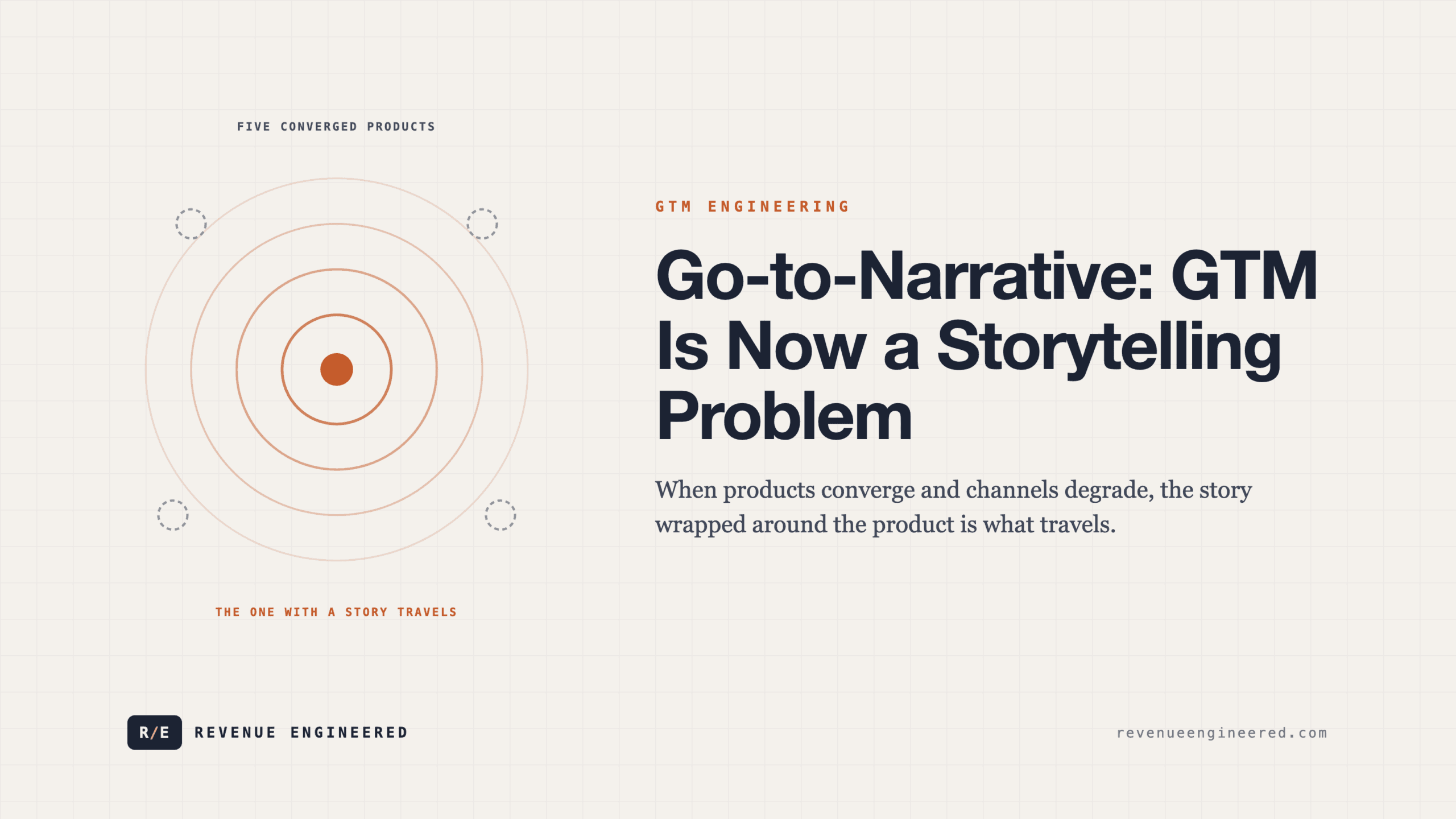
Go-to-Narrative: Why GTM Is Now a Storytelling Problem
Products are commoditized. Channels are degrading. The company that controls the narrative wins the market.
There is a question that most go-to-market strategies skip over entirely. They define the target market, the channels, the funnel stages, the conversion targets, the budget allocation. They answer “who,” “where,” and “how much.” But they rarely answer the question that determines whether any of it works: distributing what, exactly?
The default answer is “our product.” The GTM strategy exists to put the product in front of buyers. But this framing has a problem that is getting harder to ignore. When products in the same category converge on similar feature sets, similar pricing, and similar architectures, the product stops being the differentiator. The differentiator becomes the story wrapped around the product. How a company frames the problem. What it believes about the future. Why it exists beyond the transactional. The narrative.
Go-to-market is evolving into go-to-narrative. And the companies that understand this transition are pulling ahead of the ones that are still optimizing distribution of a message nobody remembers.
Why products stopped being enough

Why products stopped being enough reframed as system design.
The convergence is real and accelerating. In any mature B2B SaaS category, the top five competitors share 80% of the same features. They integrate with the same tools, deploy on the same infrastructure, and price within the same range. A buyer evaluating CRM platforms, project management tools, or analytics products will struggle to find meaningful functional differences between the leading options. The feature gap that used to separate winners from losers has collapsed.
AI is accelerating this collapse. When every company can ship AI-powered features in weeks rather than months, the window of differentiation through capability shrinks to almost nothing. An AI feature that was your competitive advantage in January is a checkbox feature across the category by June. Building faster does not help when everyone is building faster.
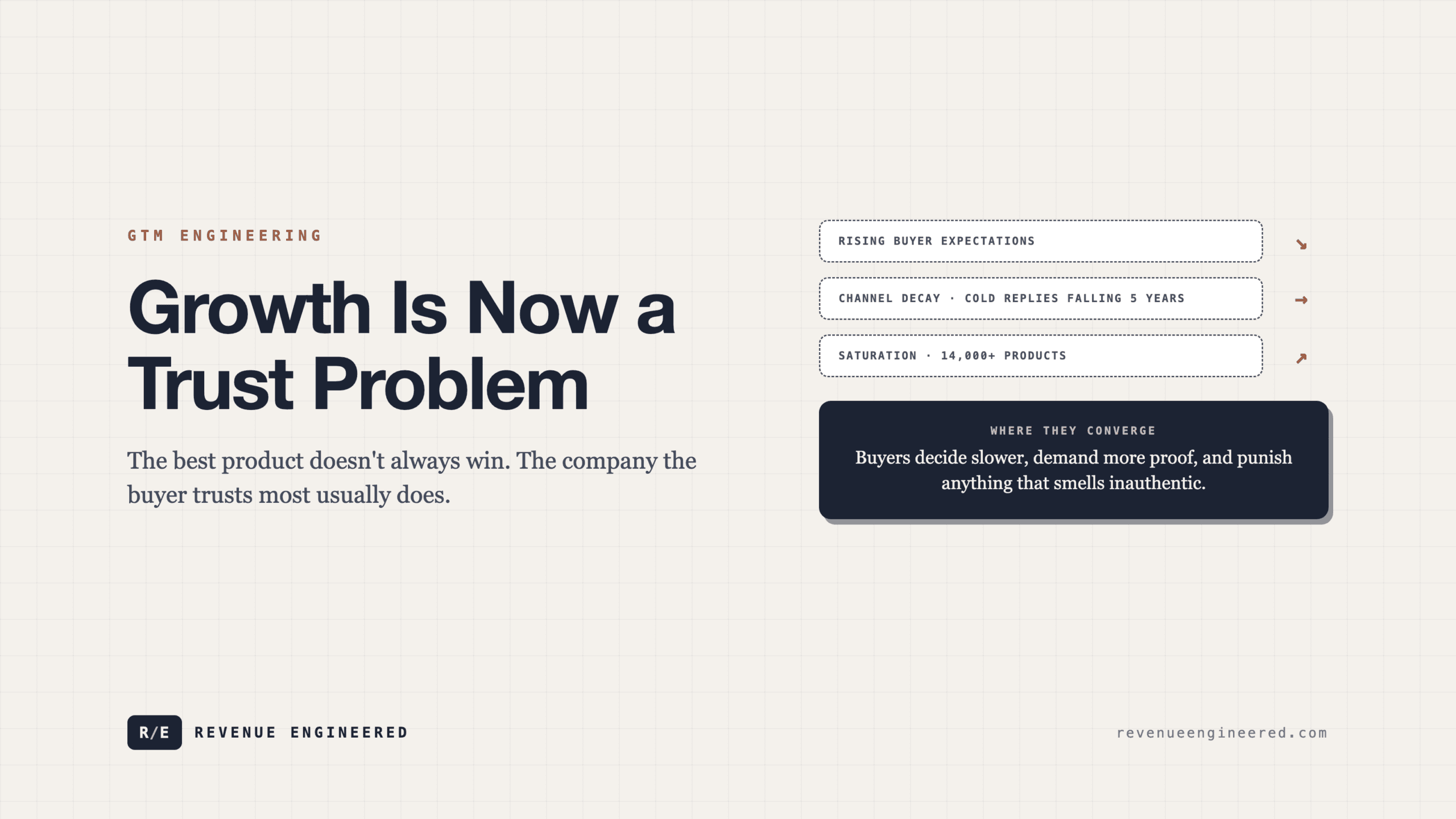
At the same time, the channels companies use to distribute their message are degrading. Organic search traffic is declining as AI-generated answers intercept queries before users click through to websites. Cold email response rates have fallen below 1% in most B2B segments. LinkedIn organic reach drops predictably each quarter. Paid acquisition costs rise annually. The distribution infrastructure that GTM strategies depend on is getting more expensive and less effective simultaneously.
This creates a specific problem. If your product is similar to competitors and your distribution channels are getting noisier, the only remaining variable is the message itself. And most B2B companies have a message that is functionally interchangeable with their competitors. “We help [persona] do [thing] faster/better/cheaper.” Swap the logo and the tagline and nobody would notice the difference.
The companies that are winning market share right now are not winning on product or distribution alone. They are winning because they have something specific to say, and that specificity makes them memorable in a way that product features cannot.
Narrative as a compression algorithm
There is a reason stories work better than feature lists. The reason is mechanical, not sentimental.
A story compresses complex information into a format that humans can remember and pass along. A feature comparison chart contains more data, but the data is ephemeral. Nobody walks out of a meeting and recites a comparison chart to a colleague. They walk out and say, “There’s this company that believes X, and here’s why that matters for us.” The story is what travels.
This is how word-of-mouth actually works in B2B. A buyer recommends a product to a peer. The recommendation is always a narrative, never a feature list. “We switched to this tool because they think about the problem differently. Their whole approach is built around the idea that X should work like Y, and once you see it that way you can’t go back.” That narrative does more selling than any product demo because it rewires how the listener thinks about the problem category. By the time they evaluate your product, they are already using your framework.
The compression function matters because B2B buyers are processing an absurd amount of information. The average enterprise buyer evaluates three to five vendors and consumes dozens of pieces of content before making a shortlist decision. They cannot remember the specifics of every product demo. But they can remember a story that changed how they think about the problem. That story is your narrative, and it is doing your selling when you are not in the room.
Vibe is the first touchpoint
Here is something that the traditional GTM framework does not account for at all: buyers encounter your company’s narrative before they encounter your product. Often months before.
A buyer’s first impression of your company is rarely a product demo or even a landing page. It is a LinkedIn post from your CEO that shows up in their feed. It is a podcast clip that a colleague shared. It is a screenshot of your website that someone posted in a Slack community with the comment “these people get it.” It is the aesthetic, the point of view, the vibe.
That word, vibe, sounds imprecise. It is not. Vibe is the aggregate signal a company sends through every touchpoint: the design language, the tone of voice, the positions it takes, the topics it chooses to talk about, and the topics it chooses to ignore. Buyers process this signal intuitively and form a categorization almost instantly. “This company is for people like me” or “this company is not for me.” That categorization happens before any rational evaluation of features or pricing.
The practical implication is that companies need to design their narrative experience at least as carefully as they design their product experience. The first-touch narrative, whether it is a social post, a blog, a talk, or a community comment, is setting the frame through which everything that follows will be evaluated. A strong narrative frame makes the product demo feel like confirmation. A weak or generic narrative frame makes the product demo feel like one more option in a crowded category.
Launching narratives, not features

Launching narratives, not features as a maturity path.
Product marketing is in the middle of a fundamental redefinition. The traditional PMM role centers on launches: new feature, new integration, new pricing tier. The launch follows a template. Internal enablement, external announcement, blog post, email campaign, sales deck update. The unit of work is the feature.
The problem with feature-centric launches is that features are forgettable. The average B2B buyer sees dozens of feature announcements per month in their category. They blend together. “Now with AI-powered X” is background noise dressed as a launch.
The companies that cut through are launching narratives, not features. The narrative launch reframes how the audience thinks about the problem, and the product feature is presented as evidence that the new frame is correct. The sequence matters. The story comes first. The feature validates the story.
Consider the difference. A feature launch says: “We added AI-powered lead scoring that predicts conversion probability with 85% accuracy.” A narrative launch says: “The traditional MQL is dead. Buyer behavior has changed fundamentally, and scoring models built on form fills and page visits are measuring ghosts. Here is how we think about buying signals now, and here is the system we built to act on it.” The first announcement competes with every other AI feature announcement that week. The second announcement changes how the reader thinks about their own pipeline, regardless of whether they buy your product.
There is a well-established argument that positioning is the strategic foundation everything else in marketing builds on. I think that is right, and the next evolution is that positioning is becoming narrative. Static positioning statements, the kind that get documented in brand guides and never read again, are being replaced by dynamic narratives that provoke and spread.
The spiky point of view
The most common failure mode in B2B narrative is blandness. Companies know they need “thought leadership” so they produce content that states obvious truths in polished language. “Data-driven decision making is important.” “Customer experience is a competitive advantage.” “Teams need to be aligned.” These are not narratives. They are furniture. They occupy space without changing anything.
What works is specificity and edge. A spiky point of view is a position that some percentage of your audience will disagree with. It has to be arguable. If everyone agrees, it is not a point of view. It is a platitude.
“Cold email is dead” is spiky. Half the B2B world relies on cold email and will push back immediately. That pushback is the point. It creates a conversation. People who agree share it. People who disagree respond to it. Both actions distribute the narrative further. A bland statement like “outbound is evolving” creates no reaction and therefore no distribution.
The fear that prevents most companies from taking spiky positions is that they will alienate potential buyers. This fear is mathematically wrong. A position that 30% of your addressable market strongly agrees with and 70% ignores is better than a position that 100% of your market vaguely nods at and nobody remembers. The 30% who agree become advocates. They share your content, recommend your product, and defend your position in buying conversations. The 70% who ignore you were never going to buy anyway because you had not given them a reason to care.
The best B2B narratives are built on a specific, defensible belief about how the world works or how it is about to change. Gong’s narrative is that revenue decisions should be based on conversation data, not CRM data. That is a spiky claim. It implies that most companies are making decisions wrong. It gives Gong’s audience a framework for evaluating their own processes, and that framework naturally leads to Gong’s product category.
Building your go-to-narrative

Building your go-to-narrative translated into operating choices.
The practical work of building a narrative is different from the practical work of building a GTM motion, and most teams are not structured for it.
Start with the belief. What does your company believe about the world that most competitors do not? This cannot be about your product. It has to be about the problem space. The belief should be true, or at least defensible with evidence, and it should imply a specific course of action that your product enables. If the belief is “companies waste 30% of their revenue capacity on data debt” and your product fixes data debt, the narrative and the product are aligned. The belief does the selling. The product is the proof.
Test the belief in small formats before investing in large ones. Write a LinkedIn post that states the belief plainly and see what happens. If it generates strong agreement or strong disagreement, you have something. If it generates polite indifference, refine it. The small-format test is cheap and fast. A narrative that does not resonate in 200 words will not resonate in a 2,000-word blog post or a 30-minute keynote.
Build a content architecture around the belief, not around keywords. Most B2B content strategies start with SEO keyword research and produce content that answers search queries. This is useful for distribution but it does not build a narrative. Narrative-first content starts with the belief and explores its implications across multiple angles. Each piece reinforces the central thesis. Over time, the audience associates your company with a specific way of thinking about the problem, and that association is far more durable than a search ranking.
Train your team to tell the story, not just sell the product. Sales reps, customer success managers, and executives all need to be fluent in the narrative. When a rep opens a discovery call by sharing a belief about the market rather than asking “what are your pain points,” the conversation starts at a different level. The buyer engages with the idea rather than defending against a pitch. The narrative opens doors that product demos cannot.
Measure narrative penetration, not just content performance. Page views and engagement rates tell you whether people consumed your content. They do not tell you whether the narrative is spreading. Track how often your specific framing shows up in prospect conversations (your sales team can report this). Track whether analysts and journalists use your language when writing about the category. Track whether prospects arrive already believing your thesis before they talk to your team. These are harder to measure than clicks. They are the metrics that actually indicate whether your narrative is winning.
The distribution question, reframed
Most GTM strategies optimize for distribution and then wonder why the results are mediocre. The problem is not distribution. The problem is that they are distributing something generic. More efficient distribution of a forgettable message just makes you a louder version of invisible.
The companies winning now have flipped the sequence. They start with something worth saying. Then they figure out how to say it everywhere. The narrative is the product of the GTM team, and the actual product is the evidence.
Go-to-market is becoming go-to-narrative. The companies that build their GTM around a strong, specific, spreadable story will own their categories. The companies that keep optimizing distribution of messages that could have come from any competitor will keep wondering why growth is getting harder every quarter.
Enjoying this essay?
Written by

Elom
GTM, growth, and revenue systems operator with 12 years across Fortune 500s, fintech, and B2B startups. Building at the intersection of AI, data, demand, and revenue.
Get the next deep-dive in your inbox
Essays on demand creation, GTM, growth engineering, and revenue systems. Free.