The Generalist Advantage: Why AI Kills the Marketing Specialist
The specialist was an artifact of tool complexity. AI flattened the learning curve. The scarce skill now is systems thinking.
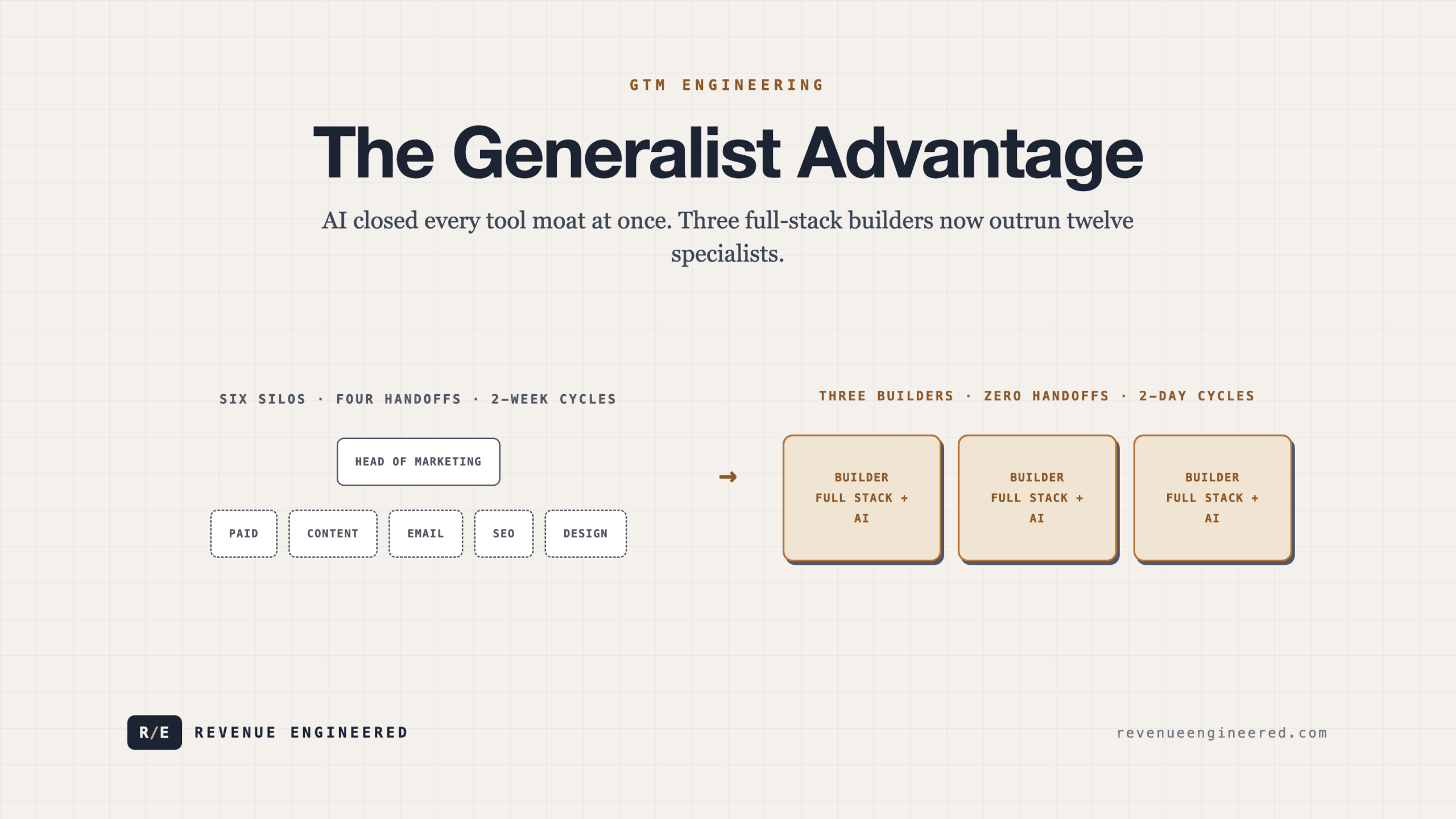
I spent last week reviewing the org charts of eleven B2B SaaS companies between Series A and Series B. Eight of them had marketing teams structured the same way: a head of marketing sitting on top of a paid ads manager, a content writer, an email marketer, an SEO specialist, and some fractional design help. The headcount ranged from six to twelve. The pipeline output ranged from decent to terrible, with no correlation to team size.
The two companies producing the best pipeline-per-dollar had marketing teams of three and four people respectively. No dedicated specialists. Generalists running AI tools across every channel. One of the three-person teams was outperforming a twelve-person team at a competitor with twice the funding.
Something has broken in how we think about marketing org design. The specialist model that dominated the last decade is collapsing, and most companies haven’t noticed yet because they’re still hiring from the old playbook.
The specialist was a product of tool complexity

specialist was a product of tool complexity reframed as system design.
Here is the part nobody says out loud: we didn’t hire specialists because specialization was inherently superior. We hired specialists because the tools were so complex that each one required a dedicated operator.
Google Ads had its own certification ecosystem. HubSpot required months of ramp time. Marketo was a full-time job to configure and maintain. Salesforce administration was its own career path. Each tool created a knowledge moat around itself, and companies responded by hiring people who could operate inside those moats.
The specialist’s value wasn’t their strategic thinking. It was their ability to navigate a specific tool’s interface, understand its quirks, and produce output from it. A good paid ads manager knew which bidding strategies worked for which campaign types, how to structure ad groups for quality score, and when to use broad match versus phrase match. This knowledge took years to accumulate. It was genuinely hard-won. And it is now worth a fraction of what it was eighteen months ago.
AI tools have flattened the learning curve for every major marketing platform. Not eliminated it. Flattened it. The difference between a specialist with five years of Google Ads experience and a smart generalist with AI assistance has compressed from a canyon to a curb. The specialist still has an edge, but the edge no longer justifies a full-time salary.
The math has changed
Let me put numbers on this. A standard B2B marketing team at a Series A company looks something like: Head of Marketing ($180K), Paid Ads Manager ($95K), Content Writer ($80K), Email Marketer ($75K), SEO Specialist ($85K), and a part-time designer ($40K). That is $555K in annual compensation before benefits, tools, and overhead. Call it $700K fully loaded.
Now look at what a three-person team with AI tools costs: Head of Marketing ($180K), two senior generalist marketers ($120K each), and $30K in AI tooling. That is $450K, call it $550K loaded. You save $150K a year, and in the cases I’ve seen, you get more output.
The output advantage comes from eliminating handoffs. In the specialist model, a campaign requires the content writer to draft copy, the designer to create assets, the paid ads manager to build the campaign, and the email marketer to set up the nurture sequence. Four people, four handoffs, four calendars to coordinate. In the generalist model, one person builds the entire campaign end to end. They write the copy with AI assistance, generate the creative with AI tools, configure the ads, and set up the email sequence. The cycle time drops from two weeks to two days.
I’ve watched a single generalist marketer, working with Claude and a handful of other AI tools, produce a full multi-channel campaign in an afternoon. The same campaign would have taken a four-person specialist team a week and a half. The quality was comparable. The speed was not even close.
The one-person proof point
The clearest evidence that the specialist model is dying comes from the agency world. Solo operators running AI-augmented agencies are hitting $100K per month in revenue. One person, doing the work that used to require a team of eight to twelve.
These aren’t junior people skimming the surface. They’re experienced practitioners who understand how all the channels connect. They know that the landing page copy needs to match the ad copy which needs to match the email follow-up sequence. They understand attribution modeling, funnel math, and conversion rate optimization. They have the strategic layer. And they’ve used AI to replace the execution layer that used to require specialists.
This is happening because the execution layer was always the commodity part. Knowing which buttons to click in Google Ads was hard, but it was procedural knowledge. It was learnable, documentable, and therefore automatable. The strategic layer, understanding how the pieces fit together, which channels reinforce each other, where to allocate marginal budget, what message will resonate with a specific buyer persona, remains human work. AI can draft the copy, but it cannot tell you what to say. AI can build the campaign, but it cannot tell you which campaign to build.
The hidden execution crisis
Here is what makes this shift urgent rather than merely interesting. Most B2B GTM teams have a strategy problem they think is a strategy problem, but it is actually an execution problem.
They have the deck. They have the quarterly plan. They have the channel strategy. What they don’t have is the ability to ship. Campaigns sit in review for weeks. Content calendars slip by months. New channel tests never launch because nobody has bandwidth. The strategy is fine. The execution is the bottleneck.
The specialist model makes this worse because it creates dependencies. You can’t launch the paid campaign until the content person finishes the landing page. You can’t send the email until the email specialist configures the automation. Every specialist becomes a single point of failure, and when one of them is on vacation or overloaded or just slow, the whole pipeline stalls.
Generalists break these dependencies. When one person owns the full stack for a campaign, there are no handoffs to manage, no coordination overhead, no waiting on someone else’s queue. The execution crisis disappears not because the team works harder, but because the work structure changes.
What the generalist actually needs to know

What the generalist actually needs to know as a maturity path.
I’m not arguing that expertise doesn’t matter. I’m arguing that the shape of the required expertise has changed. The specialist needed deep vertical knowledge of one platform. The generalist needs broad horizontal knowledge of how the whole system works.
Specifically, the generalist marketer needs to understand acquisition economics at the channel level, not just how to run a Google Ads campaign but why you’d choose Google Ads over LinkedIn Ads for a given ICP and ACV. They need to understand lifecycle marketing, how a prospect moves from awareness through activation to revenue. They need to understand measurement well enough to connect marketing activity to pipeline and revenue, not stop at tracking clicks. And they need systems thinking, the ability to see how a change in one part of the funnel affects every other part.
This is a higher bar than most specialist roles. A paid ads manager can be effective knowing only paid ads. A generalist marketer needs to understand the full revenue architecture. The tradeoff is that the company needs fewer of these people, but each one needs to be significantly stronger.
The AI tools handle the execution mechanics. The generalist provides the judgment layer on top. What to build, why, in what sequence, and how to measure whether it worked. The AI can write twenty versions of ad copy in minutes. The generalist decides which angle to test and why.
Death of pure management
This shift has a secondary effect that nobody talks about enough. When AI replaces the execution layer, the management layer loses its purpose.
A Head of Marketing managing six specialists was doing coordination work. Making sure the content person’s output fed into the email person’s sequences, which aligned with the paid person’s campaigns. Scheduling reviews, managing timelines, resolving conflicts about priorities. Half or more of that role was traffic management between specialists.
When the team shrinks to three generalists who each own complete workflows, the coordination overhead collapses. The Head of Marketing’s job shifts from managing people to doing the work. They’re not reviewing the content writer’s draft, they’re writing it themselves with AI. They’re not approving the paid ads manager’s campaign structure, they’re building campaigns. Every person in the org becomes a builder.
This is uncomfortable for people who built careers on management. But it is the direction things are moving. The companies I see winning have leadership teams where everyone ships. The CEO writes code. The CMO runs campaigns. The VP of Sales still closes deals. Management as a distinct activity, separate from building, is shrinking to the point where it might disappear at the early-stage level entirely.
The transition problem

transition problem translated into operating choices.
The hard part is the transition. You can’t fire your specialist team on Monday and hire generalists on Tuesday. The institutional knowledge, the campaign history, the vendor relationships, the platform configurations all live in your specialists’ heads.
The companies handling this well are doing it gradually. They’re cross-training their existing specialists, giving them AI tools, and expanding their scope. The best paid ads managers are becoming full-stack demand gen operators. The best content writers are becoming campaign builders. The people who adapt are the ones who were always curious about how the other pieces worked. They were specialists by job description but generalists by disposition.
The ones who struggle are the people who built their identity around platform expertise. “I’m a Google Ads expert” is a statement that depreciates every quarter as AI gets better at Google Ads. “I understand how to build pipeline across channels” appreciates every quarter as the systems get more complex.
The hiring side of the transition is equally awkward. Job descriptions haven’t caught up. Post a job listing for a “marketing generalist” and you’ll attract junior people who think generalist means “I know a little about everything.” What you actually need is someone who knows a lot about how everything connects. The interview filter I’ve found most useful is asking candidates to walk you through a campaign they built end to end, across at least three channels, including how they measured the outcome. The specialists describe their piece. The generalists describe the system.
Where this lands
Within two years, the standard marketing team at a Seed-to-Series B company will be three to five people, down from eight to twelve. Each person will operate across the full marketing stack with AI handling execution. Specialist roles will still exist at enterprise scale, where the volume and complexity of a single channel justifies dedicated attention. But for companies under $50M in revenue, the generalist model will be the default.
The scarce resource was never the ability to operate a specific tool. It was the ability to think across tools, channels, and systems. AI made that obvious by commoditizing everything else.
The hiring market is already reflecting this. Compensation for generalist marketing roles with AI proficiency is climbing faster than specialist roles in the same bands. Companies are starting to pay $130K-$160K for marketers who can operate across the full stack with AI tools, which is more than the individual specialists they’re replacing. The per-head cost goes up. The total team cost goes down. The output goes up. The math works for everyone except the specialist who didn’t adapt.
Companies that restructure early get a compound advantage: lower cost, faster execution, fewer handoffs, and a team that understands the full picture rather than their individual piece of it. Companies that wait will keep paying specialist salaries for work that AI does in minutes, wondering why their leaner competitors are moving faster on less budget.
The generalist’s moment arrived. The specialist’s moment passed. The only question is how quickly your org chart catches up.
Enjoying this essay?
Written by

Elom
GTM, growth, and revenue systems operator with 12 years across Fortune 500s, fintech, and B2B startups. Building at the intersection of AI, data, demand, and revenue.
Get the next deep-dive in your inbox
Essays on demand creation, GTM, growth engineering, and revenue systems. Free.