The GTM Engineer Career Path: From Zero to Hired
The first new GTM role in a decade is being defined in real time
Sometime in mid-2024, a job title started appearing on LinkedIn that most hiring managers could not define. GTM Engineer. It showed up in postings from growth-stage startups, usually sandwiched between Head of Growth and Senior Revenue Operations roles. The job descriptions were inconsistent. Some read like a marketing ops role with a technical bent. Others looked like data engineering positions that happened to mention pipeline and revenue. A few were honest enough to say, in various phrasings, that they needed someone who could do a little bit of everything and were willing to pay well for it.
By mid-2025, there were roughly 1,400 LinkedIn postings with the title. By January 2026, that number had crossed 3,000. The compensation bands reflect genuine scarcity: $120K to $300K OTE depending on seniority and geography. At the top end, that puts GTM Engineers on par with staff-level software engineers and senior product managers, which tells you everything about how much companies value this profile and how few people currently fit it.
This is the first new GTM role to emerge in roughly a decade. The last one was arguably Revenue Operations, which crystallized around 2015-2016 as companies realized they needed someone to unify the data layer across sales, marketing, and customer success. Before that, you had the formalization of the SDR role in the early 2010s. These roles did not appear overnight. They emerged from a gap between what organizations needed and what existing role definitions could deliver. The GTM Engineer is following the same pattern, except the gap it fills is wider and the demand curve is steeper.
What the role actually is

What the role actually is reframed as system design.
The simplest definition I can offer: a GTM Engineer is someone who builds and operates the technical systems that make a go-to-market motion work. That includes data orchestration, workflow automation, scoring and routing logic, integration architecture, and the analytics layer that tells you whether any of it is working.
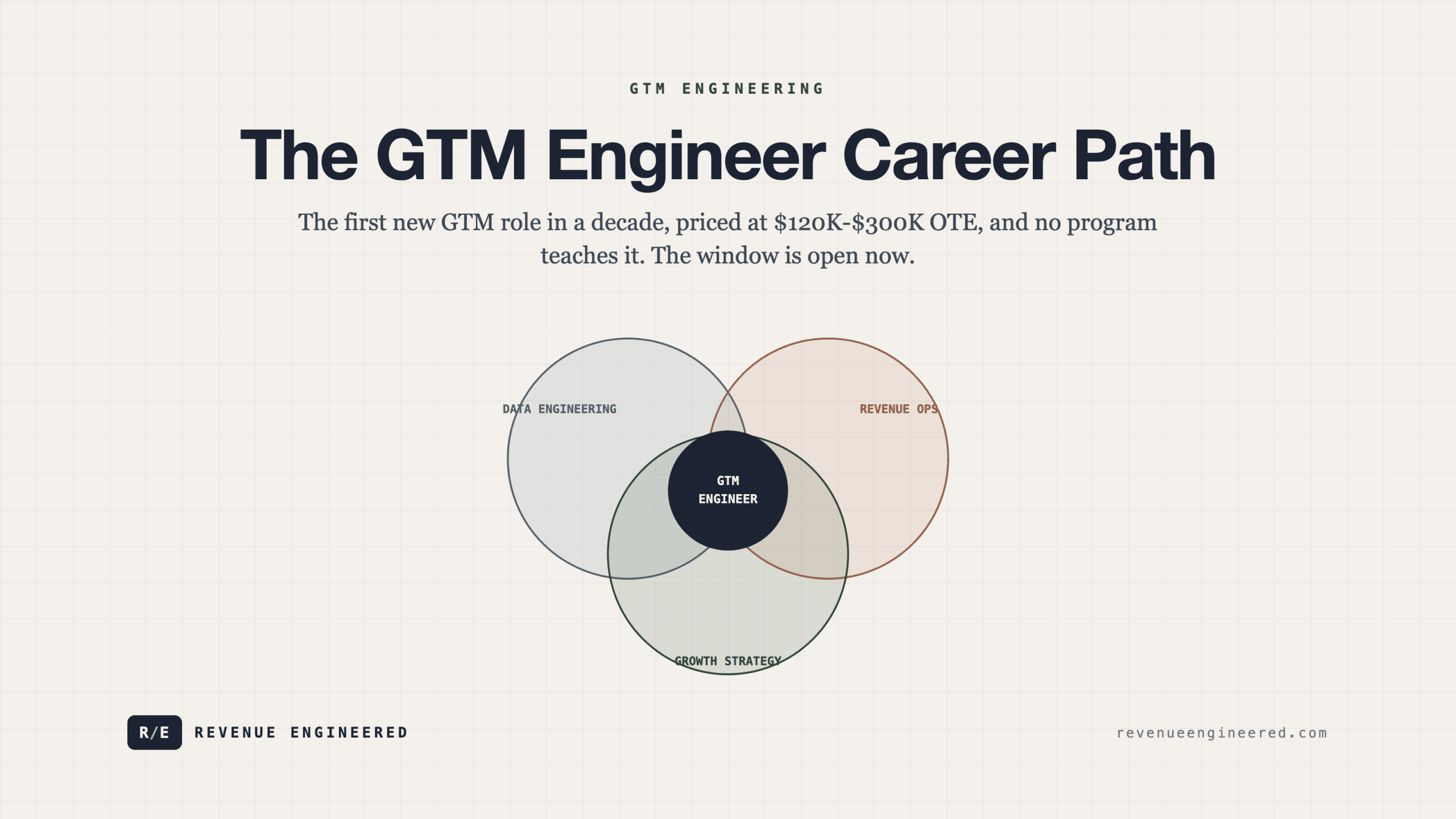
It is neither a marketing role with some SQL skills bolted on nor a software engineering role that happens to touch CRM data. It sits at the intersection of three domains that have historically been siloed: data engineering, revenue operations, and growth strategy.
The traditional org chart put these responsibilities in separate boxes. Data engineering built the pipelines. RevOps configured the CRM and managed the tech stack. Growth or marketing strategy decided what to do with the output. The GTM Engineer collapses all three into one person, or at least one function, because the speed of modern GTM requires it. When your outbound engine needs to ingest intent signals, enrich prospect data from four different providers, score leads against a custom model, personalize email copy with AI, and route responses to the right rep, you cannot wait for three teams to coordinate across sprint cycles. You need someone who can build the entire pipeline end to end.
The emergence of tools like Clay has accelerated this collapse. Clay is essentially an orchestration layer for GTM data workflows, and the people who are best at using it look nothing like traditional marketers or traditional engineers. They think in data flows. They understand API integrations at a practical level. They have opinions about enrichment waterfall sequencing. And they can connect the output of a technical pipeline to a strategic GTM decision. That combination is what makes the role new. The individual skills existed before. The combination did not have a name or a career path.
Where GTM Engineers come from
Because the role is new, there is no standard pipeline producing GTM Engineers the way computer science programs produce software engineers or MBA programs produce product managers. The people currently filling these roles are coming from five distinct backgrounds, and each background produces a different flavor of GTM Engineer.
The most common source is Revenue Operations. These are people who spent years configuring Salesforce, building reports in HubSpot, managing Marketo campaigns, and slowly accumulating enough technical skill to automate the parts of their job that were repetitive. They understand the GTM motion deeply because they have been operating inside it. Their gap is usually on the engineering side. They can build in no-code tools but may struggle with custom integrations and scripting, or with data infrastructure at scale.
Marketing operations is a close second, overlapping with RevOps but tending to produce people with stronger data analysis skills and weaker CRM depth. Marketing ops professionals are used to working with attribution models, campaign analytics, and audience segmentation. They understand experimentation frameworks. Their transition to GTM Engineering usually involves learning more about the sales side of the funnel and picking up integration skills.
Data engineering is another feeder. These are technical people who know how to build pipelines, work with APIs, write Python or SQL fluently, and manage data infrastructure. They have the strongest technical foundation but often lack GTM intuition. They can build the system but need guidance on what the system should optimize for. A data engineer who has never sat in on a sales call may build a technically elegant scoring model that optimizes for the wrong signal.
Growth roles produce a different variant. Growth marketers and growth product managers who have been running experiments, building landing pages, and optimizing funnels for years. They understand the strategic layer well. They know what moves metrics. Their gap is usually in the infrastructure and automation layer. They can design the experiment but need help building the pipeline that runs it at scale.
The increasingly common fifth source is self-taught generalists. People who came from adjacent roles, maybe customer success, sales, or even product management, and taught themselves the technical skills by building their own automations. They learned Clay by using it. They learned API integrations by needing them. They have no formal background in any of the four traditional sources, but they have the combinatorial skill set because they built it through necessity. Some of the best GTM Engineers I have encountered came from this path because they never inherited the domain silos that constrain people from traditional backgrounds.
The skill stack
If you want to become a GTM Engineer or hire one, the skill stack breaks into four layers.
At the foundation is data fluency. This means comfort with APIs, JSON, CSV transformations, basic scripting (Python is the lingua franca), SQL for querying and analysis, and an understanding of how data flows between systems. You do not need to be a software engineer, but you need to be able to read API documentation, debug a failing webhook, and write a script that transforms data from one format to another.
Above that is tool proficiency, the orchestration layer. Clay is the current center of gravity, but the layer extends to enrichment providers (Apollo, Clearbit, ZoomInfo, and the long tail of specialized data vendors), email infrastructure (Instantly, Smartlead, or whatever your outbound platform is), CRM systems (HubSpot and Salesforce primarily), and workflow automation platforms (Make, n8n, Zapier at the simpler end). The specific tools change. The ability to learn a new tool in a day and integrate it into an existing workflow is the durable skill.
The intelligence layer covers scoring and segmentation, plus personalization. This is where GTM intuition meets technical implementation. Building lead scoring models that actually predict conversion. Designing enrichment waterfalls that maximize data coverage while minimizing cost. Implementing AI-powered personalization that goes beyond “insert first name” and actually tailors messaging based on prospect context, using intent signals that have real predictive value rather than noise.
Strategy sits on top, and it is the hardest to teach. It is the ability to look at a GTM motion, identify where the constraint is, and design a system to remove it. The person with this skill knows the problem is not “we need more leads” but “our leads are reaching the wrong rep because the routing logic does not account for territory overlap.” They understand that the outbound reply rate is low not because the copy is bad but because the enrichment data is stale and the emails are bouncing before they reach the inbox. This layer is pattern recognition built from experience, and it is what separates a GTM Engineer from a technical ops person.
The hiring problem

hiring problem as a maturity path.
Companies trying to hire GTM Engineers face a genuine structural challenge. The talent pool is small because the role is new. The people who have the right skill combination often do not know the title exists, and the people who know the title exists often do not have the right skill combination.
The most common hiring mistake I see is posting a GTM Engineer role and then evaluating candidates the way you would evaluate a software engineer or a marketing manager. Technical assessments that test algorithmic thinking miss the point entirely. Marketing case studies that test campaign strategy miss the point from the other direction. The role requires a different evaluation framework.
The best interview process I have seen for GTM Engineers uses a live systems-design exercise. Give the candidate a realistic GTM scenario: here is our ICP, here is our current tech stack, here is our outbound volume target, and here is the problem we are trying to solve (low reply rates, poor lead quality, slow time-to-first-touch, whatever). Ask them to design the system that solves it. Not write code. Not build a campaign plan. Design the data flow, the enrichment sequence, the scoring logic, the routing rules, and the feedback loop that lets the system improve over time.
This exercise surfaces the combinatorial thinking that defines the role. Can they translate a strategic goal into a technical architecture? Do they understand the tradeoffs between different enrichment providers? Can they identify where AI adds value and where a simple rule-based approach is better? Do they think about cost per lead alongside conversion rate? The answers to these questions tell you more about a candidate’s fit than any resume line item.
Compensation and career trajectory

Compensation and career trajectory translated into operating choices.
The current compensation bands are wide because the market has not standardized. At the junior end, individual contributors with strong RevOps or marketing ops backgrounds and emerging technical skills are commanding $120K to $160K total compensation. Mid-level GTM Engineers with demonstrated ability to build and operate complex pipelines independently sit in the $160K to $220K range. Senior GTM Engineers, the ones who can design an entire GTM technical architecture from scratch and have done it successfully at least once, are pulling $220K to $300K OTE.
These numbers will compress as the talent pool grows, but right now the scarcity premium is real. Companies are competing for a small number of people who possess a skill combination that did not have a label two years ago.
The career trajectory is still being written, which is both the opportunity and the risk. There is no established path from “GTM Engineer I” to “VP of GTM Engineering.” The people in these roles today are inventing the ladder as they climb it. Some will evolve into Heads of Growth Engineering, leading teams that own the entire technical GTM stack. Others will become technical co-founders or move into GTM-focused venture roles, evaluating startups through the lens of their go-to-market infrastructure.
The career risk is that the role gets absorbed. If the major CRM platforms build enough native automation and AI capability, the need for a dedicated GTM Engineer could diminish. I think this is unlikely in the near term because the complexity of multi-tool orchestration keeps growing, but it is worth acknowledging. The GTM Engineers who build deep strategic judgment alongside their technical skills will be insulated from this risk. The ones who are primarily tool operators will be more vulnerable.
The window
Every new role has an early window where the demand-supply imbalance creates outsized opportunity for the people who move first. For software engineers, that window was the 2000s and early 2010s. For data scientists, it was roughly 2012 to 2018. For product managers, it was the mid-2010s.
For GTM Engineers, the window is open right now. The demand is accelerating. The supply is constrained by the fact that no university program or bootcamp teaches this specific skill combination. The people who are building the skill stack today, through a combination of hands-on experience, self-directed learning, and actual pipeline construction, are positioning themselves for a career trajectory that the market is pricing at a premium.
The companies that figure out how to hire and develop this role will build GTM systems that outperform their competitors on speed and cost efficiency. The ones that keep trying to solve GTM engineering problems with traditional role definitions will keep wondering why their outbound takes three weeks to launch and their data is always stale.
The role is real. The career path is being paved in real time. The only question is whether you are building the skills or still debating the job title.
Enjoying this essay?
Written by

Elom
GTM, growth, and revenue systems operator with 12 years across Fortune 500s, fintech, and B2B startups. Building at the intersection of AI, data, demand, and revenue.
Get the next deep-dive in your inbox
Essays on demand creation, GTM, growth engineering, and revenue systems. Free.