Growth Is Now a Trust Problem
Low conversion is not a landing page problem. High churn is not a product problem. Most growth failures are trust failures in disguise.
A company I advise ran an A/B test on their pricing page last quarter. Version A had the original layout. Version B had a redesigned layout with better visual hierarchy and a more prominent CTA. Version B lost. Not by a little. Conversion dropped 18%.
They spent two weeks trying to figure out what went wrong with the design. The answer had nothing to do with design. Version B removed the customer logos, the case study links, and the “trusted by” banner that sat above the fold on Version A. The redesign optimized for clarity and lost on credibility. The prospects who landed on that page weren’t confused about the product. They were uncertain about the company.
I keep seeing this pattern. Teams diagnose growth problems as funnel problems, messaging problems, product problems, pricing problems. They run A/B tests, rebuild landing pages, adjust copy, and tweak onboarding flows. Sometimes it works. Often it doesn’t. When it doesn’t, the underlying issue is almost always the same: trust is broken somewhere in the journey, and nobody thought to look for it there.
The three-front war

three-front war reframed as system design.
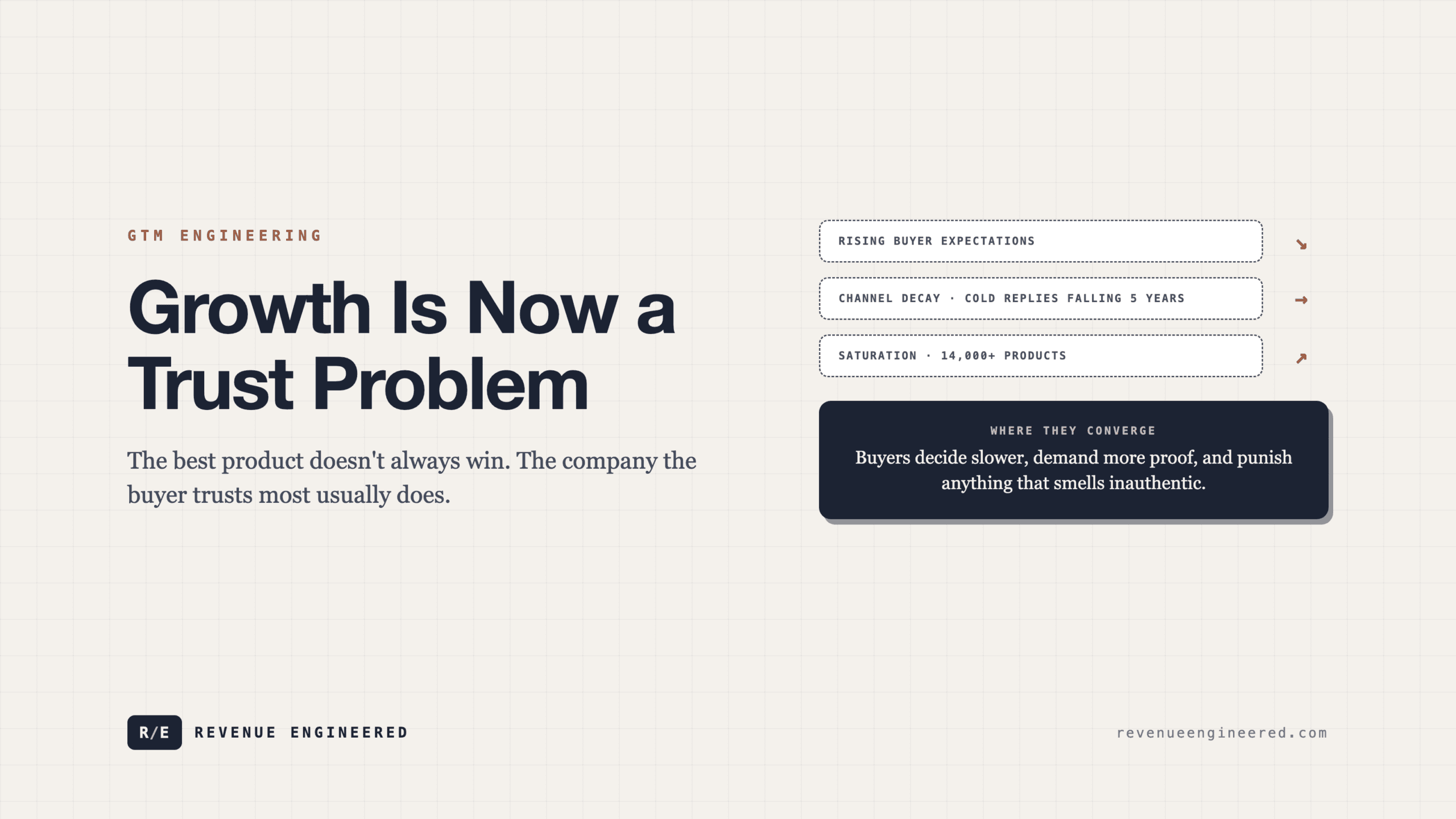
B2B companies are fighting on three fronts simultaneously, and the combined effect is a trust crisis.
The first front is rising buyer expectations. Enterprise buyers now expect the same frictionless experience they get from consumer products. They expect to try before they buy, to find honest information without talking to sales, and to see proof from peers rather than vendor claims. When a company falls short on any of these, the buyer doesn’t think “this company has a subpar buying experience.” They think “I don’t trust this company enough to give them my time.”
The second front is channel decay. Cold email response rates have been declining for five straight years. LinkedIn outreach is approaching spam territory. Even warm introductions convert at lower rates than they did in 2022. The channels haven’t just gotten noisier. They’ve gotten less trustworthy. When every cold email claims to be personalized (and clearly isn’t), when every LinkedIn message starts with a fake compliment, when every webinar is a thinly disguised product demo, the default buyer posture shifts from neutral to skeptical.
The third front is market saturation. There are now over 14,000 marketing technology products alone. Every category has five to fifteen credible competitors. Buyers face choice paralysis, and when people can’t differentiate on features or price, they default to trust signals. Which vendor do my peers use? Who has the best reputation? Which company feels most credible? The company with the best product doesn’t always win. The company the buyer trusts most usually does.
These three forces compound. Rising expectations meet declining channel trust meets overwhelming choice. The result is buyers who take longer to decide, require more proof before committing, and punish any signal of inauthenticity.
Problem illumination beats pitching
The natural response to declining trust is to sell harder. Push more outbound volume. Write more aggressive copy. Offer bigger discounts or create urgency with limited-time pricing.
All of this makes the problem worse. The best sellers I’ve studied in the last year do the opposite. They don’t pitch. They illuminate.
Illumination means helping prospects see problems they didn’t know they had. Instead of saying “our product does X,” the approach is “here’s a problem you’re probably experiencing and might not have a name for yet.” The prospect sells themselves once they understand the problem, because the company that named the problem becomes the natural authority for solving it.
The physics of this are simple. When someone pitches you, your guard goes up. You evaluate their claims, look for the catch, discount their enthusiasm. When someone helps you understand something about your own situation, your guard goes down. The relationship shifts from adversarial (seller vs. buyer) to collaborative (advisor and advisee). Trust forms in the gap.
Richard Feynman said if you can’t explain something simply, you don’t understand it well enough. The same principle applies to selling. If you can’t explain your prospect’s problem more clearly than they can explain it themselves, you don’t understand their situation well enough to earn their trust. The companies that win are the ones that achieve Feynman-level simplicity in describing what’s broken for their buyers.
Incentivized users are worse users
Here’s where the trust problem shows up in metrics that most growth teams misread. A SaaS company launches a referral program with a $50 credit for each invited user. Signups spike 40%. The growth team celebrates. Three months later, retention on referred users is 35% lower than organic users. The referral program didn’t grow the business. It inflated a vanity metric while creating a cohort of users who came for the incentive and left when it expired.
This pattern repeats across every incentive-driven growth tactic. Free tiers attract users who were never willing to pay. Steep discounts attract price-sensitive buyers who churn at the first renewal. Aggressive outbound brings in prospects who said yes to a meeting, not yes to a problem they need solved. The cheapest user to acquire is often the most expensive user to keep.
The trust lens explains why. Incentivized acquisition creates a transactional relationship from day one. The user’s mental model starts at “I’m getting a good deal” rather than “this product solves my problem.” Transactional relationships are inherently fragile. The moment a better deal appears, or the incentive expires, the relationship ends.
Organic acquisition, by contrast, happens when someone trusts the company enough to try the product on its merits. They came because a peer recommended it, because they read something that resonated, because they saw the company demonstrate expertise in their space. The relationship starts with trust, and trust-based relationships survive pricing changes, competitor launches, and product hiccups that would kill a transactional one.
I’m not saying never run promotions. I’m saying measure the quality of the users they bring in, not just the quantity. If your referral program produces users with half the LTV of organic users, your effective CAC on those referrals is double what your dashboard shows.
The buyer’s real decision framework

buyer’s real decision framework as a maturity path.
Most B2B growth models assume buyers make rational decisions based on features, pricing, and ROI. This is wrong, and the gap between the assumption and reality is where trust failures hide.
Real buyers, especially in mid-market and enterprise, optimize for career safety. A VP of Engineering evaluating a new tool isn’t asking “will this improve our velocity by 20%?” They’re asking “if this goes wrong, will it make me look bad?” A Head of Marketing choosing a platform isn’t asking “which has the best feature set?” They’re asking “which one can I defend to my CEO when she asks why we switched?”
This means trust operates at two levels. Level one is product trust: does this work, is it reliable, will it do what it claims? Level two is social trust: will choosing this vendor make me look smart, or will it put my reputation at risk?
Most companies optimize for level one and ignore level two. They build feature comparison pages and ROI calculators, assuming the buyer needs logical ammunition. What the buyer actually needs is social cover. Case studies from companies similar to theirs. Named references they can call. Content and industry recognition that positions the buyer as sophisticated for choosing this vendor.
The VP who championed a vendor that fails doesn’t just lose a tool. They lose credibility with their leadership. The perceived risk of being wrong far outweighs the potential reward of being right. This asymmetry is why “no decision” remains the most common outcome in B2B sales. Not choosing a competitor. Choosing to do nothing, because doing nothing carries no career risk.
Trust is the antidote. When a buyer trusts the vendor deeply enough, the perceived risk of choosing them drops below the perceived risk of missing out on the improvement. That’s the tipping point. Every growth tactic that doesn’t move the trust needle is pushing on a door that opens the other way.
Where trust breaks down
If you accept that most growth problems are trust problems, the diagnostic question changes. Instead of “why isn’t the funnel converting?” you ask “where does trust break down in the buyer journey?”
The common break points are predictable once you start looking. At the top of funnel, trust breaks when the first impression is generic. A cold email that could have been sent to anyone. A LinkedIn ad that says nothing specific. A blog post that reads like it was written by a committee. The buyer’s first thought is “this company doesn’t know me,” and they move on.
In the middle of funnel, trust breaks when claims exceed evidence. The sales deck says “10x improvement” with no supporting data. The case study describes a customer success without naming the customer. The demo shows a polished version of the product that doesn’t match the trial experience. Each gap between claim and evidence is a trust withdrawal.
At the bottom of funnel, trust breaks when the buying process is harder than it should be. Opaque pricing that requires a sales call. Contract terms buried in legal language. Security questionnaires that go unanswered for weeks. Every friction point signals “we’re not ready to serve you,” even if the product itself is excellent.
And post-sale, trust breaks when the product experience doesn’t match the promise. The onboarding is slower than the sales team suggested. The features that closed the deal are the features that work worst. Churn traces back to the promise-delivery gap, and the size of that gap determines the speed of the churn.
Rebuilding trust as a growth strategy

Rebuilding trust as a growth strategy translated into operating choices.
The actionable version of this insight is straightforward. Audit your entire buyer journey for trust gaps, and fix them before you optimize anything else.
Start with your first-touch channels. Is your outbound specific enough that recipients believe you understand their situation? Is your content based on original data or experience that can’t be found elsewhere? Do your ads make claims you can immediately substantiate on the landing page they link to?
Move to your middle-funnel experience. Do your case studies name real companies and real results? Can prospects talk to existing customers without going through a sales-mediated reference process? Does your demo show the actual product, including the parts that aren’t perfect yet? Counterintuitively, showing rough edges builds trust. Buyers know no product is flawless, and the vendor who acknowledges limitations feels more honest than the one who claims perfection.
Examine your buying process. Is pricing available without a sales conversation? Are contract terms simple and fair? Is the procurement experience fast enough that it doesn’t signal organizational dysfunction?
And look at your post-sale experience. Does onboarding match what sales promised? Are the first thirty days deliberately designed to prove the product delivers on its claims? Do you systematically close the gap between what was sold and what was experienced?
Each of these fixes is individually small. Collectively, they transform how buyers experience your company. Better conversion, lower churn, more expansion revenue: all of it flows from the same source: a buyer journey where trust accumulates at every touchpoint instead of leaking at random ones.
The trust compound
Trust compounds the same way distrust does. A buyer who trusts you at the awareness stage is more open during evaluation. A buyer who trusts you during evaluation converts faster. A customer who trusted the buying process has higher activation rates. A customer with high activation churns less. A customer who doesn’t churn expands more.
Every trust improvement at one stage multiplies through every subsequent stage. This is why fixing trust gaps produces outsized returns compared to traditional conversion optimization. You’re not improving one number. You’re improving the multiplier that affects every number downstream.
Growth is a trust problem. Solve the trust problem and the growth follows.
Enjoying this essay?
Written by

Elom
GTM, growth, and revenue systems operator with 12 years across Fortune 500s, fintech, and B2B startups. Building at the intersection of AI, data, demand, and revenue.
Get the next deep-dive in your inbox
Essays on demand creation, GTM, growth engineering, and revenue systems. Free.