Growth Loops Replace Funnels: Building Non-Linear Revenue Systems
Funnels measure what you lose. Loops measure what compounds. The mental model upgrade most GTM teams haven’t made yet.
The funnel is the most entrenched mental model in B2B go-to-market. It shows up in every board deck, every pipeline review, every marketing attribution report. You pour leads in at the top, they trickle through stages, and some fraction emerges at the bottom as revenue. The model is clean, linear, and intuitive. It is also fundamentally wrong about how growth actually works.
I am not making a semantic argument. The funnel model creates specific, measurable problems in how companies allocate resources, design systems, and evaluate performance. It trains entire organizations to think about growth as a sequence of losses rather than a system of compounding gains. And the companies that have figured out how to replace funnel-thinking with loop-thinking are producing results that funnel-optimized companies cannot explain with their own frameworks.
Seven problems with funnels that nobody wants to talk about

Seven problems with funnels that nobody wants to talk about reframed as system design.
The standard funnel has structural flaws that go beyond “it’s a simplification.” These are problems that actively distort decision-making.
The first is linearity. Funnels assume growth is a straight line from awareness to purchase. In practice, buyers loop back, skip stages, enter from the middle, get influenced by existing customers, and follow paths that look nothing like a sequential progression. A B2B buyer might discover your product through a peer’s recommendation, skip straight to a product trial, loop back to your content for validation, then buy. The funnel cannot represent this. It forces a linear narrative onto a non-linear process, and every metric derived from that narrative inherits the distortion.
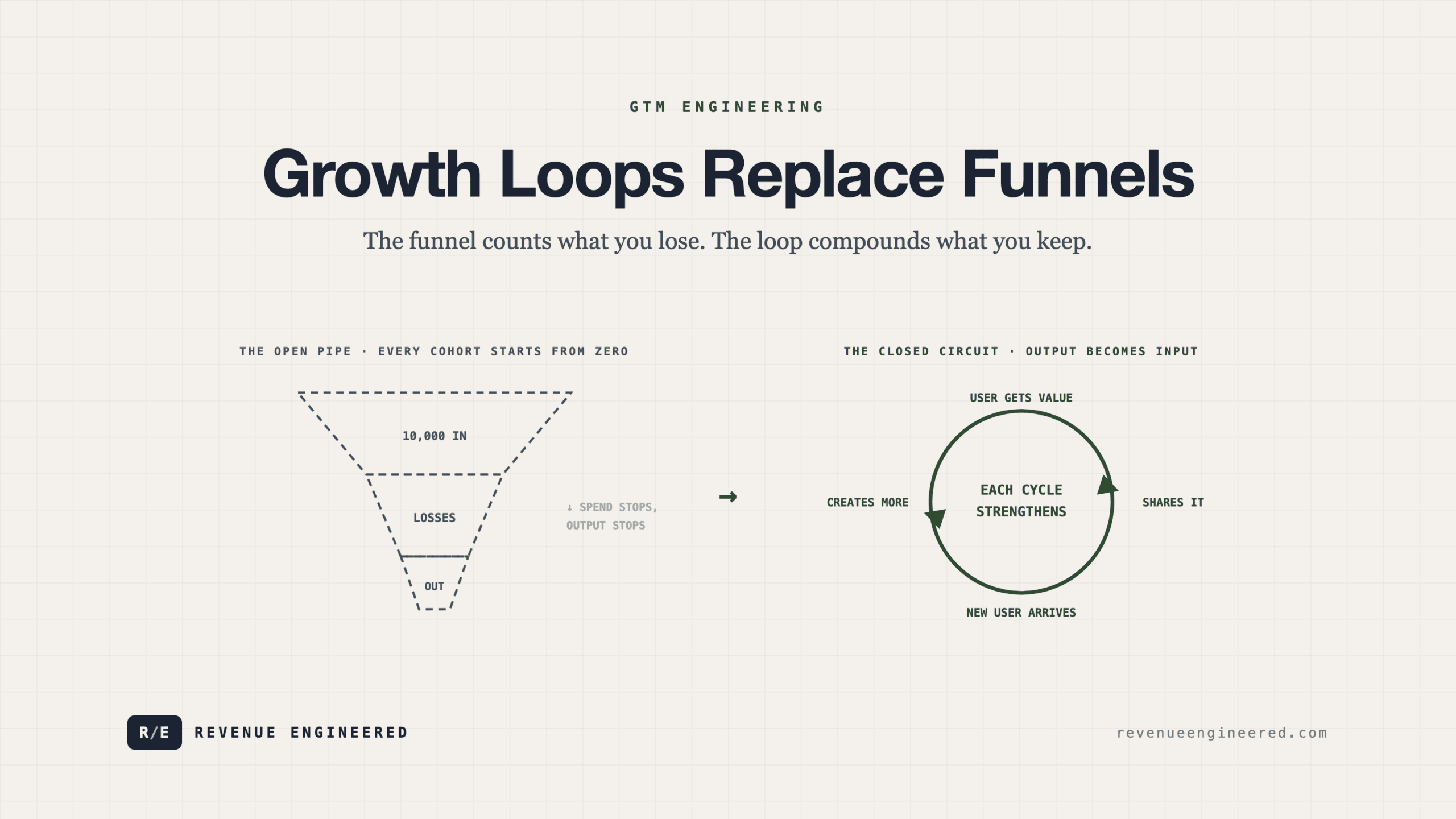
The second is the loss framing. Every funnel stage is defined by its conversion rate, which is another way of saying its loss rate. You start with 10,000 visitors and track how many you lose at each step. This framing trains teams to optimize for reducing losses rather than creating gains. The operational difference is significant. Reducing friction in a checkout flow is a funnel optimization. Building a referral system that turns every new customer into an acquisition channel is a different kind of thinking entirely.
The third is the absence of feedback loops. A funnel is open at both ends. Leads enter the top and either convert or fall out. What it cannot represent is the customer who converts, gets value, and then drives new leads back into the system. That feedback mechanism is where the majority of durable growth comes from, and the funnel model makes it invisible.
The fourth is the isolation of channels. Funnels typically get sliced by acquisition channel: the paid funnel, the organic funnel, the outbound funnel. This creates organizational silos that mirror the model. The paid team optimizes their funnel. The content team optimizes theirs. Nobody is responsible for the system-level interactions between channels, and those interactions are often where the real gains exist.
The fifth is the spending treadmill. Because funnels are linear and open-ended, every cohort starts from zero. The leads you acquired last quarter do not help you acquire leads this quarter (unless you have a loop, but the funnel model does not account for that). This means growth requires continuously increasing inputs. Stop spending on acquisition and the funnel stops producing output. The model treats this as normal. It is actually a design flaw.
The sixth is temporal blindness. Funnels measure snapshots. They tell you what happened to a cohort as it moved through stages. They do not tell you how the system’s capacity changes over time. A company with strong loops is getting more efficient every quarter because each cycle strengthens the next one. A funnel-optimized company can look identical in a point-in-time snapshot and be in a structurally worse position because it has no compounding mechanism.
The seventh, and the one that kills companies, is that funnels hide retention problems. You can have a beautiful funnel with strong conversion rates at every stage and still be dying if the customers coming out the bottom are churning faster than you replace them. Wish is the case study that should be required reading for every growth team. At its peak, Wish was spending hundreds of millions on Facebook and Google ads, driving massive top-of-funnel volume, and posting impressive acquisition metrics. The funnel looked great. But retention was terrible. Customers bought once, had a poor experience, and never came back. The funnel kept telling the team to spend more on acquisition. The loop that should have existed, where satisfied customers drove repeat purchases and referrals, was never built. The company’s market cap went from $14 billion to under $200 million. The funnel did not cause the failure. But it made the failure invisible until it was too late.
What loops actually are
A growth loop is a closed system where the output of one cycle becomes the input of the next. That is the entire definition. The important distinction from a funnel is that loops are self-reinforcing. Each cycle makes the next cycle more effective.
The simplest example is a referral loop. A user signs up, gets value from the product, refers a colleague, that colleague signs up, gets value, and refers someone else. Each new user is both an output (they converted) and an input (they drive future conversions). The system feeds itself.
But referral loops are just one architecture. The more interesting loops are the ones built into the product itself.
A content loop works like this: users create content inside your product, that content gets indexed or shared publicly, new users discover the product through that content, they sign up and create their own content. Notion, Figma, and Canva all run variations of this loop. The product generates its own distribution as a byproduct of normal usage. Nobody in marketing had to write a blog post or buy an ad. The product did it.
A data loop works like this: users provide data through usage, that data improves the product, the improved product attracts more users, who provide more data. Every AI product that gets better with usage is running a data loop. The more people use it, the better it gets, the more people want to use it. This is why AI companies with strong data loops pull away from competitors over time rather than converging with them.
A network loop works like this: each new user makes the product more useful for existing users, which increases retention and word-of-mouth, which attracts more new users. Slack, Zoom, and every communication tool that won its category ran network loops. The product becomes harder to leave as more people join. That is not a marketing outcome. It is a structural one.
The economics are not close
The difference between funnel economics and loop economics is not incremental. It is categorical.
A funnel-driven company has roughly linear growth. If you spend $100K on acquisition and get 500 customers, spending $200K gets you approximately 1,000 customers. Actually, it usually gets you fewer than 1,000 because of channel saturation and rising CPAs. The marginal cost of acquisition tends to increase over time as you exhaust the cheapest segments of your addressable market. Funnel companies face a graph that curves the wrong way.
A loop-driven company has non-linear growth. Each cycle through the loop adds capacity for the next cycle. If 500 customers each refer 0.3 new customers on average, you get 150 additional customers without spending anything on acquisition. Those 150 refer another 45. Those 45 refer another 13. The total acquisition from a single cohort is not 500 but closer to 715. And the next cohort starts with a larger base, so the absolute numbers from each cycle increase even if the referral rate stays flat. The graph curves the right way.
The math gets more dramatic with product-generated distribution. Figma’s community files, shared publicly, function as permanent acquisition assets. Each template, each design system, each shared project is a page that can be discovered, indexed, and converted from indefinitely. The cost of creating that asset was zero to Figma because the user created it for their own purposes. There is no equivalent in funnel economics. There is no paid channel where the cost per incremental impression drops to zero over time.
This is why Casey Winters, who led growth at Pinterest and Grubhub, has argued that product-led acquisition is the only channel that scales long-term. Every other channel degrades. SEO gets more competitive. Paid gets more expensive. Outbound gets noisier. But a product that generates its own distribution improves as it grows because the loops strengthen with scale.
How to build a loop from scratch

How to build a loop from scratch as a maturity path.
If you are sitting in a company that runs on funnels and you want to build loops, here is the practical methodology.
Start by mapping the value chain. Identify every point where your product delivers value to a user. Not where you tell the user about value. Where they actually receive it. For each value moment, ask: does this value stay contained within the user’s experience, or does it naturally spill over to other potential users? A report generated in your analytics tool is contained value. A dashboard shared with a client is spillover. Spillover is where loops start.
Next, identify the natural sharing or exposure mechanism. You are not inventing behavior. You are finding behavior that already exists and building infrastructure around it. If users already share outputs from your product with colleagues, make those outputs carry your brand and a signup path. If users already talk about their results in communities, make those results easy to screenshot and attribute. If your product generates data that improves over time, make that improvement visible so users have a reason to stay and a story to tell others.
Then close the loop by connecting the exposure back to acquisition. The shared dashboard needs a “powered by” link that goes to a landing page optimized for the specific context of someone who just saw that dashboard. The screenshot needs to be legible enough that a viewer can identify and find your product. The referral needs an incentive structure that rewards the referrer at the moment of highest satisfaction, not three emails later when the dopamine has faded.
The most common mistake is trying to bolt a loop onto a product that does not naturally produce shareable outputs. Not every product has a loop. Some products are genuinely single-player experiences with no natural spillover. If that is your product, the honest answer is that your growth will be funnel-driven and you need to be excellent at funnel optimization. Forcing a referral program onto a product with no organic sharing behavior produces a program that nobody uses and a team that gets demoralized chasing vanity metrics.
Measuring loops instead of funnels

Measuring loops instead of funnels translated into operating choices.
The metrics change when you shift from funnels to loops.
Funnel metrics track loss rates: conversion rate per stage, drop-off rate, MQL-to-SQL ratio, lead-to-close rate. These are useful for diagnosing specific breakdowns. They are useless for understanding whether your growth system is getting stronger or weaker over time.
Loop metrics track cycle efficiency and compounding rate. The core metric for any loop is what you might call the loop multiplier: for every cohort that enters the loop, how many additional users does that cohort generate before the cycle dampens to zero? A multiplier above 1.0 means viral growth (each cohort generates more than one additional cohort, and growth is exponential). A multiplier below 1.0 means the loop amplifies growth but does not sustain it independently. Most B2B products operate between 0.2 and 0.6, which means loops are not their sole growth driver but are a meaningful multiplier on top of other channels.
Cycle time matters as much as multiplier. A loop with a 0.4 multiplier and a one-week cycle time will outperform a loop with a 0.6 multiplier and a three-month cycle time. Speed compounds. This is why the best loop-driven companies obsess over reducing time-to-value. Every day between signup and the moment a user produces shareable output is a day of lost compounding.
Track loop contribution as a percentage of total new users. This number tells you how dependent your growth is on paid inputs versus organic compounding. A company where loops contribute 60% of new users has a structurally different cost profile than a company where loops contribute 10%. The first company can survive a budget cut. The second cannot.
The transition is the hard part
The shift from funnel-thinking to loop-thinking is the single biggest mental model upgrade available to GTM teams right now. It is also uncomfortable because it requires admitting that the framework everyone has been using for twenty years optimizes for the wrong thing.
Funnels measure what you lose at each stage. Loops measure what compounds. Those are entirely different orientations toward growth, and they produce different organizations. The funnel-oriented company builds large marketing teams, invests heavily in channel-specific specialists, and treats growth as a spending problem. The loop-oriented company builds product features that generate distribution, invests in reducing time-to-value, and treats growth as a design problem.
You do not have to abandon funnels entirely. Funnel analysis is still useful for diagnosing conversion problems within a loop. But the funnel should be a diagnostic tool, not the mental model that governs your growth strategy. The strategy should be: build loops first, then use funnels to debug them.
The companies that figure this out early have an advantage that compounds, which is fitting, because compounding is the whole point.
Enjoying this essay?
Written by

Elom
GTM, growth, and revenue systems operator with 12 years across Fortune 500s, fintech, and B2B startups. Building at the intersection of AI, data, demand, and revenue.
Get the next deep-dive in your inbox
Essays on demand creation, GTM, growth engineering, and revenue systems. Free.