Revenue Engines Don’t Scale — They Compound
The best GTM teams stopped adding headcount and started building systems with feedback loops
Most revenue organizations are built to scale linearly. You hire ten reps, you get roughly ten reps’ worth of output. You hire twenty, you get twenty. The math is straightforward, and it is also the reason most go-to-market teams plateau. The operating model treats revenue like a labor problem when it is fundamentally a systems problem.
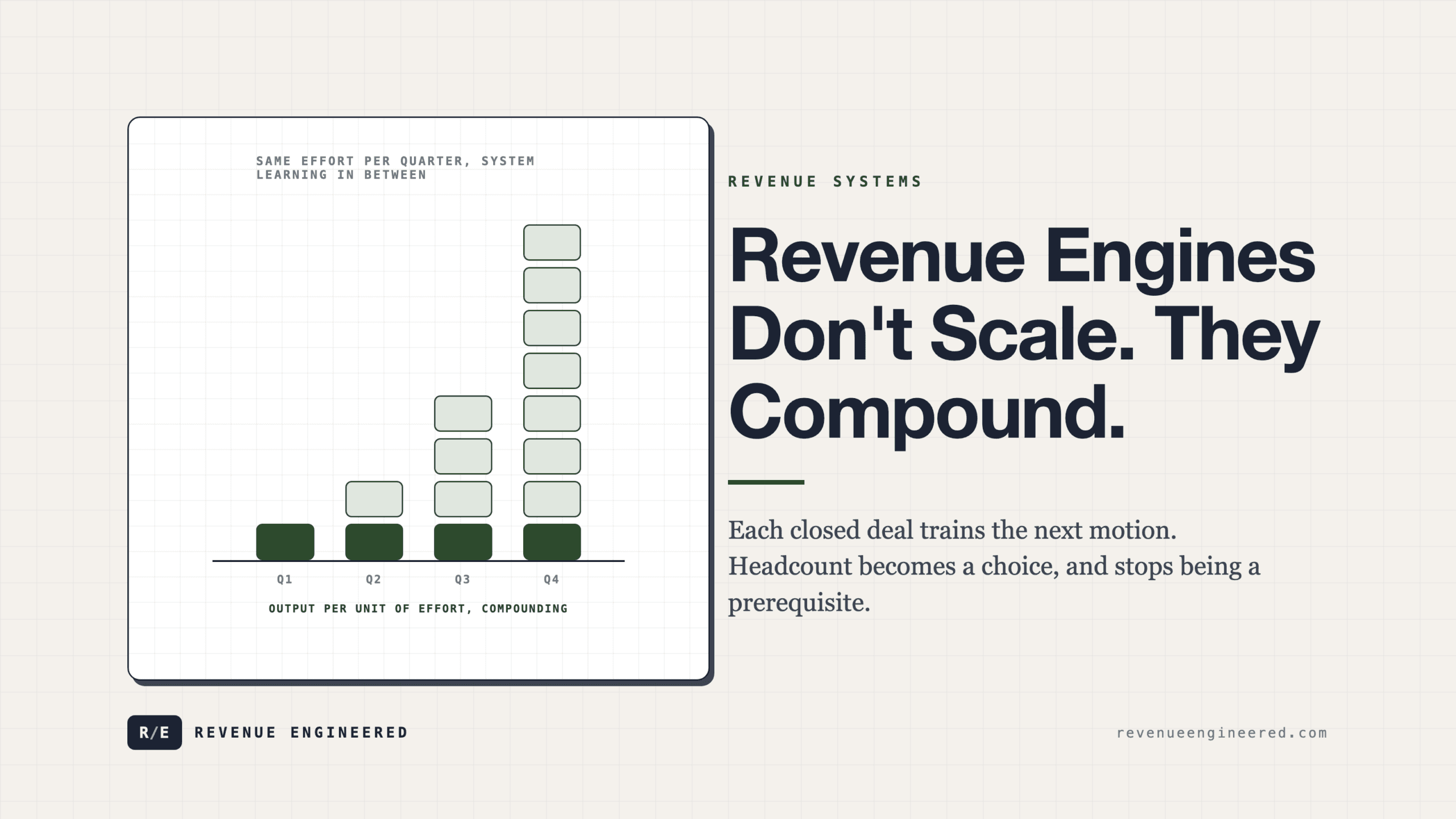
The companies pulling away from the pack right now are not doing it by adding headcount. They are doing it by building revenue systems that get smarter with every cycle. Each closed deal feeds data back into targeting. Each campaign informs the next one’s messaging. Each lost opportunity sharpens the qualification criteria. The output per unit of effort goes up over time without anyone needing to flip a single new seat license.
This is the difference between scaling and compounding. Scaling means doing more of the same thing. Compounding means doing the same thing better every time you do it.
The first ten customers are system design

Linear teams add people. Compound systems learn..
There is a common temptation to treat early customers as a sales problem. Get bodies through the door, worry about process later. This is backwards.
The first ten customers are where you design your revenue system, whether you realize it or not. Every founder who has made it past the initial chaos says some version of the same thing: you need to close those deals yourself. Not because you cannot afford a sales hire, but because those conversations contain the raw signal that every downstream system will depend on. The objection patterns. The words prospects actually use. The moment in the demo where they lean forward or check out.
Founders who hand off selling before they have this signal end up building their entire GTM machine on guesswork. They hire an AE, give them a pitch deck built on assumptions, and wonder why the pipeline stalls at stage two. The founders who sit in those first ten conversations and actually listen walk away with a targeting model and a qualification rubric that no amount of market research could have produced. They also walk away with the exact language their buyers use, which is worth more than any messaging workshop.
This is the compounding principle at its smallest scale. Those ten conversations do not just produce ten customers. They produce the operating logic for the next hundred.
Content is infrastructure, not a channel
The growth teams that treat content as a marketing channel are stuck on the linear treadmill. Write a blog post, get some traffic, repeat forever. The ones treating content as infrastructure are playing a different game entirely.
Infrastructure means your content does work while you sleep. It means a single article written eighteen months ago still generates qualified inbound because it was built around a real problem your buyers have, not a keyword you wanted to rank for. It means your sales team sends prospects to specific pieces mid-cycle because the content answers the exact objection that just came up on the call. It means new hires ramp faster because the institutional knowledge lives in published form.
The best content operations look less like a publishing schedule and more like a compounding asset. Each piece links to others. Each piece captures search intent. Each piece strengthens domain authority. The twentieth article you publish performs better than the first not because you became a better writer, but because the system beneath it has accumulated weight.
Community-driven content takes this further. When you start by finding the exact problems people are posting about in their own words, you skip the product-market fit anguish on the content side. You know what to write because the audience already told you. The content finds its readers because it was designed around conversations they were already having. Build enough of these pieces and you have a self-sustaining acquisition engine where the cost per lead decreases while the volume increases.
That is what compounding looks like in practice.
AI gives small teams massive leverage

Every revenue event should train the next motion..
There is a phrase floating around that captures something real: AI gave you a team of twenty without payroll. This is not aspirational language. It describes what is already happening across the best-run growth operations.
A solo founder or a three-person growth team can now run outbound sequences, generate first-draft content, analyze call transcripts, build reports, and maintain customer communications at a throughput that would have required fifteen people two years ago. The work still requires human judgment at every decision point. But the labor between decision points has collapsed.
What makes this compound rather than merely scale is the feedback loop. AI tools that process your pipeline data get more accurate with each quarter of usage. Models fine-tuned on your win/loss patterns surface better prospects every quarter. Automated reporting catches performance shifts faster than any human review cadence, which means you course-correct sooner and waste less budget.
The old model was to hire your way to coverage. Need to reach more accounts? Hire more SDRs. Need more content? Hire more writers. Need more analysis? Hire more ops people. The new model is to build a system that reaches more accounts, produces more content, and surfaces more analysis because the underlying infrastructure improves with usage. Headcount becomes a choice about where to apply judgment, not a prerequisite for doing work.
This is where staying deliberately small stops being a philosophical position and becomes a structural advantage. Small teams with compound systems outperform large teams on linear treadmills because their cost structure does not grow with their output. Profit margins widen as revenue grows. The founders who resisted premature hiring and poured that budget into system design are the ones sitting on 50% margins while their competitors burn cash on the eighteenth SDR.
Why adding more reps is the wrong answer
The standard revenue playbook goes like this: hit quota, hire another rep, hit quota again, hire two more. It looks like growth because the top-line number goes up. But the unit economics tell a different story.
Every new rep adds coordination cost. They need onboarding, which takes a manager’s time. They need leads, which pressures marketing to produce more volume at the same quality. They need tools, which adds license costs. They need coaching, which fragments leadership attention. The fully loaded cost of a new rep is always higher than the salary line on the offer letter, and the ramp time means you are paying that cost for months before seeing output.
Compare this to investing the same budget in systems that compound. A better lead scoring model does not need onboarding. A content library that generates inbound does not take PTO. An AI-powered sequence engine does not forget to follow up.
The companies that figured this out early did something counterintuitive. They removed themselves from the revenue machine before they felt ready. Not by abdicating responsibility, but by encoding their judgment into systems. They turned their best rep’s call framework into a documented playbook. They turned their top performer’s prospecting logic into a scoring algorithm. They turned tribal knowledge into infrastructure.
The goal was never to build an organization full of people. The goal was to build a machine that runs with fewer people and improves with every cycle.
The compounding checklist

A revenue system compounds when these trends improve..
There is a simple test for whether your revenue operation compounds or just scales. Ask yourself these questions:
Does your cost per lead decrease as volume increases? If every incremental lead costs the same or more, you are on a linear treadmill.
Does your win rate improve quarter after quarter without changing the team? If your conversion only goes up when you hire a better closer, your system is not learning.
Does a new hire reach full productivity faster than the last one? If onboarding time stays flat, your institutional knowledge is locked in people’s heads rather than embedded in process.
Can your team take a week off without pipeline collapsing? If revenue stops when people stop, you built a job, not a system.
Does your content generate more traffic this quarter than last quarter from the same number of published pieces? If organic growth is flat, your content is a channel, not infrastructure.
None of these are technology questions. They are architecture questions. The tools matter, but the design of how they connect, what data flows between them, and how the output of one process feeds the input of the next — that is what separates teams that compound from teams that just grow.
Where this goes
The next generation of revenue teams will look nothing like the current model. They will be small by design, not by budget constraint. They will run on systems that get measurably better every quarter. They will treat every customer interaction as training data for the next interaction. And they will generate more revenue per employee than any team in the previous era thought possible.
We are already seeing the early versions of this. Three-person companies doing what used to take thirty. Solo operators running sophisticated outbound while also producing high-quality content and managing customer relationships. The pattern is consistent: build the system, feed the loops, let it compound.
The organizations still hiring their way to growth targets will eventually realize they are solving the wrong problem. Revenue is not a headcount problem. It is a system design problem. And the teams that figured this out first will be very difficult to catch.
Enjoying this essay?
Written by

Elom
GTM, growth, and revenue systems operator with 12 years across Fortune 500s, fintech, and B2B startups. Building at the intersection of AI, data, demand, and revenue.
Get the next deep-dive in your inbox
Essays on demand creation, GTM, growth engineering, and revenue systems. Free.