The Architecture of Modern Outbound
Why targeting, channel design, and process architecture matter more than copy
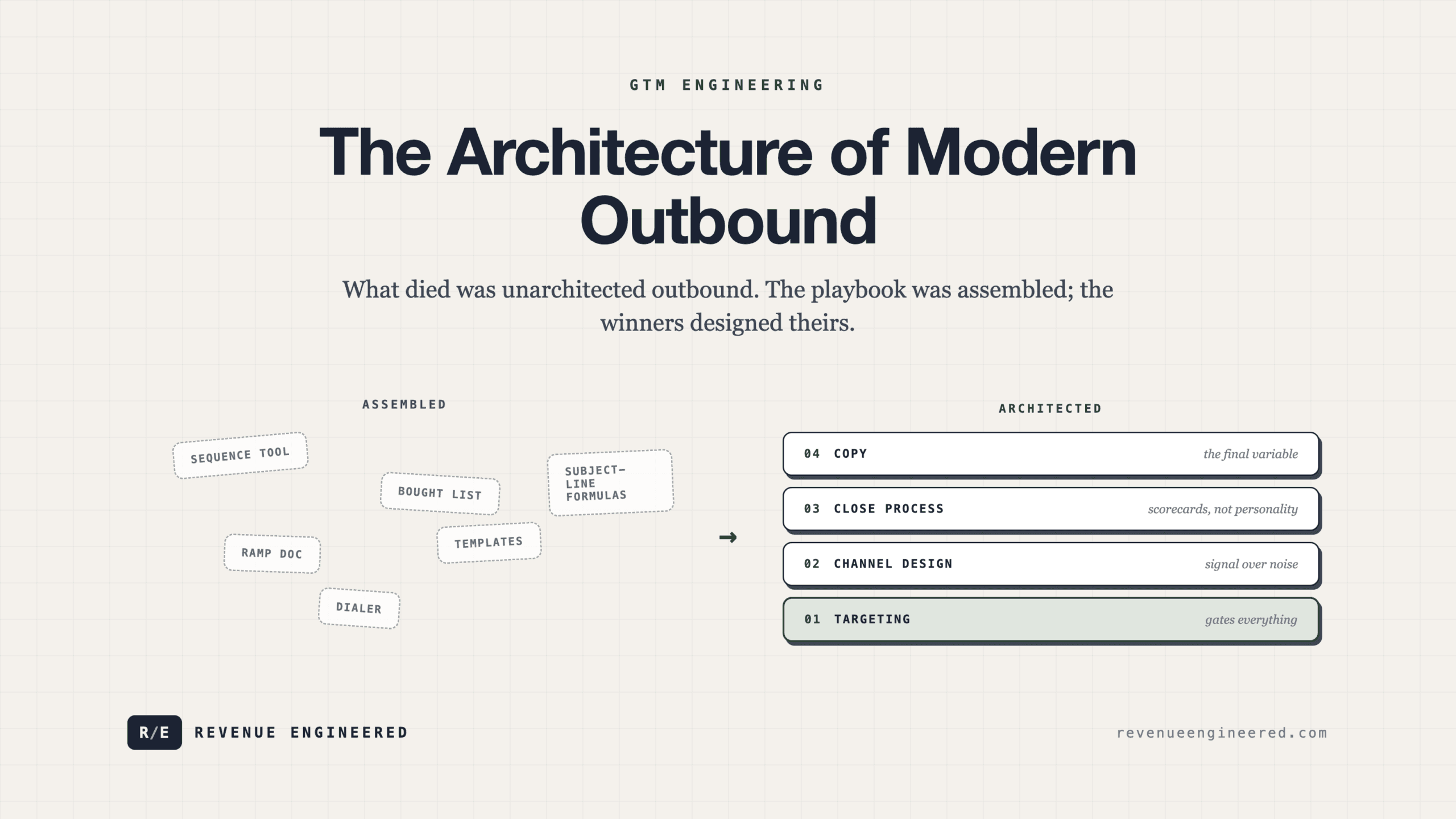
One of the most interesting things happening in B2B right now is the slow collapse of the outbound playbook that dominated the last decade. Not because outbound stopped working. Because the version of outbound that most teams are running was never really designed. It was assembled. Pieces bolted together across tools and templates and SDR ramp docs, with no coherent architecture underneath. And the results look exactly like what you’d expect from an undesigned system: unpredictable, expensive, and almost impossible to diagnose when something breaks.
The standard narrative is that cold email is dead. That buyers are overwhelmed, inboxes are saturated, and the only path forward is inbound content or product-led growth. There is some truth in the saturation claim. But the conclusion is wrong. What’s actually dead is unarchitected outbound, the kind where a rep buys a list of 10,000 contacts, loads them into a sequence tool, and hits send. That approach produces a 0.3% reply rate and a very confident declaration that “cold email doesn’t work anymore.” The problem was never the channel. The problem was that nobody engineered the system.
What’s emerging across the teams that are actually generating pipeline from outbound is a fundamentally different approach. They treat outbound not as a set of tactics but as an architecture, one with distinct layers, each with its own inputs, outputs, and failure modes. Targeting is a layer. Channel selection is a layer. Message construction is a layer. Close process is a layer. And the order matters. You can’t optimize layer three if layer one is broken. This is obvious in retrospect, but almost nobody builds their outbound motion this way, because the industry’s incentive structure rewards selling copywriting courses and sequence templates, not the boring structural work that actually determines outcomes.
The targeting layer

Copy is the final layer, not the foundation.
Here is the uncomfortable math that most outbound teams never confront. If you buy a list of 10,000 contacts and your actual ideal customer profile represents 5% of that list, you have 500 real prospects and 9,500 people who were never going to buy. Your automation tool doesn’t know the difference. Your SDR doesn’t know the difference. Your reply rate looks terrible and everyone blames the copy. But the copy was never the variable that mattered. The targeting was.
We’re seeing teams that run a simple exercise before any outreach begins: take 25 companies, a mix of current customers, active pipeline, and explicitly disqualified accounts, and map each one against ICP attributes. Industry. Revenue range. Team size. Tech stack. Pain indicators. Growth signals. The passing threshold is 90% accuracy. If a rep can’t look at a company and reliably say whether it’s a fit within seconds, they don’t have a real ICP. They have a vague category, and vague categories produce vague results.
The data on this is consistent. A mediocre email sent to a perfect-fit prospect outperforms a brilliant email sent to a mediocre-fit list. Every time. We’ve seen reps triple their reply rates not by rewriting their sequences but by cutting their lists in half and keeping only the accounts that actually match. The math is counterintuitive for anyone raised on the “more volume = more pipeline” doctrine, but it holds up. Two hundred emails to precisely targeted accounts generate more revenue than five thousand emails to a mixed list. The economics work out better in every scenario we’ve tested.
This has real organizational implications. Most revenue teams invest 80% of their enablement time on messaging and 20% on targeting. The ratio should be inverted. Targeting is the load-bearing wall of the entire system. When reply rates drop below 3%, the instinct is to A/B test subject lines. The correct instinct is to audit the list. Almost always, the list has drifted from the ICP, either because the ICP was never precise enough to begin with or because it shifted and nobody noticed.
Channel architecture

Deal velocity rises with channel signal.
The second layer that most teams get wrong is channel design. The default outbound motion is email-only: prospect by email, follow up by email, try to close by email. This ignores the single most important variable in deal velocity, which is signal-to-noise ratio.
Every communication channel has a signal profile. Email is high-noise. A buyer’s inbox has 200 unread messages from people trying to sell them things. SMS has maybe five messages, all from people they actually know. A phone call is real-time, high-bandwidth, impossible to passively ignore. In-person is the highest signal environment available. The channel you’re communicating on is not neutral. It shapes how your message is received, how quickly it gets a response, and whether the prospect treats you as a vendor or a person.
What the best-performing outbound teams do is treat channel selection as an escalation sequence, not a preference. Cold email opens doors. It’s the right tool for first contact because it’s low-friction for both sides. But the moment a live interaction happens, a call, a demo, a meeting, the communication channel should escalate. The protocol we see working: after a first call, get the prospect’s cell number. Immediately text them something simple. “Great connecting today. Wanted you to have my cell.” From that point, the deal runs over text. Not email. Not LinkedIn. Text.
The results of this pattern are significant. Deals that were stalling for weeks over email close within days of moving to text. The reason is structural, not psychological. On text, ignoring you is a conscious act. In email, it’s the default. The channel itself is a qualification filter. High-intent buyers engage on high-signal channels. The prospects who refuse to leave email are frequently the ones who were never going to close. Each rung up the ladder, from email to LinkedIn DM to phone to text to in-person, moves the conversation into a higher-signal environment where momentum compounds.
The objection everyone raises is that prospects will find texting intrusive. The data says the opposite. When you’ve earned the channel through a real conversation, a text signals accessibility and confidence. It puts you in the category of “real person” rather than “sales sequence.” In practice, almost nobody asks to go back to email once the text thread is established.
Process engineering over persuasion
The third architectural layer is close process, and this is where the gap between engineered outbound and ad hoc outbound becomes most visible. Most sales teams treat closing as a moment. A line, a technique, something the rep pulls out at the end of the demo. In reality, closing is a process outcome. If the upstream layers are well-designed, the close should feel like a formality. If it feels like a battle, something went wrong earlier in the architecture.
One pattern we see consistently is the use of a structured scorecard during sales conversations. Ten items, each representing a specific thing that needs to happen during the call. Did the rep identify the prospect’s core pain? Did they get the prospect to articulate the cost of inaction? Did they demonstrate the product against the prospect’s specific use case? Did they establish a decision timeline? Did they confirm the buying process?
The correlation between scorecard adherence and conversion is remarkably clean. Calls that score 4 or below on a 10-point scale convert at roughly 10%. Calls that score 8 or above convert at 30-40%. Close rate is almost entirely a function of process execution, not personality. This has serious implications for how revenue teams should think about hiring and training. The conventional wisdom is that great closers are born, not made. The scorecard data suggests the opposite: closing is a repeatable process that can be taught, measured, and improved systematically.
There’s a secondary technique worth noting for the “I need time to think” stall, which is the most common momentum killer in B2B sales. Instead of following up with pressure or going silent, the approach is to send a short form framed as a waitlist. “No rush. I’ll add you to the waitlist for next month. Just fill this out so I have your details, and note what you’re mainly hoping to solve.” The form asks for basic info plus one open-ended question about their core problem. The act of writing out their problem in their own words creates commitment. They articulate the pain, see it on screen, and realize they need to solve it. Roughly 60% of people who fill out that form come back ready to buy. They close themselves while thinking they’re waiting in line. The psychology here is well-documented: self-generated arguments are more persuasive than external ones. The form just creates the conditions for that self-persuasion to happen.
The copy question

Most of the reply-rate equation is decided before copy.
Here is where we have to be honest about something the outbound industry does not want to hear. Copy matters far less than the cold email ecosystem suggests. The reason is structural: the people who teach cold email make money selling copywriting courses, not targeting courses. The incentive is to overweight the variable they can monetize.
In practice, the hierarchy of impact in a cold email looks roughly like this. Relevance, whether this person is actually a fit, accounts for about 70% of whether you get a reply. Timing, whether something is happening in their world right now, accounts for maybe 20%. Clarity and tone split the remaining 10%.
The best-performing cold emails we’ve observed, the ones that produce 40%+ reply rates, were optimized for situational relevance, not copywriting. Not “I noticed your LinkedIn post from six months ago.” Something happening in the prospect’s world at that exact moment. A product launch. A hiring spree. An industry shift. Situational relevance outperforms template personalization by a wide margin because it demonstrates that you understand their context, which is the only thing a cold email actually needs to prove.
The email itself should be short. Three to five word subject line, lowercase, no punctuation tricks. One line of situational context. One problem, framed in their language. One ask, low-friction, a 15-minute call or a yes/no question. If they need to scroll, it’s too long. The goal of the email is to start a conversation, not make a sale. Feature dumps, case studies, and walls of text all fail because they try to compress the entire sales process into a medium that only needs to accomplish one thing: earning the next interaction.
Infrastructure economics
Something deeply underappreciated about modern outbound is how radically the infrastructure economics have shifted. A single SMTP inbox costs less than a team dinner and can send 15,000 emails a month. Even a 2% reply rate on that volume creates real pipeline. The barrier to entry for serious outbound has collapsed to near zero, which means the differentiator is no longer access to tools. It’s the quality of the architecture sitting on top of those tools.
This is why pricing and list-building deserve mention as downstream layers in the outbound architecture. Most founders set a price once based on competitor analysis and gut feel, then never revisit it. The teams running engineered outbound treat pricing as a live experiment. Launch at a conservative point, raise the price at regular intervals, and track the conversion curve. Most founders underprice by 40-60%, not because they’re generous, but because they anchor to what feels safe rather than what the market will actually bear.
And every prospect who doesn’t convert today should flow into a newsletter, a compounding asset that transforms cold outreach into warm pipeline over time. The newsletter has to be good enough to stand alone, so good that someone would subscribe even if they’d never heard of your company. When it’s time to sell, you’re no longer cold-emailing a stranger. You’re emailing someone who’s been reading your thinking for months. That is a fundamentally different sale.
What this means going forward
The outbound teams that will win over the next three to five years are the ones that treat their go-to-market motion as a designed system rather than a collection of inherited tactics. The layers matter. The order matters. Targeting gates everything. Channel design determines velocity. Process architecture determines conversion. Copy is the final variable, not the first one.
The industry will continue to sell subject line formulas and sequence templates because that’s what’s easy to package. But the real leverage lives in the structural decisions that happen before a single email gets written. The organizations that figure this out will operate at a fundamentally different efficiency than the ones still optimizing the wrong layer of the stack. Outbound is not dying. It’s being re-architected. And the teams doing the re-architecture are quietly building a compounding advantage that will be very difficult to reverse-engineer from the outside.
Enjoying this essay?
Written by

Elom
GTM, growth, and revenue systems operator with 12 years across Fortune 500s, fintech, and B2B startups. Building at the intersection of AI, data, demand, and revenue.
Get the next deep-dive in your inbox
Essays on demand creation, GTM, growth engineering, and revenue systems. Free.