Product-Led Sales: The Blueprint for Marrying Self-Serve With an Enterprise Motion
How the best B2B companies run PLG and sales-led simultaneously without breaking either
The default mental model for B2B go-to-market has been a binary choice for as long as most operators can remember. You either build a self-serve product that acquires users at low cost and monetizes them through usage-based pricing and upgrade paths. Or you build a sales-led organization that targets named accounts, runs demos, negotiates contracts, and closes six-figure deals. The assumption was that these were two different businesses requiring two different organizational architectures, two different hiring profiles, and two different ways of thinking about the customer.
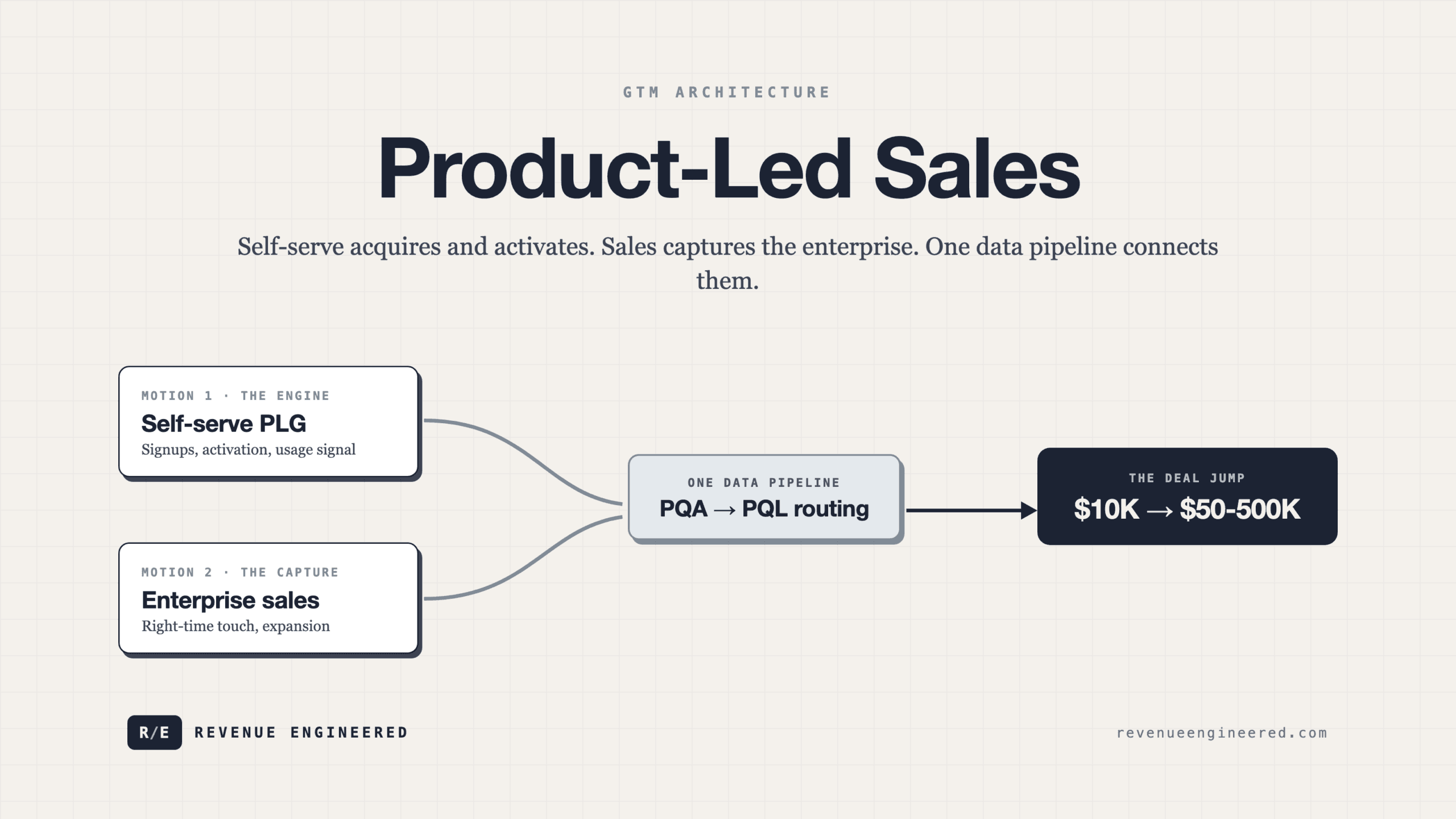
That assumption is wrong, and the evidence at this point is overwhelming. The fastest-scaling B2B companies of the last decade have all converged on the same structural pattern: product-led growth as the acquisition and activation engine, with a sales motion layered on top to capture the enterprise revenue that self-serve alone cannot reach. Datadog, Figma, Slack, Notion, HubSpot, Miro, Amplitude. Different categories, different price points, same underlying architecture. Product usage generates signal. Signal feeds qualification. Qualification activates a sales team that engages users who already know and trust the product. This is product-led sales (PLS), and it is the dominant GTM architecture for B2B software in 2026.
But getting there is hard. Most companies that attempt the transition from pure self-serve to PLS, or from pure sales-led to PLS, break something in the process. They either hire salespeople too early and destroy the product experience that was generating organic growth, or they bolt on a freemium tier to their sales-led product and wonder why nobody converts. The failure rate is high because PLS is a systems problem, not a hiring problem or a pricing problem. It requires changes to product instrumentation, qualification frameworks, organizational design, and compensation structures, all simultaneously.
Why the binary model fails

Why the binary model fails reframed as system design.
The split between PLG and sales-led made more sense in the early 2010s, when B2B sorted cleanly into two segments. Small businesses bought self-serve tools on credit cards. Enterprises bought through procurement processes with long sales cycles. The mid-market was thin and ambiguous.
That has changed. The mid-market segment (companies between 100 and 1,000 employees) has undergone the biggest transformation. These companies have enough budget to justify a sales touch, but their employees also have enough autonomy to try new tools without going through formal procurement. A designer at a 300-person company can sign up for Figma, invite five teammates, and build a meaningful usage pattern before anyone in IT or finance even knows the tool exists. That bottom-up adoption creates something that traditional sales-led companies never had: a warm pipeline of accounts with existing product usage, existing champions, and existing proof of value.
The numbers make the economics obvious. Self-serve acquisition for SMB customers typically lands at $10 to $100 per month, which caps out at around $10K in annual contract value. At that level, it is unprofitable to assign a sales rep. But when self-serve usage spreads across a mid-market or enterprise organization, the potential deal size jumps to $50K-$500K+. That is profitable territory for a sales motion, and the cost of acquisition is a fraction of what it would be through outbound prospecting, because the product already did the selling.
The PQA and PQL framework
The system that makes PLS work depends on two layers of qualification: product-qualified accounts (PQAs) and product-qualified leads (PQLs). These are distinct concepts, and conflating them is one of the most common mistakes.
A PQA is an account-level signal. It answers the question: does this company have enough usage volume, velocity, and breadth to suggest they could benefit from an enterprise plan? The inputs are things like: how many unique users from the same company domain have signed up, how frequently are they using the product, which features are they engaging with, and how quickly is usage growing. A company where 15 people from the same domain signed up in the last 30 days, with daily active usage across multiple workspaces, is a PQA. A company where one person signed up and logged in twice is not.
A PQL is an individual-level signal. It answers a different question: who within that account is the right person for sales to contact? The end user who adopted the product first is often not the economic buyer. They are the champion. The PQL process involves identifying the person who has budget authority, usually through a combination of onboarding profiling (asking role and department during signup), product behavior (who is adding users, adjusting settings, exploring admin features), and third-party enrichment (matching email domains to org charts).
The progression works like this: product usage data generates PQAs. PQAs get enriched with firmographic and behavioral data to score them. Scored PQAs that cross a threshold get routed to sales. The sales team then works to identify a PQL within that account, either by finding a hand-raiser (someone who proactively requested pricing or a demo) or by engaging the champion to gain an introduction to the economic buyer.
The distinction matters operationally. If you send every PQA straight to an AE without identifying a PQL, the AE will waste cycles trying to figure out who to talk to. If you skip PQA scoring and send every user who signs up to sales, you will flood the pipeline with low-fit accounts and train your sales team to ignore product-sourced leads entirely. We’re seeing this mistake at nearly half the companies that attempt PLS for the first time. The sales team gets a few hundred “leads” from the product, discovers that 90% of them are individual users with no buying authority and no budget, and concludes that product-led leads are garbage. That conclusion becomes organizational canon, and the PLS initiative dies.
The timing problem
When to engage a self-serve user with a sales touch is the hardest question in PLS, and the answer has enormous consequences in both directions.
Reach out too early and you create friction in the product experience. A user who signed up five minutes ago, explored two features, and just started building their first workflow does not want a call from a sales rep. They are still evaluating. They have not yet experienced the product’s value. An unsolicited outreach at this point feels like spam, and it creates negative brand association at the exact moment when the user’s impression of the product is being formed. The data on this is consistent: premature sales outreach on self-serve users reduces overall free-to-paid conversion by 15-30%, depending on the product category.
Reach out too late and you miss the buying window. Users who have already spread the product through their team, built workflows around it, and decided it meets their needs will often self-serve to a paid plan or decide to stick with the free tier. By the time sales engages, the user has already formed their opinion about what the product is worth. Trying to upsell them to a $50K enterprise plan when they have been happily paying $200/month on a team plan is an uphill conversation.
The signal that matters is velocity of usage growth at the account level. A single user’s engagement is noisy. But when an account goes from 3 users to 12 users in two weeks, when the number of active workspaces doubles, when someone from the account visits the pricing page and the security documentation on the same day, those are buying signals. The best PLS operations track a composite score that combines usage volume, expansion velocity, and website engagement, and they only trigger a sales touch when the composite crosses a threshold.
In practice, the typical timeline looks like this. Users sign up and enter a fully self-serve experience. Product data is collected from day one. Around the 14-30 day mark, account-level patterns start to emerge. If the account clears the PQA threshold, it enters a nurture track: in-product prompts about enterprise features, targeted content about security and admin capabilities, maybe a soft email offering a product consultation (not a demo, not a pitch). If the account shows acceleration signals (rapid user growth, pricing page visits, or a direct hand-raise), it gets routed to an AE. The entire process from first signup to first sales conversation is typically 30-90 days for mid-market and 60-180 days for enterprise.
Companies that got it right (and wrong)

Companies that got it right (and wrong) as a maturity path.
Figma is the clearest example of PLS executed well. Designers adopted the product individually because it solved a real problem (collaborative design in the browser). Teams formed organically around shared projects. Usage data gave Figma precise visibility into which companies had broad adoption. When it came time for an enterprise conversation, the product had already proven its value across dozens of users, and the champion (usually a design lead) was prepared to advocate internally. Figma’s path from self-serve to enterprise produced deals with ACVs above $100K, fed entirely by bottom-up adoption. The 2022 acquisition bid from Adobe valued the company at $20 billion, and the engine behind that valuation was PLS.
Datadog followed a similar pattern in infrastructure monitoring. Developers installed the agent to monitor a few servers. Usage expanded as more infrastructure got instrumented. Datadog’s product data showed exactly when a company’s monitoring footprint crossed the threshold where a self-serve credit card plan no longer made sense and an enterprise agreement with volume discounts became the logical next step. Their sales team engaged with accounts that already had deep product dependency. The result: 130% net revenue retention and an average annual revenue per customer above $20K as of their last earnings.
Slack’s trajectory shows both the promise and the risk. Bottom-up adoption among individual teams was explosive. The product spread virally through workspaces. But Slack’s enterprise motion took longer to develop than it should have, and Microsoft Teams entered the market with a top-down distribution advantage through Office 365 bundling. Slack eventually built a PLS motion that worked, but the delay cost market share in the enterprise segment that a faster-moving PLS operation might have captured.
The cautionary tales are equally instructive. Several well-funded B2B companies have tried to bolt a sales team onto a PLG product too early. They hire five AEs before they have 50 PQAs per month, and the reps spend their time cold-calling because the product pipeline cannot keep them busy. Sales-led habits take over. The reps start requesting that marketing generate outbound leads. The product team gets pulled into building sales-enablement features instead of the self-serve experience that was driving growth. Within twelve months, the company is effectively sales-led with a free tier that nobody on the sales team cares about. The PLG motion atrophies, and with it, the organic growth engine that justified the company’s valuation.
Organizational design: where PLS teams sit
The most common failure in PLS organizational design is treating it as a sales initiative. When the PLS team reports to the VP of Sales, the gravitational pull toward traditional sales metrics (pipeline, quota, close rate) distorts the motion. Reps start pitch-slapping every signup. Product usage data gets ignored in favor of BANT qualification. The product experience degrades because sales pressures product to add friction (require a demo, gate features, force contact with sales to access pricing).
The companies that execute PLS well typically structure it in one of two ways. The first model places PLS under a growth or GTM operations function that sits between product and sales. This team owns the data pipeline from product usage to sales qualification. They build the PQA/PQL scoring models, design the nurture tracks, and manage the handoff to AEs. The AEs still report to sales leadership, but the pipeline they receive has been qualified by a team that understands product behavior, not just firmographic fit.
The second model, which is gaining traction among companies like Clay and others with strong GTM engineering cultures, replaces the traditional SDR/AE split with a hybrid role sometimes called a “GTM engineer.” This person is product-literate enough to have a substantive conversation about the user’s workflow, technical enough to understand integration and deployment questions, and commercially savvy enough to navigate a deal. They function as consultants, not closers. The value they provide in the sales conversation is product expertise, not persuasion.
Compensation is where most PLS structures break. If AEs are compensated on new logo acquisition, they will ignore expansion opportunities within existing self-serve accounts. If they are compensated only on ACV, they will push for the largest deal possible instead of right-sizing the contract to the customer’s actual usage. The PLS-native compensation model uses a combination of logo and expansion quotas, with a heavy weight on net revenue retention. Some companies have moved to account-level compensation, where the AE is rewarded based on the total growth of their account portfolio, including organic self-serve expansion they did not directly influence. This aligns the AE’s incentives with the PLG motion instead of placing them in conflict.
The data infrastructure nobody talks about

data infrastructure nobody talks about translated into operating choices.
PLS does not work without product analytics that are instrumented at the account level, not just the user level. Most PLG companies start with user-level analytics: DAU, feature adoption, activation rate. These metrics tell you whether the product is working for individuals. They do not tell you whether an organization is adopting the product in a way that suggests enterprise-readiness.
The infrastructure required includes: domain-level account mapping (grouping individual users by company), account-level usage aggregation (total users, total actions, feature breadth across the account), expansion velocity tracking (growth rate of users and usage within an account over time), and behavioral triggers (pricing page visits, security doc views, admin feature exploration, API key generation). This data needs to flow into a CRM or a dedicated PLS platform where it can be scored, prioritized, and surfaced to the right rep at the right time.
Building this is not a weekend project. The companies that do PLS well typically spend 6-12 months instrumenting their product and building the data pipeline before they hire their first PLS-dedicated sales rep. The ones that rush to hire reps before the data infrastructure exists are the ones that fail most predictably.
Where this is heading
The PLS architecture is becoming the default for B2B SaaS, not the exception. AI is accelerating this shift in two ways. First, AI-powered products naturally start with individual users (a developer using an AI coding assistant, a marketer using an AI writing tool), creating bottom-up adoption patterns that feed PLS motions. Second, AI is making the PLS data infrastructure cheaper to build. Usage signals that used to require custom instrumentation can now be captured through AI-native analytics platforms. Scoring models that required a data science team can now be built with off-the-shelf ML tools.
The companies that will win the next decade of B2B are the ones that design their GTM architecture around this reality from day one. Not PLG or sales-led. Not PLG then sales-led. Both, simultaneously, with a data pipeline connecting them. The product sells itself to individuals. The sales team sells the enterprise contract to organizations. And the system that connects those two motions is the actual competitive advantage.
Enjoying this essay?
Written by

Elom
GTM, growth, and revenue systems operator with 12 years across Fortune 500s, fintech, and B2B startups. Building at the intersection of AI, data, demand, and revenue.
Get the next deep-dive in your inbox
Essays on demand creation, GTM, growth engineering, and revenue systems. Free.