The Distribution Reset: Every Channel Is Dying and What Comes Next
Organic, paid, social, content — all structurally degrading. The question is whether the channel model itself is ending.
I have been tracking channel performance across about 40 B2B SaaS companies for the past two years. The data tells a story that nobody in marketing wants to hear: every major distribution channel is degrading simultaneously. The cause is structural, not a temporary dip from one algorithm change or one economic cycle. Distribution itself is shifting, and it requires a different kind of response than “find the next channel.”
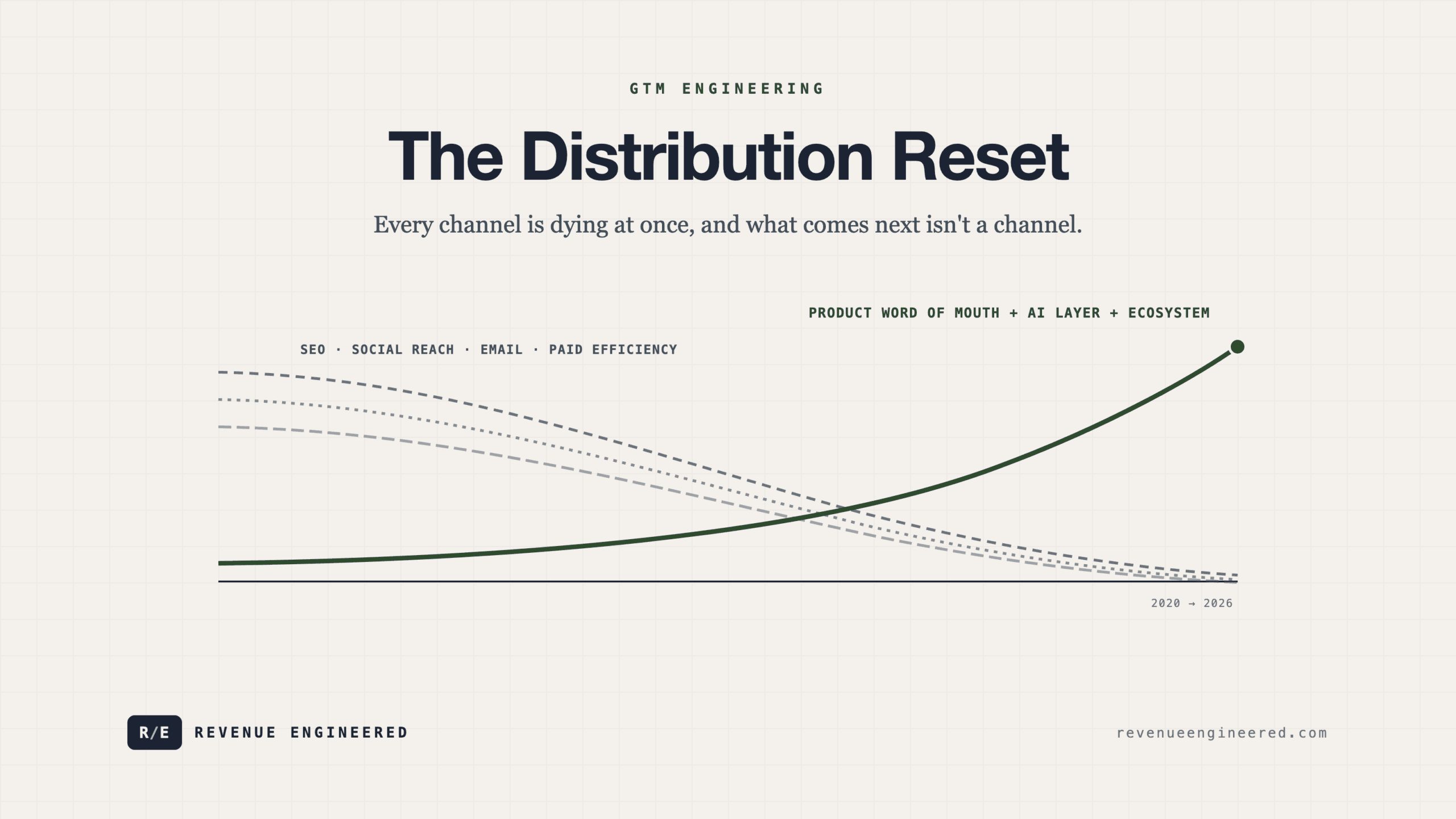
Google organic traffic is down across the board. LinkedIn organic reach has fallen off a cliff. Email open rates are sliding. Paid acquisition costs are climbing. Content marketing, the darling of the last decade, produces diminishing returns for most companies. Every channel that B2B teams rely on is getting harder, more expensive, and less reliable at the same time.
The instinct is to look for the next untapped channel. That instinct is wrong. The problem is not that the channels are underperforming. The problem is that channels degrade as a structural property of how markets work, and we may be approaching the end of the channel-first distribution model entirely.
The degradation thesis

degradation thesis reframed as system design.
Every marketing channel follows the same lifecycle. Someone discovers it works. Early adopters get outsized returns because competition is low and the audience is unsaturated. Success stories spread. More companies pile in. The platform adjusts its algorithm (or the audience adjusts its attention). Returns decline. The channel reaches equilibrium at a fraction of its early performance, then continues degrading as competition increases and attention fragments.
This pattern is not new. Email marketing went through it. SEO went through it. Facebook ads went through it. Content marketing went through it. The difference in 2026 is that every major channel is hitting the degradation phase at once, and there is no obvious “next channel” absorbing the displaced demand.
The driver is attention saturation. There are a finite number of B2B buyers. There are an effectively infinite number of companies trying to reach them. Every channel eventually becomes so crowded that the cost of standing out exceeds the value of the attention captured. This is a mathematical certainty, not a hypothesis. The only variable is how long each channel takes to reach that point.
AI is accelerating the degradation cycle. Content marketing took roughly a decade to go from “secret weapon” to “table stakes.” AI-powered content generation compressed the next wave of saturation into eighteen months. Every company can now produce competent content at volume. When everyone has a blog publishing three articles a week, the blog ceases to be a differentiator. It becomes noise.
The specific channels, specifically
Let me be concrete about what is happening.
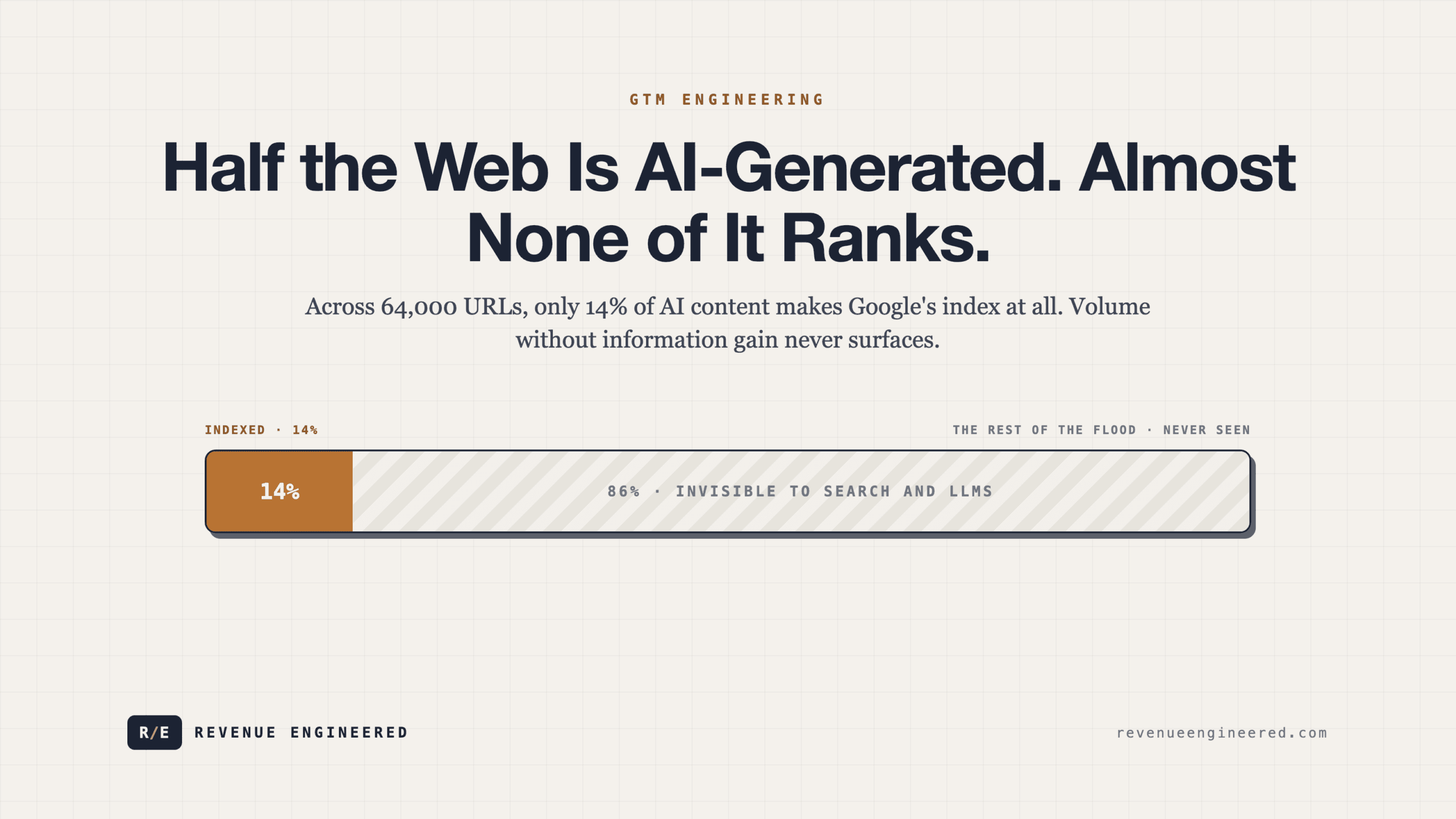
Google organic search is being restructured from the ground up. AI Overviews now appear on a growing percentage of queries, answering the question directly inside the search results page. For informational queries (the bread and butter of B2B content marketing), click-through rates have dropped significantly. A study of 64,000 URLs found that only 14% of AI-generated content appears in Google’s index, and only 18% of indexed URLs get cited by ChatGPT. The relationship between “content that ranks” and “content that generates business value” is weaker than it has ever been.
Company blogs, as a category, are dying. The traditional content marketing playbook (publish keyword-targeted articles, build domain authority, capture organic traffic, convert with gated content) worked when there were information gaps for content to fill. Those gaps are largely filled. Google’s helpful content updates have devalued generic informational content. And the audience has shifted its research behavior to AI tools, peer networks, and community spaces that content marketing cannot reach.
LinkedIn organic reach peaked in 2023 and has been declining since. The platform has progressively throttled organic distribution to push companies toward paid. Engagement pods, which artificially inflated reach numbers, trained the algorithm to reward engagement signals that do not correlate with business outcomes. Teams that built their distribution strategy around LinkedIn organic are watching their impression counts slide by 30-50% year over year with no obvious fix.
Marketing attribution, the system that is supposed to tell you which channels are working, is itself broken. Multi-touch attribution models depend on being able to observe the buyer’s journey across touchpoints. When 70-80% of that journey happens in untrackable channels (dark social, DMs, Slack communities, AI conversations), the attribution data describes a fraction of reality. Companies are making million-dollar channel allocation decisions based on data that is structurally incomplete. The channel that “drives the most pipeline” in your attribution model might be the channel you happen to measure best, not the channel that actually influences the most buying decisions.
Paid acquisition costs are rising across every platform. Google Ads CPCs in B2B categories have increased 15-25% year over year for the past three years. Meta ads face the same pressure. The bid-up is relentless because more companies are competing for the same finite inventory of high-intent impressions. Companies that achieved efficient paid acquisition in 2022 are finding those same economics unsustainable in 2026.
The end of the billion-user ad-supported model
Zoom out further and there is an even larger shift underway. The venture-backed model of building companies to a billion users through ad-supported distribution is breaking down.
For two decades, the playbook was clear: raise capital, acquire users through paid and organic channels, monetize attention through advertising, reinvest in more acquisition. Facebook, Google, Twitter, and their ecosystem of ad-supported startups proved the model at scale.
That model depended on cheap acquisition, high engagement, and growing ad budgets. All three assumptions are failing at the same time. Acquisition is expensive. Engagement is fragmenting across an expanding number of platforms. Ad budgets are under scrutiny as companies demand measurable ROI from every dollar.
The implication for B2B is indirect but real. The platforms that B2B companies use for distribution (Google, LinkedIn, Meta) are under pressure to extract more revenue from each impression. Their incentives are shifting from “help companies reach audiences efficiently” to “maximize revenue per impression.” That means higher costs, lower organic reach, and more aggressive monetization of every surface. The platforms are not your distribution partners. They are your landlords, and the rent is going up.
What attribution cannot tell you

What attribution cannot tell you as a maturity path.
I want to spend a moment on attribution because it distorts how companies think about channel strategy. If your measurement system is broken, your optimization is broken, and everything downstream compounds the error.
Here is the core problem. Last-touch attribution says the demo request came from a Google ad. But the buyer had already seen your founder’s LinkedIn post, heard you mentioned on a podcast, read about you in a Slack community, and asked ChatGPT about your category before they ever clicked that ad. The ad gets 100% credit. The other four touchpoints get zero. Your budget flows toward ads and away from the activities that actually generated the demand.
Multi-touch attribution tries to fix this by distributing credit across observed touchpoints. But it can only distribute credit to touchpoints it can observe. The podcast? Untrackable. The Slack community? Untrackable. The ChatGPT conversation? Untrackable. The LinkedIn post viewed but not clicked? Untrackable. Multi-touch attribution distributes credit across the 20% of the journey it can see and presents that as a complete picture.
Companies are making eight-figure annual budget decisions on this data. The attribution model says content marketing drives 8% of pipeline. Maybe it does. Maybe it drives 30% and the attribution model cannot see it. You genuinely do not know, and the tools cannot tell you.
This is not a temporary tooling gap. It is a structural property of how modern buying works. Buyers research in private. They form opinions in spaces your analytics cannot reach. By the time they take an observable action on your property, the decision is largely made. Attribution captures the last mile of a marathon and calls it the race.
What comes next
If every channel is degrading and attribution cannot tell you which ones are actually working, what do you do? This is the question I have been wrestling with, and I think the answer has three parts.
The first part is accepting that the only durable distribution advantage is the product itself. Channels come and go. Algorithms change. Costs increase. The one constant is whether your product delivers enough value that customers talk about it. Word of mouth is the original distribution channel and the only one that does not degrade over time. It actually compounds. Every happy customer becomes a distribution node that requires zero marketing spend to activate. The companies that survive every channel reset are the ones whose products are actually excellent. Call it a product insight with marketing implications.
The second part is building for the AI distribution layer. While traditional channels degrade, a new discovery layer is forming through AI search platforms. ChatGPT, Perplexity, and Gemini are becoming primary research tools for B2B buyers. Traffic from AI search converts at dramatically higher rates (the data suggests 6x) because users arrive with higher intent and more context. Generative Engine Optimization (GEO) is the emerging discipline for this layer, and it requires different signals than traditional SEO. Being cited by AI models requires original research, named frameworks, and distinctive claims that LLMs can reference. This is not a mature channel yet, which is precisely why the early-mover advantage is significant.
The third part is shifting from channel strategy to ecosystem strategy. Instead of asking “which channel should we invest in,” the better question is “where does our audience already pay attention, and how do we become part of that environment?” This means investing in community presence over content production. It means building relationships in the spaces where buying decisions actually form, even if those spaces are untrackable. It means accepting that some of your most effective distribution activities will never appear in an attribution report.
The uncomfortable math

uncomfortable math translated into operating choices.
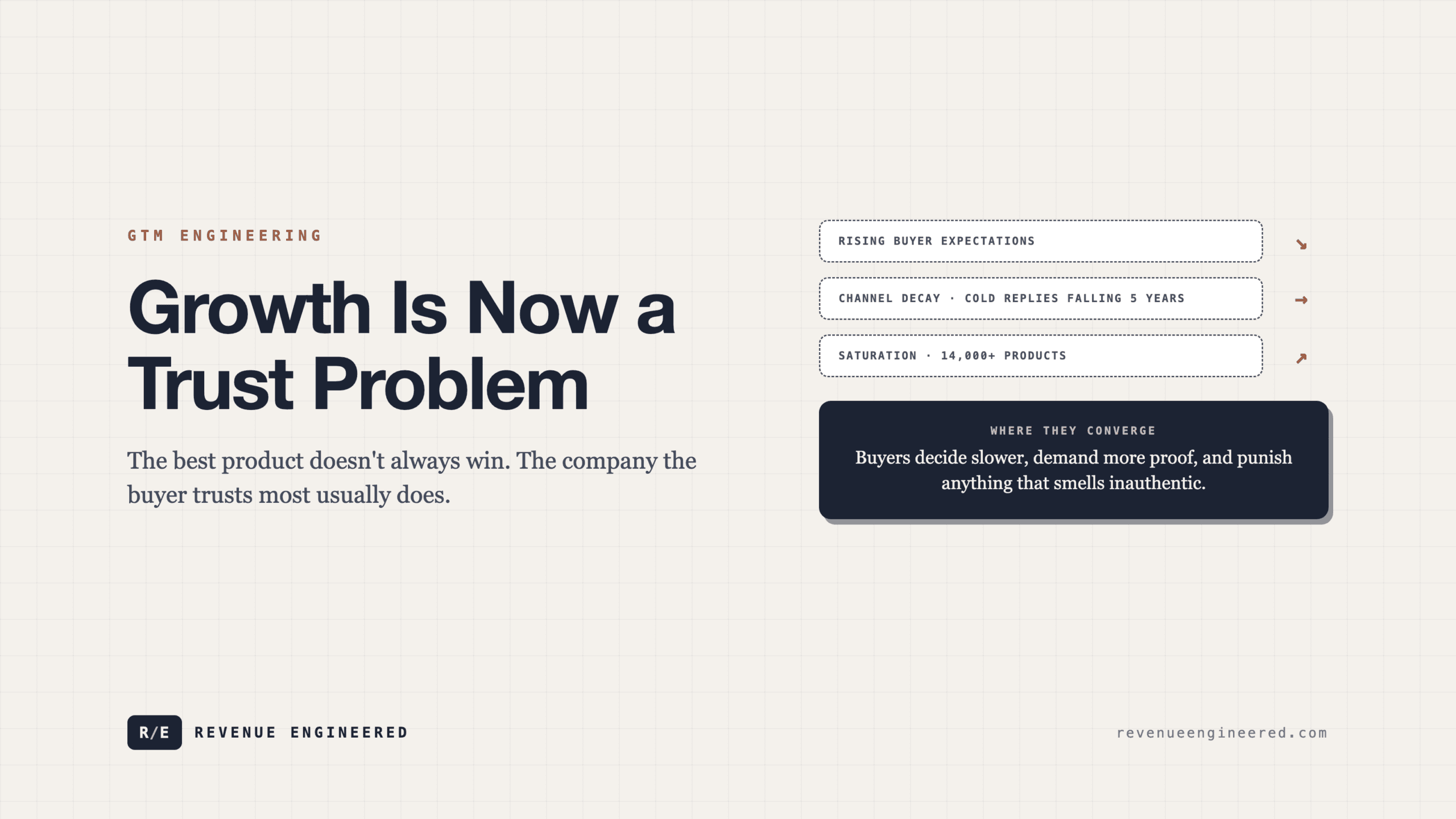
This is what makes it hard. Channel-based marketing is measurable (imperfectly, but measurably). Ecosystem-based distribution is largely unmeasurable. Every CFO, every board, every investor wants to see pipeline attributed to specific spend. Moving budget from measurable-but-degrading channels to unmeasurable-but-effective activities is a career risk that most marketing leaders will not take.
The companies making this transition are doing it by running a dual system. They maintain their channel investments at reduced levels to keep the measurable pipeline flowing. Simultaneously, they invest in ecosystem activities (community, partnerships, thought leadership, product quality) that generate demand through invisible channels. They accept that a growing percentage of their pipeline will be attributed to “direct” or “organic” with no further explanation, and they are okay with that because total pipeline grows even as attributed pipeline from specific channels declines.
This requires a different kind of marketing leader. Someone comfortable operating without full visibility into what is working. Someone who can make investment decisions based on leading indicators (brand awareness, share of voice in communities, product NPS, referral rates) rather than trailing indicators (MQLs, attributed pipeline, channel ROI). The playbook era of marketing, where you could follow a proven channel strategy and produce predictable results, is ending.
The reset is the opportunity
Every distribution reset creates a window where the incumbents are still optimizing for the old model and the insurgents are building for the new one. We are in that window now.
The companies that will emerge from this reset with durable distribution advantages are doing three things. They are building products good enough to generate organic word of mouth. They are investing in AI search visibility before the channel becomes crowded. And they are embedding themselves in the communities and ecosystems where their buyers actually make decisions, without waiting for attribution to validate the investment.
The channels are not coming back. The next iteration of B2B distribution will look structurally different from the one we are leaving behind. The companies that recognize this earliest will build the systems that define the next era. The ones waiting for their existing channels to recover will be waiting for a long time.
Enjoying this essay?
Written by

Elom
GTM, growth, and revenue systems operator with 12 years across Fortune 500s, fintech, and B2B startups. Building at the intersection of AI, data, demand, and revenue.
Get the next deep-dive in your inbox
Essays on demand creation, GTM, growth engineering, and revenue systems. Free.