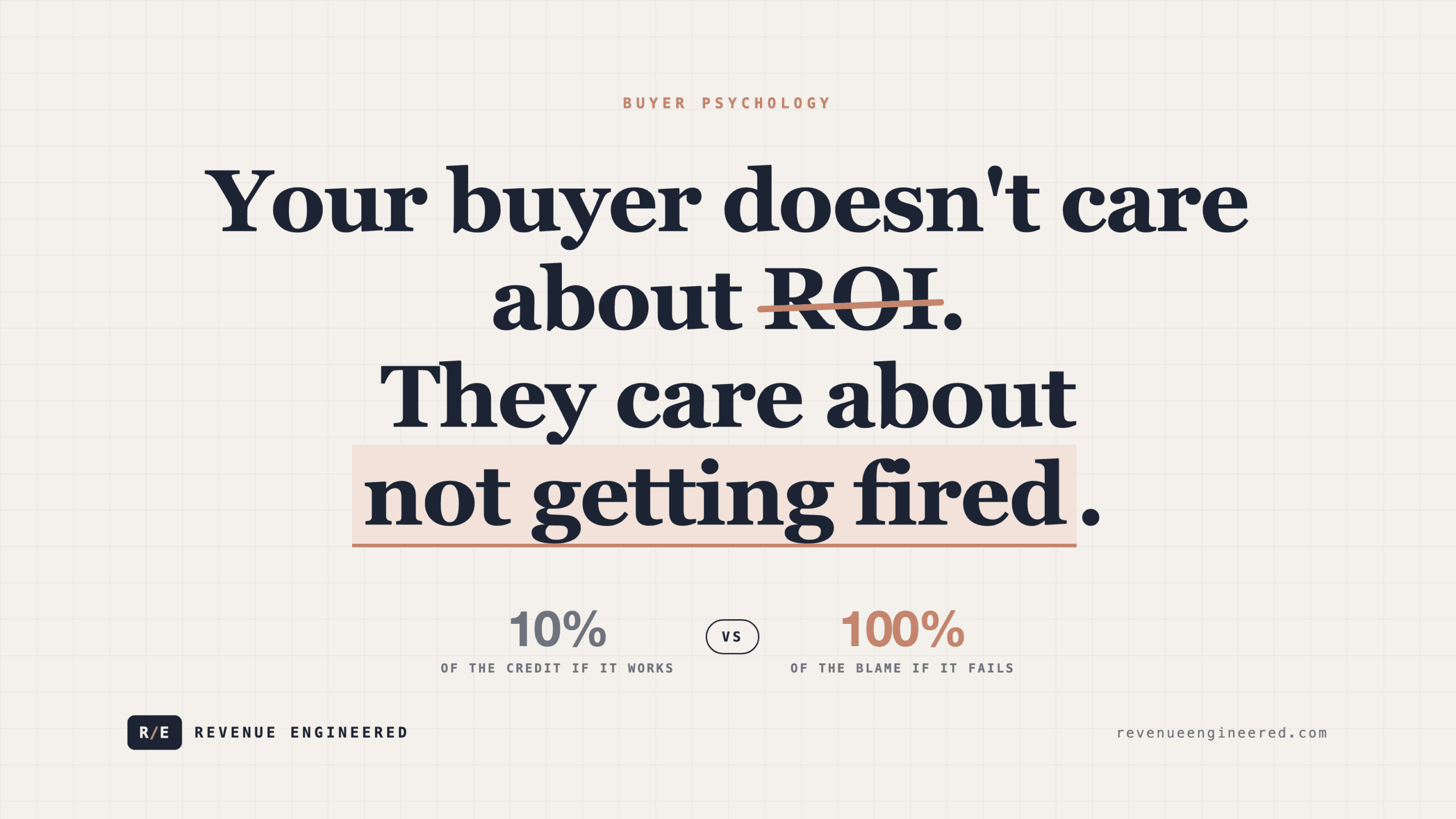
Your Buyer Doesn’t Care About ROI. They Care About Not Getting Fired.
Why career risk, not financial return, drives every B2B buying decision
Every B2B vendor on earth has an ROI calculator. You have seen them. Plug in your number of reps, your average deal size, your current conversion rate, and the tool spits out a projection: “3.2x return in year one.” The prospect nods politely, downloads the PDF, and then does absolutely nothing with it. Six months later, the deal is dead, and the post-mortem says the buyer “went dark” or “couldn’t get internal alignment.” Nobody in the room asks the harder question: was the buyer ever actually persuaded by the ROI math in the first place?
I have been on both sides of this table. Selling enterprise software, building business cases, sitting in QBRs with custom-built value models. And I have watched buyers approve a competitor with worse unit economics because the competitor felt safer. The product was more expensive and the ROI projections were weaker, but the brand was familiar and the reference list was longer. That was enough. The realization took me years to internalize, but once you see it, you cannot unsee it: B2B purchasing decisions are career-risk calculations dressed up as financial analyses.
The VP evaluating your product runs a scenario analysis on their own career, not a discounted cash flow in their head. Will this make me look smart? Will this blow up and put my name on the failure? Can I defend this choice when the CFO asks why we spent $400K on a platform nobody has heard of? Those are the real questions driving the decision. The ROI spreadsheet is just the artifact they need to justify the answer they already arrived at emotionally.
How loss aversion became procurement policy

How loss aversion became procurement policy reframed as system design.
Daniel Kahneman and Amos Tversky demonstrated decades ago that humans feel losses roughly twice as intensely as equivalent gains. In consumer psychology, this means people are more motivated to avoid losing $100 than to gain $100. In enterprise buying, the asymmetry runs far more extreme, because the losses are reputational rather than financial.
A VP who champions a new vendor that delivers 30% improvement to pipeline velocity gets a mention in the quarterly all-hands. Maybe a promotion review bump. The upside is real but diffuse, shared across the team, and measured over a long enough timeline that other factors muddy the attribution. A VP who champions a new vendor that crashes during implementation, misses its integration deadlines, or produces worse results than the incumbent? That VP owns the failure personally. Their judgment gets questioned. Their political capital evaporates. In a down market where headcount is tight, that failure can cost them their job.
The math on this is brutal for anyone selling on upside. The buyer’s mental model looks something like: a successful purchase earns me 10% of the credit. A failed purchase earns me 100% of the blame. No rational actor would take that bet unless the downside risk is nearly zero.
This is why the most common outcome in enterprise sales is not a “no.” It is a “not right now,” which is really just a “no” that lets the buyer avoid the political cost of rejecting something outright. The status quo is the safest possible decision because nobody has to defend it. The existing vendor, however mediocre, has one thing going for it that no challenger can match: it has already been approved. It already passed legal review. It already went through procurement. It is already in the budget. Choosing to stay with the incumbent requires zero career risk. Choosing something new requires putting your name on the line.
The committee is five different risk profiles, not one buyer
Enterprise deals in 2026 involve an average of 8 to 11 stakeholders according to Gartner’s latest buying group research. What most sellers miss is that each stakeholder is running a completely different risk calculus.
The internal champion, typically a director or senior manager, has the most to gain and the most to lose. They want to look innovative. They want to bring something to the table that shows strategic thinking. Their risk is that they spend months shepherding a deal through procurement and the product underperforms. They get tagged as the person who wasted everyone’s time. The champion needs ammunition: proof that this will work, evidence that similar companies have deployed successfully, and a fallback plan if things go sideways.
The economic buyer, often a VP or C-level, has a different equation. They are evaluating whether approving this purchase is a defensible decision, not whether your product works. If the board asks why they spent $500K on a new platform, can they point to a rigorous evaluation process? Did they consider alternatives? Was there a pilot? The economic buyer needs process legitimacy more than product capability. They need to know the decision will look reasonable in hindsight, regardless of outcome.
The CFO or finance stakeholder operates on pure downside protection. They want to know what happens if this fails. What is the contract structure? Can we exit in 12 months? Is there a ramp period on pricing? What are the implementation costs beyond the license fee? The CFO does not care about your ROI model because they have seen hundreds of vendor ROI projections and know that every single one assumes best-case adoption rates. They care about exposure: how much money is at risk if this does not deliver?
End users care about one thing: disruption to their daily work. They do not care about strategic value or financial returns. They care about whether this new tool means they have to learn a new interface, migrate their data, change their workflows, or sit through training sessions during their busiest quarter. End-user resistance has killed more enterprise deals than budget objections. If the people who actually have to use the product signal resistance during the evaluation, the champion loses their internal support base, and the deal collapses from the inside.
IT and security stakeholders operate on a strict “do no harm” principle. They earn no reward for enabling new technology, only blame for security incidents, integration failures, and system downtime. Their default position is skepticism because approval carries asymmetric risk: if they approve and something breaks, it is their fault. If they block and the company misses out on value, nobody notices.
Understanding these five profiles changes how you sell. You cannot write one business case and expect it to resonate with all of them, because they are not evaluating the same thing. The champion needs a story about innovation. The economic buyer needs a defensible process. The CFO needs a risk cap. End users need minimal disruption. IT needs security documentation and integration specs. A single ROI number addresses maybe one of these concerns, and even then, poorly.
“Nobody ever got fired for buying IBM” still runs the market
That phrase is 40 years old, and it describes B2B buying behavior in 2026 as accurately as it did in 1986. The dynamic it captures is simple: when a buyer chooses a well-known, established vendor, they are insulated from blame even if the product underperforms. “We went with Salesforce” is a statement that requires no defense. “We went with this Series A startup that has 40 customers” requires an elaborate justification.
This creates a structural advantage for incumbents and category leaders that has nothing to do with product quality. It is a risk premium. Buyers pay more for established vendors not because the product is better but because the purchase decision is safer. The markup is insurance against career damage.
For startups and challengers, this dynamic is the single biggest obstacle to enterprise sales, and most of them respond to it in exactly the wrong way. They build more ROI calculators. They add more features. They cut prices. None of this addresses the actual problem, which is that choosing you feels risky to the human making the decision.
The companies that break through the IBM dynamic do so by systematically reducing perceived career risk. Not by proving higher ROI, but by making the purchase decision feel as safe as choosing the incumbent.
Repositioning GTM around risk reduction

Repositioning GTM around risk reduction as a maturity path.
If you accept that buyers optimize for career safety rather than financial return, your entire GTM motion needs to shift. Here is what that looks like in practice.
Social proof is your buyer’s primary risk-mitigation mechanism, not a marketing nice-to-have. When a VP is evaluating your product, the first thing they do is look for evidence that someone like them, at a company like theirs, made this decision and survived. Case studies, logos, named references are the buyer’s insurance policy, not vanity metrics. Every logo on your website is the buyer thinking: “If this goes wrong, at least I can say that Company X chose them too.” The more specific the social proof (same industry, same company size, same use case), the more effective the risk reduction.
Implementation guarantees directly address the CFO’s downside calculation. A 90-day money-back guarantee sounds like a revenue risk to you. To the buyer, it is the single most powerful thing you can say because it caps their exposure. If the contract includes a clear exit ramp, the decision shifts from “what if this fails and we are locked in for three years?” to “what if this fails and we walk away having lost 90 days?” That is a dramatically different risk profile.
Pilot programs are de-risking mechanisms disguised as sales motions. The pilot exists to give the champion a way to show results before they have to put their reputation on the line for a full commitment. Proving ROI is beside the point. A well-structured pilot lets the internal champion build political capital: “We ran a pilot with 20 reps in the Northeast region, and here is what happened.” Now the champion presents evidence instead of asking the economic buyer to take a leap of faith. The risk of the decision has been transferred from the buyer’s judgment to observed data.
Pricing structure signals risk tolerance. Annual contracts with no exit clause tell the buyer: “If this fails, you own it for 12 months.” Quarterly contracts with a ramp, or usage-based pricing that scales with adoption, tell the buyer: “If this fails, your exposure is limited.” The second message converts better in competitive deals, even when the total cost of ownership is higher, because it reduces the perceived downside.
What happens when messaging shifts from upside to downside protection
The pattern is consistent across the companies I have worked with or observed making this transition. When GTM messaging shifts from “increase revenue by X%” to “reduce the risk of Y,” conversion rates on mid-market and enterprise deals improve materially. The gains are not marginal. Teams that reframe around risk reduction typically see 15-30% improvement in stage-to-stage conversion, concentrated in the middle of the funnel where committee dynamics create the most friction.
One infrastructure company I worked with sold monitoring software. For years, their pitch led with “reduce mean time to resolution by 40%.” The metric was real, backed by customer data, but it was not moving deals. They reframed around “eliminate the risk of undetected outages” and led their pitch with a case study about a competitor’s customer who had a production incident that went unnoticed for six hours. Their pipeline velocity increased by 22% in one quarter. The product did not change. The price did not change. The risk frame changed, and that was enough.
Another company in the security space dropped their ROI calculator entirely and replaced it with a “risk exposure assessment.” Instead of telling prospects how much money they would save, the tool showed them how much money they stood to lose from their current gaps. The assessment became the most-shared asset in their content library, not because it was more polished, but because it gave the internal champion something to forward to the CFO. It spoke the CFO’s language: downside exposure, not upside projection.
How this changes your sales enablement

How this changes your sales enablement translated into operating choices.
Most sales enablement materials are built to help reps articulate value. But value articulation is the wrong framing for how enterprise decisions actually get made. What reps need is risk-reduction ammunition.
Your battle cards should not just compare features against competitors. They should include the specific risks of switching away from the incumbent and the specific risks of staying with the incumbent. The status quo has risks too. Most buyers have not quantified them because nobody has forced the conversation.
Your proposal template should include a section on implementation risk mitigation: what you will do if adoption is lower than projected, what happens if the integration takes longer than planned, what the exit terms are if the product does not deliver. These are the questions the committee is asking behind closed doors. If your proposal answers them preemptively, you save the champion from having to defend your product in rooms where you are not present.
Your references should be selected not for the most impressive ROI numbers but for the most similar buyer profile. The VP at a 200-person fintech does not care that a 10,000-person bank saw 5x ROI. They care that another VP at a 200-person fintech chose you and still has their job.
The fiction of rational buying
The B2B industry has spent decades building infrastructure around the fiction that enterprise purchases are rational economic decisions. CRM systems track deal stages that assume linear progression toward a logical conclusion. Business cases are structured as financial analyses. ROI is treated as the deciding variable.
All of this machinery serves a real purpose: it gives buyers the paper trail they need to justify decisions they made for entirely different reasons. The business case is a documentation tool, not a decision-making tool. It exists so that when someone asks “why did we buy this?”, there is a number on a spreadsheet that provides an acceptable answer.
Once you internalize this, you stop trying to build the most impressive ROI model and start asking the more productive question: how do I make this purchase feel safe for every person who has to approve it? That question leads to better deals, faster cycles, and fewer losses to “no decision.” Because the buyer who feels safe is the buyer who signs. And the one staring at your ROI calculator, wondering what happens to their career if the numbers do not materialize, is the one who goes dark.
The ROI calculator will never close the deal. What closes the deal is the moment every person on the buying committee looks at your proposal and thinks: “I can defend this decision.” Make that easy for them, and the spreadsheet takes care of itself.
Enjoying this essay?
Written by

Elom
GTM, growth, and revenue systems operator with 12 years across Fortune 500s, fintech, and B2B startups. Building at the intersection of AI, data, demand, and revenue.
Get the next deep-dive in your inbox
Essays on demand creation, GTM, growth engineering, and revenue systems. Free.