Activation Before Acquisition: The Growth Sequencing Framework
Why fixing your activation rate is worth more than doubling your marketing budget
Most growth teams operate with a predictable bias: when revenue stalls, they reach for acquisition. More spend on paid channels. More SDRs in the pipeline. More content at the top of the funnel. The logic feels obvious. If the business needs more revenue, it needs more customers, and more customers means more acquisition. Board decks get updated with CAC projections and channel mix charts, and the entire growth conversation anchors on how many new logos the team can bring in this quarter.
This is the default operating mode at the majority of companies I have worked with or advised. It is also, in most cases, exactly backwards.
The math is simple enough that it should be tattooed on the forearms of every Head of Growth. If your activation rate is 20%, every dollar you spend on acquisition yields twenty cents of realized value. You are not investing in growth. You are paying full price for an 80% waste rate. Meanwhile, improving that activation rate from 20% to 40% has the exact same effect on realized revenue as doubling your entire marketing budget, except it costs a fraction of the money and compounds over time instead of resetting to zero each quarter. Acquisition is a linear cost. Activation is a multiplicative lever. And yet most teams spend 80% of their resources on the linear cost because it is more visible and easier to pitch to a board.
The companies that sequence their growth investments correctly have a structural advantage over the ones that do not. That sequence is not intuitive, which is why so few teams follow it. But the data is clear, and the pattern repeats across every business model I have seen up close.
What activation actually means

What activation actually means reframed as system design.
The first problem is definitional. Most companies track activation as a binary event: the user signed up. Or perhaps the user completed onboarding. Or the user logged in a second time. These metrics are easy to measure. They are also nearly useless.
Activation, properly defined, is the process of taking a user from signup to the point where they have experienced the core value of your product and formed an initial habit around it. That definition has three distinct phases, and conflating them is where most teams go wrong.
The first phase is setup. The user performs whatever actions are required to be capable of receiving value. In a survey tool, that means creating a survey, adding questions, and selecting a distribution method. In a collaboration platform, it means creating a workspace, adding content, and inviting colleagues. Setup is necessary but insufficient. A lot of companies look at setup completion rates and declare victory, but finishing setup is like getting dressed for a run. You have not exercised yet.
The second phase is the “aha” moment, the point where the user has actually received and recognized the core value your product delivers. For SurveyMonkey, that means receiving and viewing five or more responses. For Dropbox, it means editing or sharing a file with another person. For a marketplace, it means completing the first transaction. For an AI tool, it means getting output good enough that you actually use it in real work, not just generating a demo output to see what happens. The aha moment is neither a login event nor a page view. It has to be an action that maps to genuine value delivery, and it has to be measurable in a way that correlates with downstream retention.
The third phase, and the one most teams ignore entirely, is habit formation. The aha moment is a single experience. Activation is complete when the user demonstrates that they understood the reward and want to receive it again at their natural frequency. Weekly collaboration sessions. Monthly survey sends. Daily prompt interactions. Without the habit loop, you have created a one-time experience, not an activated user. And one-time experiences churn.
Facebook’s famous “7 friends in 10 days” was an activation metric not because adding friends is interesting but because it predicted habit formation. Users who crossed that threshold kept coming back. Users who did not, left. The number mattered because of what it predicted, not because of what it measured.
The leaky bucket problem
Here’s a scenario I see regularly. A B2B SaaS company is spending $50,000 per month on paid acquisition. Their landing pages convert at a reasonable rate. Their pipeline looks healthy by top-of-funnel standards. But 80% of new signups never complete a meaningful action in the product. They sign up, look around, and leave. Some of them enter a sales-assisted flow and get pushed toward a paid plan through human persuasion rather than product experience. Most just disappear.
The growth team responds by optimizing the acquisition funnel. Better ad creative. Better landing page copy. More targeted audiences. They might improve signup volume by 15-20%. But the activation rate stays at 20%. They have made the bucket bigger without patching the holes. Every marginal acquisition dollar flows through the same sieve.
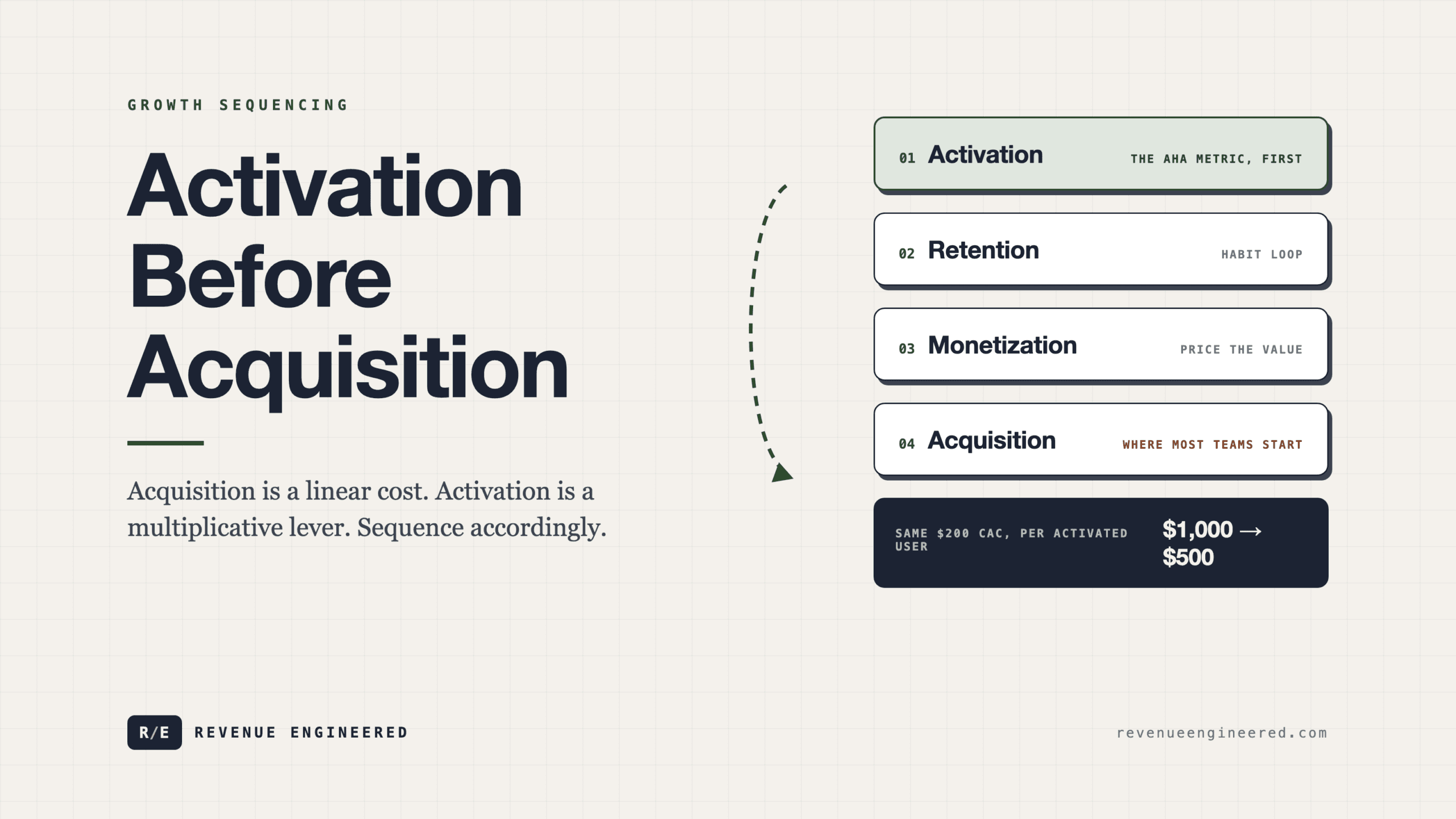
The math compounds in an ugly way. At a $200 CAC and 20% activation, your effective cost per activated user is $1,000. If you improve activation to 40%, the same $200 CAC now produces activated users at $500 each. You have just cut your effective cost per activated user in half without changing a single thing about your marketing. Alternatively, you could have doubled your marketing budget from $50K to $100K per month (an additional $600K per year) and achieved the same result. One option costs money every month. The other is a one-time investment in product improvement that pays dividends on every future cohort.
This is why growth sequencing matters. Working on acquisition before activation is actively wasteful, well beyond merely suboptimal. Every dollar you spend bringing new users into a broken activation funnel produces a fraction of the value it could if you fixed the funnel first.
Activation metrics by business type
One reason teams struggle with activation is that the right metric varies dramatically by business type. There is no universal “aha” moment. It has to be discovered empirically and validated against retention data.
For B2B SaaS products, activation typically maps to completing a first meaningful workflow. Not setup, but actual value delivery. In a CRM, that might be completing a first deal stage transition. In a project management tool, it might be a team collaborating on their first shared board. In an analytics platform, it might be generating a first custom report that surfaces an insight the user did not already know. The common thread: the user did something with the product that would have been harder or impossible without it.
For marketplaces, activation is almost always tied to the first successful transaction. Not browsing, not listing, not even adding payment information. The buyer needs to buy something. The seller needs to sell something. Until value has been exchanged, the marketplace has not activated anyone. This is why marketplace growth teams obsess over reducing friction to the first transaction: every barrier between signup and first exchange is a barrier to activation.
For AI-native products, activation is still being figured out by most teams, and the default metrics are wrong. Many AI tools measure activation as “generated first output.” That is too shallow. The gap between generating an output and actually deploying that output into a real workflow is where the churn happens. AI products have a “dopamine problem” where the initial interaction feels magical, but the magic fades when users realize the output needs significant editing, does not fit their specific context, or does not integrate into their existing processes. The better activation metric for AI tools is “first output used in a real workflow,” which is harder to measure but far more predictive of retention.
The growth sequencing framework
The correct sequence for growth investment runs in the opposite direction from how most teams operate. Start from the inside and work outward.
Phase 1: Activation. Before you spend a dollar on bringing new users in, make sure the users you already have are reaching the aha moment and forming habits. Identify your activation metric empirically. Instrument the setup-to-aha-to-habit journey. Measure where users drop off and why. Shorten time to value. Remove unnecessary setup steps. Provide templates, defaults, and guided experiences that get users to the aha moment faster. Every minute of delay between signup and value delivery is a minute where the user can leave, and they will.
The practical work here is unglamorous. It is onboarding flow optimization. It is in-product nudges and reminders that drive users toward their first meaningful action. It is email sequences that teach one feature per day for the first week instead of blasting users with marketing copy about your company’s vision. It is reducing the number of steps between landing in the product and experiencing the core value. At companies like Superhuman, the activation obsession ran so deep that they manually onboarded every single new user at scale, with 20 full-time people dedicated to it at peak. That sounds extreme until you realize it gave them a >70% activation rate while their competitors sat at 15-25%.
Phase 2: Retention. Once users are activating reliably, the next investment goes to retention. Can they come back? Do they come back? At what frequency? Retention is the validation that your activation metric was correct. If users activate but do not retain, your aha moment is wrong. Go back to phase 1 and find the real one. The retention phase is about deepening engagement, building switching costs through workflow integration, and creating the conditions for expansion. A 5% improvement in retention correlates with up to 25% improvement in profitability. Retention is where compound growth actually lives.
Phase 3: Monetization. Once users are activating and retaining, you have earned the right to optimize monetization. This means packaging, pricing, conversion triggers, and expansion paths. Trying to monetize before you have activation and retention is the equivalent of asking someone to marry you on the first date. It occasionally works, but the base rate is terrible, and the relationship is fragile.
Phase 4: Acquisition. Now, and only now, does it make sense to scale acquisition spend. At this point, every new user enters a machine that activates, retains, and monetizes them efficiently. Growth loops can compound because the product actually delivers on the promise that brought people in. Word-of-mouth accelerates because activated users recommend products they get value from, not products they signed up for and forgot about. Your CAC payback period shrinks because conversion rates are high enough to recoup investment quickly. Paid channels become profitable because the LTV on the other side of the equation is actually real, not a projection based on optimistic retention curves.
Companies that got the sequencing wrong

Companies that got the sequencing wrong as a maturity path.
The pattern is easy to spot in retrospect. Blue Apron spent nearly $400 per customer on acquisition for a product that netted less than half that in annual value, and they saw 72% churn after six months. They scaled acquisition before solving retention. The business model required massive ongoing spend just to maintain the same revenue, let alone grow. Every investor presentation showed exciting new customer numbers while the existing base bled out underneath.
The same dynamic plays out in AI-native startups today. Companies racing to $100M ARR on the back of low-friction signups and novelty-driven adoption are discovering that the growth rate cannot outrun the churn rate forever. Median gross retention for AI-native companies sits around 40%. That means 60% of the customer base walks out the door every year. At that rate, you need exponentially more new customers just to stay flat. The companies that reach scale with broken retention are three times more likely to be shrinking than growing.
Companies that got the sequencing right
Duolingo’s re-acceleration is the textbook case. After years of declining growth, they reorganized their entire growth operation around engagement and retention before acquisition. Their growth team focused on streaks, notifications, leaderboards, and gamification mechanics that drove daily habit formation. DAU went from 5 million to nearly 30 million over five years, and the stock roughly tripled over two years. The acquisition channels did not change dramatically. What changed was that every acquired user was entering a product that was far better at activating and retaining them.
Dropbox followed a similar pattern. Their growth loop (user uploads content, shares it, recipient becomes a new user) only worked because the activation experience was strong enough that users actually uploaded and shared content. If the first-run experience had been confusing, if setup had been slow, if the aha moment had been buried under unnecessary configuration, the entire viral loop would have been dead on arrival. Activation is the engine. Acquisition loops are the fuel. Without the engine, fuel does nothing.
Where most teams actually are

Where most teams actually are translated into operating choices.
The uncomfortable reality is that most companies do not know their real activation rate. They track signup-to-paid conversion or maybe some simplified onboarding completion metric, but they have not done the empirical work of identifying which actions predict long-term retention. They do not have cohort data broken out by activation behavior. They cannot tell you the difference in 90-day retention between users who completed their first workflow in day one versus day seven.
Without that data, growth investment decisions are guesswork. And guesswork defaults to acquisition because acquisition is the most visible, most measurable, and most socially rewarding part of the growth function. Nobody gets promoted for “improved onboarding completion rate by 12%.” But they should, because that 12% compounds across every future cohort in a way that a 12% increase in ad spend never will.
The forward case
The companies that will dominate their categories over the next few years are the ones that treat activation as the foundational layer of their entire growth system. They are measuring the right things: not signups, not logins, but value delivery events and habit formation rates. They are sequencing their investments correctly: activation first, then retention, then monetization, then acquisition. And they are building the organizational discipline to resist the gravitational pull of acquisition spending when the board asks why growth is not faster.
Activation is neither a feature nor an onboarding flow. It is the mechanism by which your product proves its value to every person who walks through the door. Until that mechanism works, everything else you spend money on is partially wasted. Fix the activation rate first. Then scale. The math will take care of the rest.
Enjoying this essay?
Written by

Elom
GTM, growth, and revenue systems operator with 12 years across Fortune 500s, fintech, and B2B startups. Building at the intersection of AI, data, demand, and revenue.
Get the next deep-dive in your inbox
Essays on demand creation, GTM, growth engineering, and revenue systems. Free.