Satellite Apps: The Lead Magnet Replacement for AI-Era GTM
Why free tools beat free content for lead generation in 2026
Someone downloads your ebook. They skim the first three pages. They never open it again. You nurture them for six weeks with a drip sequence. They unsubscribe. This is the lead magnet lifecycle in 2026, and if you are still running it, you are optimizing a dead system.
The ebook, the whitepaper, the gated checklist, the “Ultimate Guide to X” PDF. These worked when information had friction. When getting the answer to a question required someone to compile research, format it, and package it behind a landing page. That friction is gone. Any prospect can open Perplexity or ChatGPT and get a better, more personalized answer to their question in thirty seconds than your 22-page PDF provides. The information arbitrage that powered lead magnets for a decade has been completely eroded. What has not been eroded is the need to capture attention, demonstrate competence, and build a bridge from “stranger” to “qualified prospect.” The mechanism has to change. And what is replacing it, quietly but measurably, is the satellite app.
What a satellite app actually is

What a satellite app actually is reframed as system design.
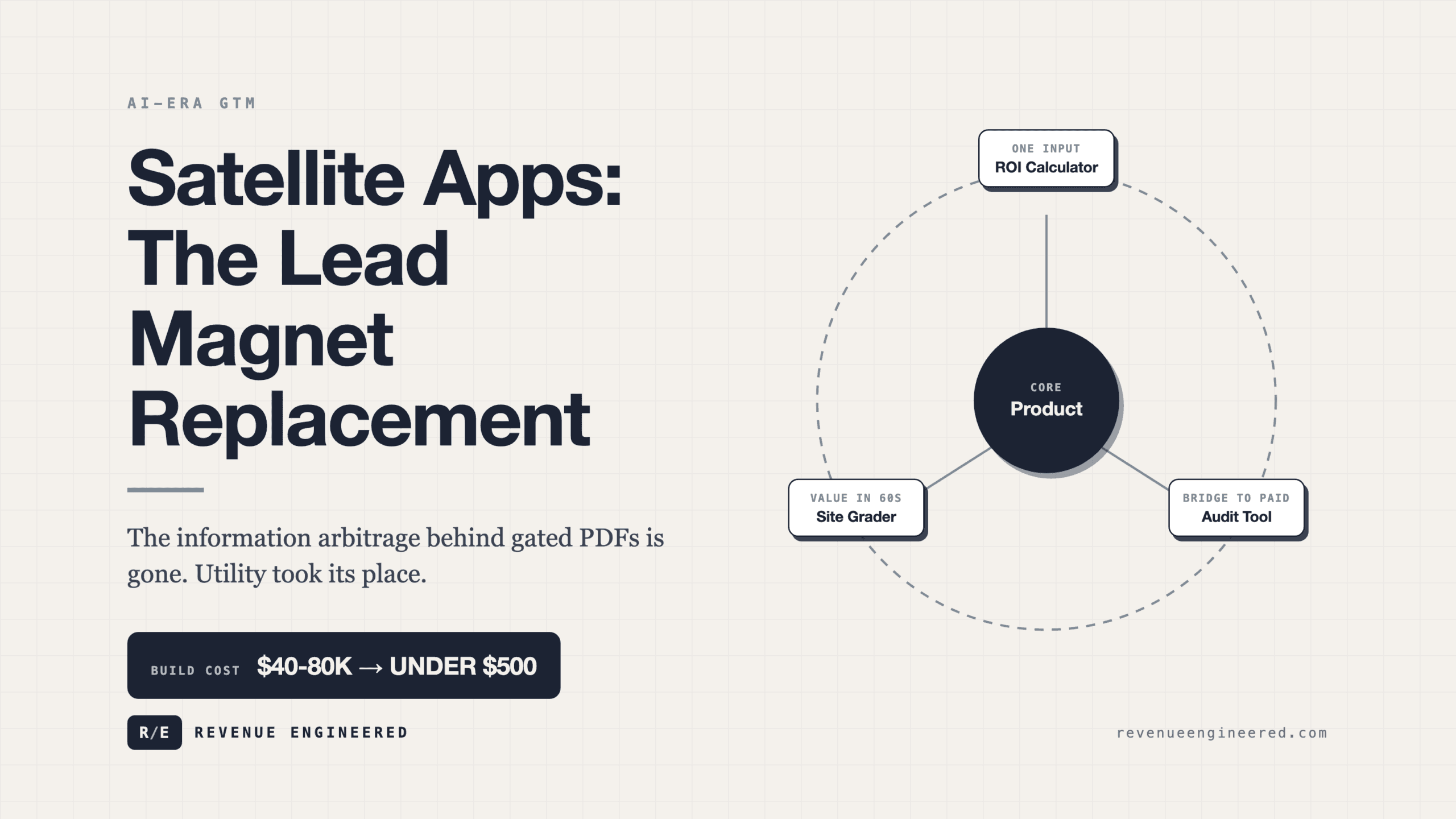
A satellite app is a small, free, standalone tool that solves one specific problem for your ideal customer profile. It requires no onboarding. It delivers value in under sixty seconds. And it collects qualifying data as a natural byproduct of usage, not as a gate.
HubSpot’s Website Grader is the canonical example. You enter a URL. You get a score with specific, actionable recommendations. In the process, HubSpot learns what kind of website you run, what your tech stack looks like, where your performance gaps are, and whether you fit their ICP. That is more qualifying data than any form fill has ever produced.
Ahrefs’ free Backlink Checker does the same thing in the SEO space. Enter a domain, see your backlink profile. Ahrefs now knows which domain you care about, what your link building situation looks like, and that you are the kind of person who checks backlinks — which makes you almost certainly a potential customer for their full suite. CoSchedule’s Headline Analyzer takes a different angle on the same architecture. Type in a headline, get a score. CoSchedule now knows you write content, you care about performance, and you are open to tooling that improves your output.
These are not new examples. What is new is that the economics of building them have fundamentally shifted.
The economics changed
Building a satellite app used to be an engineering project. You needed a product manager to scope it, a designer to mock it up, a frontend developer to build it, a backend developer to handle the data layer, and a DevOps person to deploy and maintain it. Minimum timeline: six to eight weeks. Realistic cost: $40,000 to $80,000 when you factor in opportunity cost of pulling those people off your core product.
That math made satellite apps a luxury reserved for companies with engineering surplus. HubSpot could afford to build a Website Grader because HubSpot had hundreds of engineers. A Series A startup with eight people could not justify pulling two of them off the core product for two months to build a free tool that might or might not generate leads.
The current math is different. A growth marketer with access to Cursor, Claude Code, Replit, or Lovable can build and deploy a functional satellite app in a weekend. Not a prototype. A deployed, working application with a custom domain, data collection, and a bridge to the core product. The all-in cost, including hosting, domain, and whatever coffee was consumed during the build, comes in under $500.
This is not theoretical. Growth teams are shipping these right now. The build-versus-buy calculation for marketing assets has inverted. It used to be cheaper to license a form builder and gate a PDF than to build a standalone tool. Now it is cheaper to build the tool. And the tool performs better across every metric that matters.
Anatomy of a good satellite app
Not every free tool works as a satellite app. The ones that generate pipeline share five properties, and missing any one of them usually kills the entire play.
The first is single-problem focus. The app solves exactly one problem and does it well. Not three related problems. Not a mini-version of your full product. One problem, one input, one output. The Headline Analyzer asks for a headline and returns a score. The Website Grader asks for a URL and returns a report. The constraint is the feature. If a user has to think about how to use it, you have already lost.
The second is zero onboarding. No account creation. No tutorial. No walkthrough. The user arrives, provides an input, and gets value. If the tool requires explanation, it is too complex to function as a satellite. The entire experience needs to fit in the gap between “I have this problem” and “oh, that was useful.” Sixty seconds or less.
The third is qualifying data as a byproduct. This is the property that makes satellite apps structurally superior to lead magnets. When someone downloads an ebook, you learn their email address and sometimes their job title. When someone uses a satellite app, you learn what they are actually working on. A headline analyzer tells you the user writes content. A website grader tells you their site has slow load times and missing meta descriptions. A backlink checker tells you they are monitoring a specific competitive domain. That usage data is qualification data. It tells your sales team who the prospect is, what their problem is, and how urgent it might be.
The fourth is a natural bridge to the core product. The satellite app’s output should create an obvious next step toward your paid offering. The website grader says “your SEO score is 42/100.” HubSpot’s SEO tools can fix that. The headline analyzer says “your emotional word balance is low.” CoSchedule’s content suite can optimize across your whole editorial calendar. The bridge cannot feel forced. It has to be the logical conclusion of the value already delivered.
The fifth is built-in distribution. The best satellite apps rank for high-intent tool queries that content pages struggle to compete with. “Website grader” is a search query. “Email subject line tester” is a search query. “Color palette generator” is a search query. These are queries where the searcher wants a tool, not an article. A satellite app is the only result type that genuinely satisfies that intent. This gives satellite apps an SEO advantage that blog posts, no matter how well optimized, cannot match. Google has gotten very good at recognizing when a searcher wants a tool versus information. If your satellite app solves the query, it will rank.
The first-party data angle
The data advantage of satellite apps deserves its own section because it is being undervalued by most teams running this play.
Every satellite app interaction generates first-party usage data. Not form-fill data. Not self-reported data. Behavioral data produced by someone actually engaging with a tool to solve a real problem. This is categorically different from what lead magnets produce.
A lead magnet gives you a name, an email, and maybe a company name. The prospect filled out a form under mild duress. They wanted the content, not the conversation with your SDR. The data is thin and the intent signal is weak.
A satellite app gives you the specific input the prospect provided (a URL, a headline, a domain, a keyword, a configuration), the output they received (a score, a report, a recommendation), how they interacted with the results (what they clicked, what they exported, whether they came back), and often the specific gap or problem the tool identified. When your sales team reaches out to someone who used your free website grader and scored 38/100 on mobile performance, they are not cold calling. They are reaching out to someone who has a documented problem, has demonstrated awareness of that problem, and has already interacted with your brand in a value-positive context. That call converts at 3-5x the rate of a typical marketing qualified lead from a gated ebook.
At scale, satellite app usage data also feeds your product roadmap. If 70% of users who try your free email subject line tester also try to test email body copy, and your tool does not support that, you have a product signal from actual user behavior. No survey required.
Where satellite apps fail

Where satellite apps fail as a maturity path.
Three failure modes appear consistently enough to be worth naming.
The first is too good. When the satellite app solves the problem so completely that the user has no reason to explore the core product, you have built a competitor to yourself. Ahrefs navigates this well. Their free backlink checker shows you the top 100 backlinks. To see the full profile, track changes over time, or analyze competitors, you need the paid product. The free tool demonstrates capability and creates appetite. It does not satisfy the full need. If your satellite app replaces the core product for 80% of users, you have a pricing problem, not a lead generation strategy.
The second failure mode is too disconnected. The satellite app solves a real problem for your ICP, but the bridge to your core product requires a logical leap that most users will not make. A CRM company building a free color palette generator might attract designers, but designers are not the buyer of CRM software. The satellite has to orbit your core product. It should solve an adjacent problem for the same person, not a different problem for a different person. Every great satellite app creates a “and if you want to take this further…” moment that points directly at the paid product.
The third is too complex. The satellite app requires a login, a configuration step, or more than two inputs before it delivers value. At that point, you have built a free product, not a satellite app. Free products have their own strategic logic and can work well, but they require a different investment thesis and a different operational model. The satellite app’s power comes from its simplicity. If you need a product manager to maintain it, you have crossed the line.
Industry applications
The satellite app architecture applies across verticals, and the AI-era build economics make it viable for companies that would never have considered it before.
A cybersecurity company can build a free domain exposure scanner. Enter your domain, see what is publicly visible about your attack surface. The output is a list of findings that maps directly to the paid product’s remediation capabilities. An HR tech company can build a compensation benchmark tool. Enter a role and location, get a salary range based on aggregated data. The output tells the sales team exactly which roles the prospect is hiring for and what market they are in. A logistics company can build a shipping cost estimator. Enter origin, destination, and weight, get comparative pricing. The tool generates lead data about shipping volume and routes that the sales team can reference in outreach.
In every case, the pattern is the same. One problem. Instant value. Qualifying data as output. Natural bridge to paid. The industry-specific implementation varies, but the architecture is consistent.
SEO as a distribution layer
The SEO case for satellite apps is worth being specific about because it is a structural advantage over content-based lead generation.
Content pages compete for informational queries. “What is a backlink” or “how to improve website speed” or “email marketing best practices.” These queries have gotten extraordinarily competitive. Every company in every category has published their version of “The Complete Guide to X.” The top ten results for most B2B informational queries are nearly interchangeable.
Tool queries are different. “Backlink checker” or “website speed test” or “email subject line analyzer.” These queries signal a user who wants to do something, not learn something. Google recognizes this intent difference and rewards functional results. A satellite app that genuinely solves the query will outrank a blog post about the topic, often with significantly less domain authority required.
This creates a compounding advantage. The satellite app ranks for a high-intent query. It receives organic traffic from people who are actively trying to solve a problem. Those users engage with the tool, generating qualifying data. The best-qualified users receive outreach or see a bridge to the core product. And the whole system runs on organic distribution, not paid spend.
The maintenance cost is near zero. Unlike a blog post that needs updating when search algorithms change or information becomes stale, a functional tool that solves a real problem retains its ranking as long as it continues to work. There is no content refresh cycle. There is no keyword decay. The tool either works or it does not.
The operational model

operational model translated into operating choices.
Running satellite apps well requires thinking about them as a portfolio, not as one-off projects.
The first operational decision is how many to build. The answer is more than one, but probably fewer than ten. Each satellite app targets a different problem within your ICP’s problem space, and each generates a different slice of qualifying data. A portfolio of three to five well-targeted satellite apps covers more of your buyer’s problem surface than a single tool ever could.
The second decision is measurement. Track unique users, not page views. Track depth of engagement: what did the user actually input and what output did they receive? Track bridge conversion, meaning the percentage of satellite app users who take the next step toward your core product. And track downstream revenue from leads that originated through each satellite app. This last metric is the one that justifies the whole play to leadership.
The third decision is maintenance strategy. The beauty of a simple satellite app is that it does not need much. No feature roadmap. No sprint planning. Keep it running, keep it fast, and fix bugs when they appear. If the tool is simple enough (and it should be), one person can maintain a portfolio of five satellite apps as a side responsibility, not a full-time job.
Where this goes
The traditional lead magnet depended on information scarcity. That scarcity is gone and it is not coming back. The teams that keep gating PDFs in 2026 are going to watch their conversion rates decline every quarter as prospects increasingly question why they should hand over an email address for content they can generate themselves.
Satellite apps replace information exchange with utility exchange. The prospect gets a tool that solves a real problem. The company gets qualifying data that is richer than anything a form has ever captured. The bridge to the core product feels like a natural extension, not a sales pitch. And the whole system distributes itself through search queries that content cannot compete for.
The build economics make this accessible to any team, at any stage. The question is no longer whether you can afford to build satellite apps. It is whether you can afford to keep relying on PDFs in a market where your prospects have AI that makes your ebooks redundant before they finish downloading.
Enjoying this essay?
Written by

Elom
GTM, growth, and revenue systems operator with 12 years across Fortune 500s, fintech, and B2B startups. Building at the intersection of AI, data, demand, and revenue.
Get the next deep-dive in your inbox
Essays on demand creation, GTM, growth engineering, and revenue systems. Free.