Context Engineering: The Hidden Infrastructure Layer of AI-Native GTM
Everyone talks about AI agents. Almost nobody talks about the context those agents need to actually work.
I have been running AI agents across a GTM stack for several months now. Not experimenting. Running them in production, making real decisions, producing real outputs that affect real revenue. The single biggest lesson from that experience has nothing to do with which model is best or which framework to use. The lesson is this: the quality of an AI agent’s output is almost entirely determined by the quality of the context it receives. Everything else is secondary.
This sounds obvious when stated plainly. Of course an AI that knows more makes better decisions. But the implications are far less obvious, and almost nobody in the GTM space is taking them seriously. We have an entire industry obsessed with AI agents, with multi-agent orchestration, with autonomous workflows, and yet the conversation about what those agents actually need to function well is almost nonexistent.
Context engineering is the practice of designing and managing the context that AI agents use to make decisions, then optimizing it as conditions change. It is becoming a formal discipline within the most advanced GTM teams, and I believe it will be as important to AI-native operations as data engineering is to modern analytics. The teams that get this right will produce consistently good AI-driven outcomes. The teams that ignore it will produce slop at scale.
What context engineering actually means

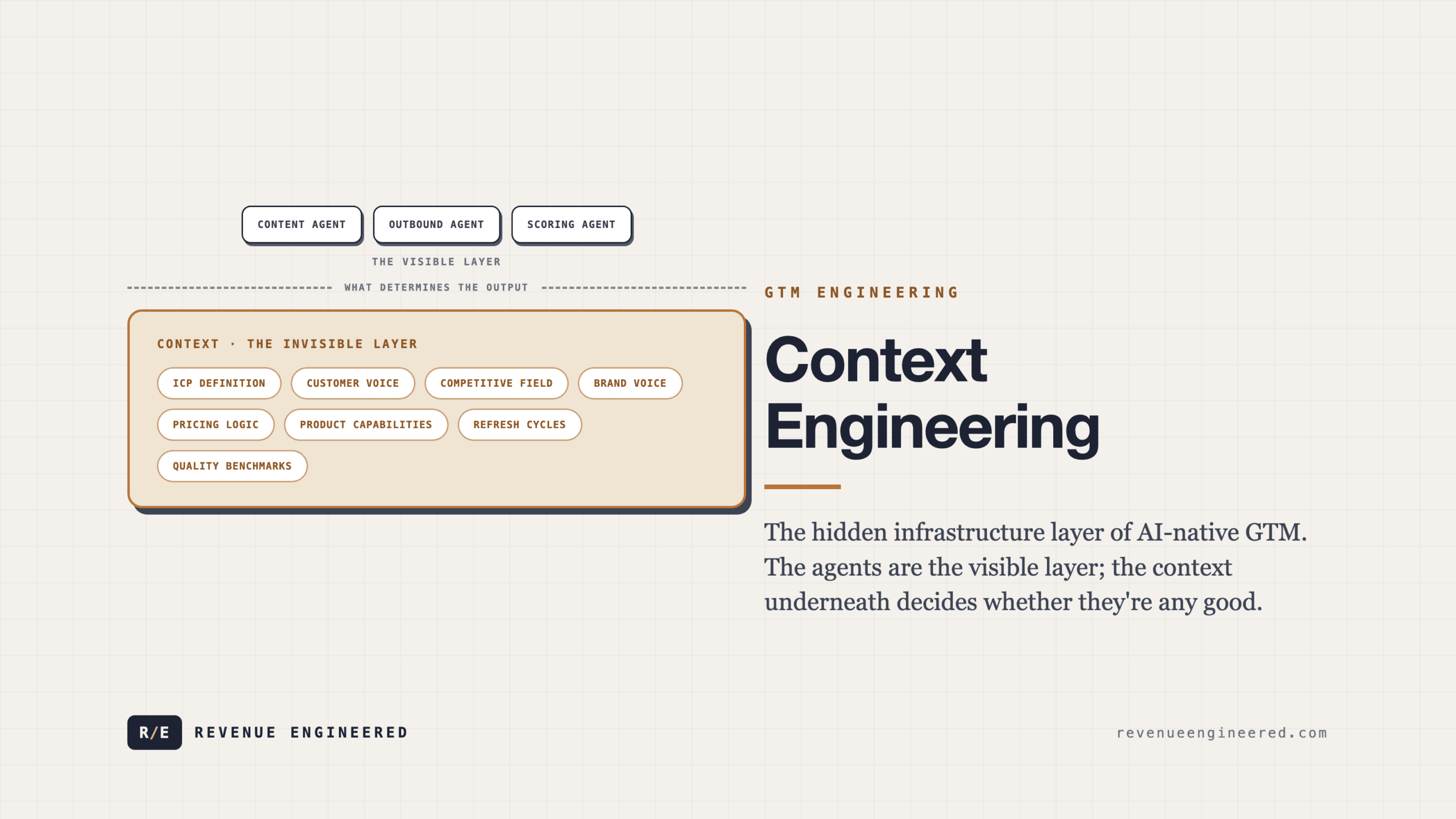
What context engineering actually means reframed as system design.
When a human employee joins your company, they spend weeks or months absorbing context. They read documentation. They sit in meetings. They learn how your customers talk about their problems. They internalize your positioning, who you compete against and why you win, your pricing logic, your brand voice. By the time they are fully ramped, they carry a detailed mental model of your business that informs every decision they make.
When an AI agent starts working for your company, it receives whatever context you give it in that moment. Nothing more. It has no institutional memory unless you build one. It has no understanding of your customers unless you provide it. It does not know your brand voice, your competitive positioning, or your pricing strategy unless those things exist in a format it can consume.
The gap between a well-contextualized agent and a poorly contextualized one is enormous. I have seen the same agent, running the same model, produce outputs that range from embarrassingly generic to genuinely insightful, with the only variable being the quality and completeness of the context provided. An agent writing outbound emails with access to your ICP definition, recent customer conversations, competitive positioning, and the prospect’s specific tech stack will produce something useful. The same agent without that context will produce something that sounds like every other AI-generated email in your prospect’s inbox.
Context engineering treats this as a design problem, not an afterthought. It asks: what information does this agent need to make good decisions? How do we package that information so the agent can use it effectively? How do we keep that information current? How do we measure whether the context is good enough?
The context drift problem
Context degrades over time. This is the single most underappreciated failure mode in AI-native GTM.
Your competitive field changes. Your product ships new features. Your pricing evolves. Customer objections shift. Market conditions move. If your AI agents are operating on context that was accurate three months ago, they are making decisions based on a world that no longer exists. The outputs look plausible, they read fluently, they follow the right structure, but the substance is wrong in ways that are hard to detect without domain expertise.
I call this context drift, and it is the AI equivalent of data debt. In the analytics world, data debt accumulates when your data pipelines, schemas, and definitions fall out of sync with the business they are supposed to describe. The dashboards still render. The numbers still appear. But the numbers are quietly wrong, and decisions made on wrong numbers compound into wrong strategies.
Context drift works the same way. Your agents still produce outputs. The outputs still look professional. But the positioning is based on last quarter’s competitive reality. The pricing references are stale. The customer pain points are from a segment you have since deprioritized. Nobody notices because the outputs are fluent and structured. The quality degradation is invisible until it manifests as poor campaign performance, off-brand messaging, or prospects receiving communications that feel disconnected from reality.
The teams taking context engineering seriously have built refresh cycles into their context infrastructure. Competitive context gets updated bi-weekly. Customer voice data gets refreshed after every batch of sales calls. Product context updates automatically when new features ship. None of this is glamorous work. It is the plumbing that determines whether your AI agents produce good outputs or confidently wrong ones.
Building a context operating system
The most advanced approach I have encountered treats context as an operating system for revenue teams. Instead of each agent, tool, and workflow maintaining its own context in isolation, there is a shared context layer that all AI systems draw from.
Think of it as a central nervous system for your GTM operation. At the core, you have foundational context: your ICP definition, your positioning, your brand voice, your competitive environment, your product capabilities. This is context that every agent needs regardless of its specific function. Around that core, you have functional context: sales-specific context about objection handling and deal stages, marketing-specific context about channel performance and content strategy, customer success context about health scores and expansion signals.
The operating system metaphor is useful because it exposes the coordination problem. When your positioning changes, every agent that references positioning needs to receive the update. When you add a new product feature, every agent that discusses product capabilities needs to know. Without a centralized context layer, each of these updates requires touching every individual agent, prompt, and workflow. That does not scale. It is the same coordination problem that led to the invention of databases, just applied to AI context instead of business data.
In practice, building a context OS does not require complex infrastructure. I have seen effective implementations built on nothing more than well-structured markdown files organized by domain, with clear ownership and update cadences. The sophistication lives not in the technology but in the discipline of treating context as a first-class asset, one that has to be actively designed, maintained, governed.
One approach that works well is packaging context into reusable skill files. These are structured documents that contain both the context an agent needs and the instructions for how to use that context. A skill file for outbound email generation might include your ICP definition, your value propositions by segment, your tone guidelines, examples of good and bad emails, and specific instructions about what to emphasize and what to avoid. The agent receives this skill file as its operating context, and the output quality is dramatically better than giving the same agent a generic prompt.
Measuring context quality

Measuring context quality as a maturity path.
You cannot improve what you do not measure, and most teams have no way to evaluate whether their agents have good enough context to make good decisions.
The concept I have found most useful is benchmarking context quality against expert human judgment. Take a set of real GTM decisions that your team makes regularly: which accounts to prioritize, what messaging angle to use for a specific segment, how to respond to a particular objection. Have your best human operator make those decisions. Then have your AI agent, with its current context, make the same decisions. Compare the outputs. Where the agent diverges from the expert, the cause is almost always a context gap, not a model limitation.
This benchmarking approach does two things. First, it identifies specific context gaps you can fill. If the agent consistently gets competitive positioning wrong, that tells you your competitive context is incomplete or stale. If the agent misses nuances in how different segments describe their problems, that tells you your customer voice data is thin. Second, it gives you a quantitative measure of context quality that you can track over time. As you improve your context infrastructure, the gap between agent decisions and expert decisions should narrow.
The anti-slop dimension of this is worth calling out explicitly. As you scale AI usage across your GTM operation, the risk of producing low-quality output at high volume increases. A single marketer using AI to write a blog post will catch quality issues during their manual review. A system of agents producing content, emails, and campaign assets across multiple channels at scale cannot rely on human review of every output. The quality control has to be built into the context and the evaluation layer, not bolted on after the fact.
The teams that are serious about this have built systematic quality checks into their agent workflows. Not just “does this output look good?” but “does this output reflect our current positioning, reference the right competitive differentiators, and use language that matches our brand voice?” These checks are themselves powered by context: a quality evaluation agent that has been given detailed criteria for what good output looks like for your specific business.
The Snowflake example and what it means at scale
One of the more instructive examples in the enterprise space is Snowflake, which has disclosed running 29-34 AI agents simultaneously across their operations. This is a large public company operating AI agents at meaningful scale, not a startup experiment.
The context management challenge at that level of deployment is qualitatively different from running a single agent. When you have 30+ agents operating in parallel, the coordination requirements multiply. Agent A makes a pricing decision that affects what Agent B should communicate to prospects. Agent C identifies a competitive shift that should change how Agent D positions the product. Without a shared context layer, these agents operate in isolation and produce inconsistent, sometimes contradictory, outputs.
This is where context engineering becomes genuine infrastructure engineering. You need systems that propagate context updates across agents in near-real-time. You need conflict resolution when different agents reach different conclusions from the same data. You need versioning so you can trace which context an agent was operating on when it made a specific decision. You need monitoring that detects when an agent’s context has drifted too far from current reality.
These are the practical challenges that every company will face as they scale from one or two AI agents up to thirty or more, not theoretical concerns. The companies that solve the context infrastructure problem early will scale their AI operations smoothly. The companies that treat context as an afterthought will hit a quality ceiling that no amount of model improvement can fix.
Context engineering for product teams

Context engineering for product teams translated into operating choices.
There is an adjacent application of context engineering that GTM leaders should be aware of because it will affect the products you sell and how you sell them.
Product managers building AI-native features face the same context challenge. An AI feature that helps users draft proposals needs context about the user’s business, their client’s requirements, and the conventions of their industry. The quality of that AI feature is determined by how well the product collects, structures, and delivers context to the underlying model. Product teams that treat context engineering as a core discipline build better AI products. Product teams that treat it as a prompting exercise build products that demo well and disappoint in daily use.
For GTM operators, this means the way you evaluate and sell AI-native products should include an assessment of how they handle context. Does the product get better as it learns about the user’s specific situation? Does it maintain and update context over time? Or does every interaction start from scratch, producing generic outputs that require heavy human editing? These questions are becoming the difference between AI products that retain customers and AI products that churn them.
The invisible layer
The reason I keep coming back to context engineering is that it is the gap between teams that talk about AI and teams that get results from AI. Every company in B2B has access to the same models. GPT-4, Claude, Gemini, open-source alternatives. The model is not the differentiator. The context is.
A GTM team with excellent context infrastructure and a mediocre model will outperform a team with poor context infrastructure and the best model available. I have seen this play out repeatedly. The team with detailed customer voice data, current competitive intelligence, well-defined ICPs, and structured brand guidelines produces consistently good AI outputs even when using a mid-tier model. The team that gives a frontier model a vague prompt and expects magic gets fluent garbage.
This is not a comfortable message for the AI industry, which wants to sell the model as the value driver. The model matters, but it matters less than the context. And building good context infrastructure is an organizational discipline problem, not a technology problem. It requires someone to own the context layer, maintain it, measure its quality, and hold the team accountable for keeping it current.
The GTM teams that will win the AI era are the ones with the best context, not the ones with the most agents or the most sophisticated orchestration. The agents are the visible layer. The context is the invisible one. And as with most things in business, the invisible infrastructure determines whether the visible output is good.
That is the thesis, and it is a simple one. The hard part, as always, is the execution. Building context infrastructure is tedious and unglamorous, and it is never finished. It requires the same organizational commitment that building a good data warehouse requires. But the teams that make that commitment will have AI systems that actually work. The rest will have expensive autocomplete.
Enjoying this essay?
Written by

Elom
GTM, growth, and revenue systems operator with 12 years across Fortune 500s, fintech, and B2B startups. Building at the intersection of AI, data, demand, and revenue.
Get the next deep-dive in your inbox
Essays on demand creation, GTM, growth engineering, and revenue systems. Free.