Vibe Marketing: The Four Maturity Levels and Why Most Teams Stall at Level 2
The gap between using AI to write faster and using AI to build autonomous systems is where the real value lives.
There is a marketer I have been following who runs a solo agency at $100K+ per month. No employees. No contractors. One person, a laptop, and a stack of AI tools that replace what used to require a team of eight. Content production, campaign management, creative generation, reporting, client communication. All handled through a combination of Claude, Cursor, custom scripts, and workflow automation that this person built themselves.
Forget prompt engineering. The real story is a fundamentally different relationship with the tools. The person running this agency does not “use AI.” They build with AI. They have constructed an operating system around themselves where AI handles execution and they handle strategy. The distinction matters because it explains why most marketing teams are getting marginal returns from AI while a small minority are getting 10x results.
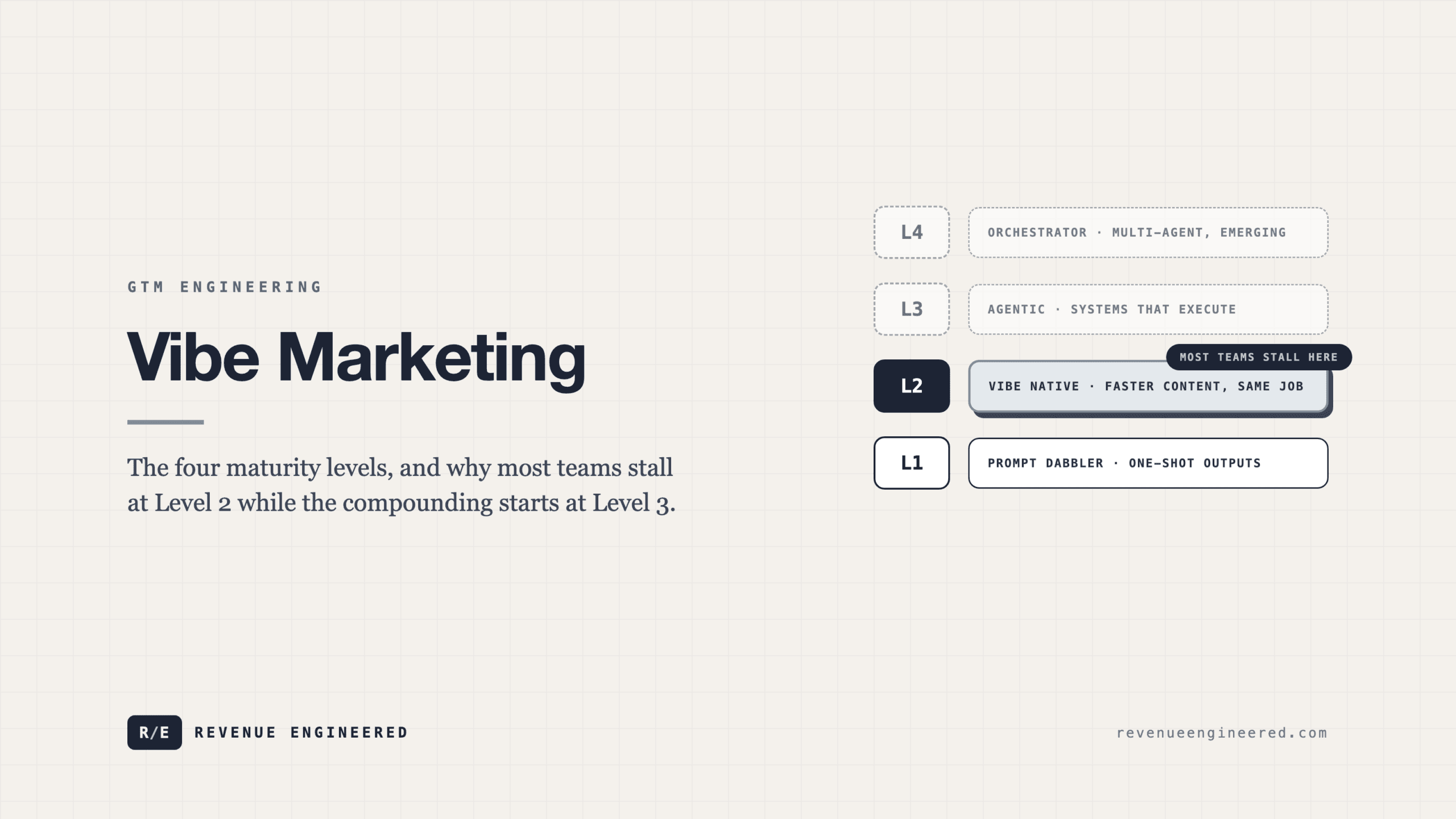
After watching dozens of GTM teams adopt AI over the past year, and after 39 days of building real GTM systems with Claude Code myself, I have started to see a clear maturity model emerge. Four levels, each with distinct capabilities and outcomes. Almost every team I talk to is stuck at Level 2, and the gap between Level 2 and Level 3 is where the entire game changes.
Level 1: the prompt dabbler

Level 1: the prompt dabbler reframed as system design.
This is where most people start. You open ChatGPT or Claude, type a prompt, get an output, copy it somewhere, and repeat. The AI is a text generator. You use it the way you would use a calculator: you give it a specific input, it gives you a specific output, and you go on with your day.
At Level 1, the workflow is entirely manual. Every interaction is a one-shot request. There is no memory between sessions. There is no system connecting outputs to actions. The marketer writes a prompt for a blog post, gets a draft, spends 30 minutes editing it, and publishes. They write a prompt for email copy, get a draft, spend 20 minutes rewriting the parts that sound like a robot, and paste it into their ESP.
The productivity gain at Level 1 is real but modest. Maybe 20-30% faster than doing everything from scratch. The quality ceiling is low because the AI has no context about your brand, your audience, your previous content, or your strategy. Every prompt starts from zero. You spend as much time providing context and editing output as you would have spent writing it yourself.
Most marketing teams adopted AI at Level 1 sometime in 2023 or early 2024. A surprising number are still here. They have ChatGPT bookmarked, they use it a few times a week, and they consider themselves “AI-enabled.” They are barely scratching the surface.
Level 2: the vibe native
Level 2 is where things start to feel productive. The marketer has developed a working knowledge of how to get good outputs from AI. They understand prompting patterns. They know that providing examples, specifying tone, and giving context produces better results. They have saved their best prompts somewhere. They might use custom GPTs or Claude Projects with pre-loaded instructions.
The vibe native produces content faster and at higher quality than the prompt dabbler. They can generate a week’s worth of LinkedIn posts in an hour. They can draft a landing page in 20 minutes. They can produce email sequences, ad copy, blog outlines, and social content at a pace that would have required a content team of three or four people.
This is where the “AI is a productivity tool” narrative lives, and it is where most marketing teams plateau.
The reason they plateau is that Level 2 is still about content generation at its core. The AI writes things. The human reviews, edits, approves, and publishes. Every output still requires human handling. The bottleneck has shifted from “producing the content” to “reviewing and distributing the content,” but there is still a bottleneck, and it is still the human.
Level 2 teams often report that AI “saves them time” but does not change their output volume dramatically. They produce content 3x faster but do not produce 3x more content because the approval and distribution workflows have not changed. The time saved on writing gets absorbed by the review cycle, the publishing process, and the coordination overhead that exists independent of how the content was created.
The vibe native mistake is thinking the problem is speed of production. The real constraint is the system around the production.
Level 3: the agentic marketer
Level 3 is where the step function happens, and it is where I see the fewest teams operating despite it being where the highest value lives.
The agentic marketer uses AI to build systems that execute, not to write things faster. The difference is structural. At Level 2, you prompt an AI to write a blog post. At Level 3, you build a system where an AI agent monitors your analytics, identifies content gaps, drafts posts that fill those gaps, formats them for your CMS, schedules them based on historical engagement data, and generates the distribution copy for email and social. The human reviews a queue of ready-to-publish content rather than initiating every piece from scratch.
This is where vibe coding becomes a GTM capability rather than a technical novelty. The agentic marketer does not need to be a software engineer. They need to be comfortable enough with tools like Claude Code or Cursor to string together automations, write simple scripts, and build workflows that connect their AI capabilities to their distribution infrastructure.
I have spent the past 39 days building exactly this kind of system. Using Claude Code, I have constructed content pipelines, analytics dashboards, research workflows, and distribution automations that would have taken a small team months to build and maintain. The experience taught me something important: the barrier to Level 3 is not technical complexity. The tools are good enough that someone with basic scripting comfort can build meaningful automation. The barrier is a mental model shift from “AI generates content” to “AI operates systems.”
The $100K/month solo agency operator I mentioned at the top lives at Level 3. They have built a client onboarding system where AI agents ingest the client’s brand guidelines, analyze their existing content, generate a strategy document, and produce the first month’s content calendar, all before the operator reviews anything. The operator spends their time on client relationships, strategy decisions, and quality control. The AI handles the production pipeline end to end.
The financial implications are direct. A traditional agency with $100K in monthly revenue needs 4-6 employees to deliver the work. The Level 3 operator delivers the same work with zero employees and AI tooling costs under $2,000 per month. The margin difference is enormous, and it compounds because the AI systems scale linearly while human teams scale with all the overhead of hiring, training, managing, and retaining people.
Level 4: the orchestrator

Level 4: the orchestrator as a maturity path.
Level 4 is still emerging, and I want to be honest that very few teams are operating here consistently. But the pattern is becoming visible enough to describe.
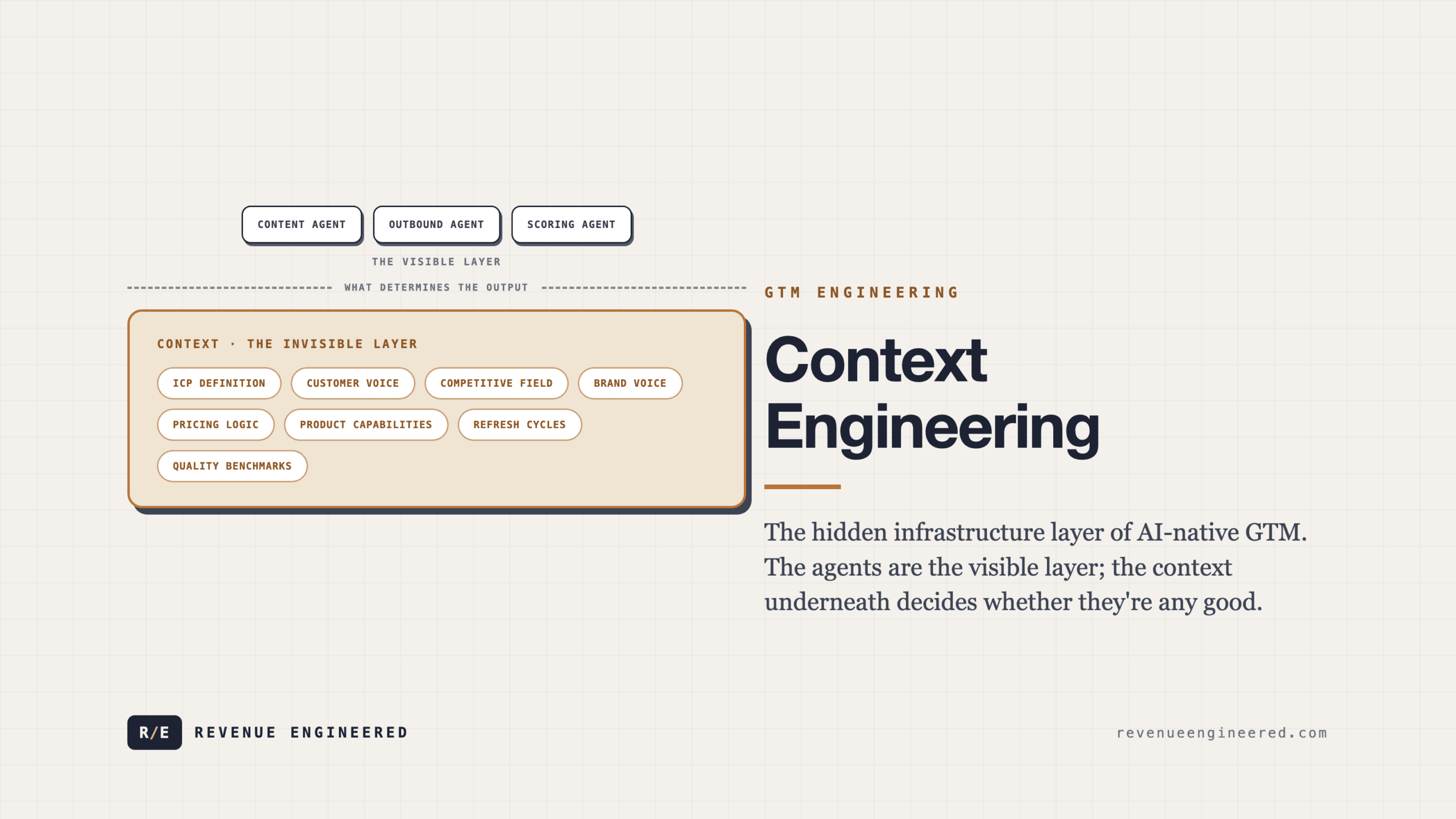
The orchestrator does not build individual AI systems. They build architectures where multiple AI agents coordinate with each other, share context, and make decisions across the GTM function autonomously. A Level 4 setup might have one agent monitoring competitive positioning, another managing content production, a third handling lead scoring and routing, and a fourth optimizing paid spend, all communicating through shared context and escalating to humans only when they encounter situations outside their decision boundaries.
The orchestrator’s job is to design the system, set its objectives, define its guardrails, and intervene when the system encounters novel situations it cannot handle, not to operate it day to day. This is a different skill set from marketing entirely. It is closer to systems architecture, and it requires thinking about feedback loops, context management, failure modes, and coordination protocols.
The early evidence from teams running multi-agent GTM setups is promising but messy. When the agents are well-designed and properly scoped, the throughput is impressive. When context drifts or agents make decisions based on stale data, the output quality degrades in ways that are hard to detect until customers notice. The quality control problem at Level 4 is not “is this content good?” It is “are these agents making good decisions?” and that is a harder problem to solve.
I expect Level 4 to mature significantly over the next 12-18 months as the tooling improves and the patterns stabilize. For now, it is a frontier that a few teams are exploring, not a proven operating model.
Why the Level 2 to Level 3 gap is so hard to cross
The gap between Level 2 and Level 3 is an identity gap, not a skills gap.
At Level 2, you are a marketer who uses AI. Your job title, your daily routines, your performance metrics, all of these are the same as they were before AI. You just do the same work faster. The mental model is familiar. The AI is a tool in your toolbox alongside Google Docs, Figma, and your ESP.
At Level 3, you are something different. You are a builder who happens to work in marketing. You think about systems before you think about content. You evaluate your work by the capabilities you have built, not the assets you have produced. Your daily routine involves reading code outputs, debugging automations, and designing workflows. This feels like a different job because it is a different job.
Most marketers resist this transition because it challenges their professional identity. They became marketers because they are good at messaging, positioning, creative strategy, and audience intuition. They did not sign up to learn scripting, build automations, or think about system architecture. The irony is that the strategic skills, the things that make someone a good marketer, are exactly what Level 3 needs. The automation handles execution. The human handles the strategy that directs the automation. But the path from here to there requires picking up capabilities that feel unfamiliar and uncomfortable.
The founders who can vibe-code have a meaningful advantage here because they have already crossed the identity gap. They already think of themselves as builders. Adding AI-assisted marketing systems to their repertoire does not require a psychological shift, just a new application of existing instincts. A founder who can prototype a product feature in an afternoon using Cursor can also prototype a GTM workflow in an afternoon using the same tools.
Vibe coding as a GTM capability

Vibe coding as a GTM capability translated into operating choices.
This is the point that most people miss when they hear about vibe coding. They think it is about building software products. It is, but it is equally about building GTM infrastructure.
The ability to write code, even imperfect code, even code that an experienced engineer would refactor significantly, gives a marketer or a growth operator capabilities that transform their effectiveness. You can build a custom attribution model instead of relying on whatever your analytics tool provides out of the box. You can create a lead scoring system tailored to your specific business rather than using a generic template. You can automate the entire workflow from content creation through distribution through performance measurement, with custom logic at every step.
Non-technical founders are now building entire products using AI coding tools. The same dynamic applies to GTM. Non-technical marketers can now build GTM systems that previously required an engineering team to support. A landing page generator that pulls from your content library and adapts to different audience segments. An automated competitive monitoring system that alerts you when a competitor changes their positioning. A content distribution pipeline that repurposes a single piece across six channels with format-appropriate variations.
None of these require deep software engineering expertise. They require enough comfort with AI coding tools to describe what you want, iterate on the output, and connect the pieces into a working system. The bar for “technical enough” has dropped dramatically, and the marketers who recognize this are the ones crossing from Level 2 to Level 3.
The compounding effect
The reason this maturity model matters for GTM leaders is that the levels compound differently. Level 1 gives you a linear productivity gain. Level 2 gives you a somewhat larger linear gain. Level 3 gives you a compounding gain because the systems you build continue to produce value without additional input. Level 4, when it matures, will give you an exponentially compounding gain because the systems will improve themselves.
A Level 2 team that produces 3x more content than they did before AI still needs to maintain that pace manually. A Level 3 team that builds a content system produces the content automatically and can redirect their attention to the next system. Over six months, the Level 2 team has produced a lot of content. The Level 3 team has built a content system, a distribution system, a competitive intelligence system, and an attribution system. The capability gap widens with every month because the Level 3 team is building infrastructure while the Level 2 team is producing assets.
The practical question for every marketing and growth leader reading this is simple: which level is your team at, and what would it take to move up one level? If you are at Level 1, the path to Level 2 is education and practice with prompting. If you are at Level 2, the path to Level 3 is building your first end-to-end automated workflow, even a simple one. Start with something small. Automate a single repetitive process. Get comfortable with the tools. Then build the next thing, and the next.
The teams that reach Level 3 in 2026 will have a structural advantage that Level 2 teams cannot close by working harder. They will have built machines that run while they sleep. And in a competitive environment where speed and volume increasingly determine who wins, that difference is the whole game.
Enjoying this essay?
Written by

Elom
GTM, growth, and revenue systems operator with 12 years across Fortune 500s, fintech, and B2B startups. Building at the intersection of AI, data, demand, and revenue.
Get the next deep-dive in your inbox
Essays on demand creation, GTM, growth engineering, and revenue systems. Free.