The GEO Stack: Ranking on ChatGPT, Perplexity, and Gemini
AI search traffic converts 6x better than organic. Here’s the technical playbook for getting cited.
A B2B SaaS company I’ve been watching closely ran a proper attribution analysis on their inbound pipeline last quarter. The finding that changed their roadmap: visitors referred from ChatGPT converted at 6x the rate of traditional organic search traffic. Not 6% more. Six times.
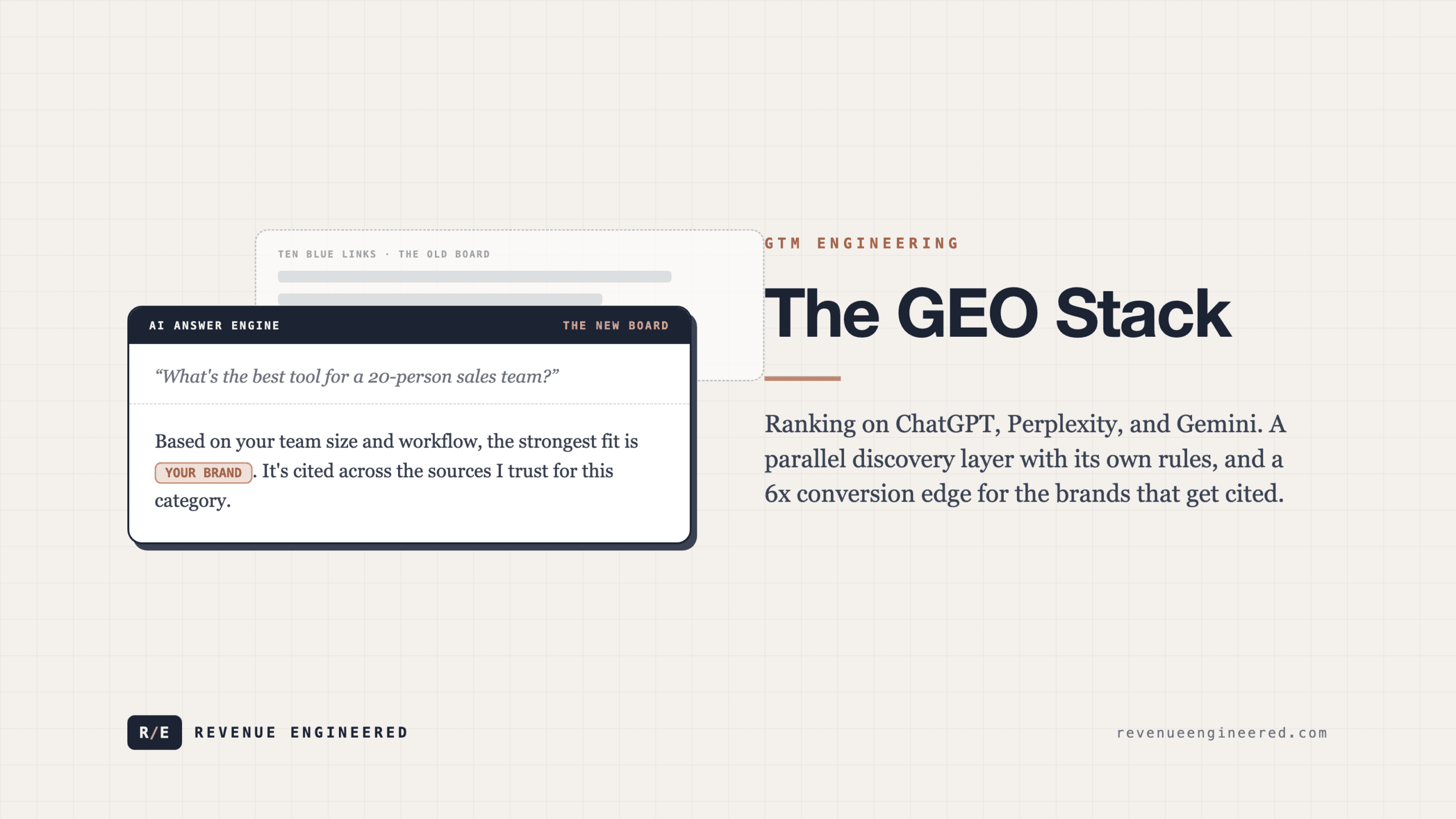
The reason is structural. Someone arriving from Google typed a query, scanned ten blue links, clicked one, skimmed the page, maybe bounced. Someone arriving from ChatGPT had a conversation. They described their problem in natural language. The model recommended a specific product. The visitor arrived with context, with intent already shaped, often with a clear sense of what they wanted to do next. That is a fundamentally different entry point into a buying journey.
This data point is the early signal of a channel shift that will reshape B2B distribution over the next two years, not a one-off outlier. And most companies have no system for influencing whether they appear in AI-generated responses at all.
The new discovery layer

Two games, two boards: the discovery layer splits.
Google still processes billions of queries per day. SEO is not dead. But a parallel discovery layer is forming, and it operates on entirely different principles.
When someone asks ChatGPT “what’s the best CRM for a 20-person sales team,” the model does not crawl the web in real time and rank pages by backlinks. It synthesizes an answer from its training data, from any retrieval-augmented sources it can access, and from the patterns it has learned about what constitutes a credible recommendation. The signals that determine whether your product appears in that answer are different from the signals that determine your Google ranking.
Perplexity works differently again. It does fetch live sources, but its citation logic prioritizes structured, authoritative content that directly answers the query. Gemini has its own retrieval patterns, heavily weighted toward Google’s own index but filtered through a different ranking function than traditional search.
Each major AI platform has its own retrieval architecture and signal model. A growing share of B2B buyers now use those systems as their first research step, not Google.
This is what Generative Engine Optimization (GEO) actually means. Not a rebranding of SEO. A different optimization surface altogether that requires a dedicated strategy and measurement layer, plus its own technical implementation.
AEO is a superset, not a replacement
There is a useful framing that clarifies the relationship between what you already do and what you need to add. AI Engine Optimization (AEO) is a superset of SEO. Everything that makes you rank well on Google still matters. But AEO adds an additional layer: optimizing for AI model citations and recommendations.
In traditional SEO, backlinks are the currency of authority. In AEO, mentions are the new backlinks. When your brand, your framework, or your product gets referenced across the web in contexts that LLMs can ingest, you increase the probability that models will cite you in their responses. A backlink from a high-authority domain helps your Google ranking. A mention of your brand in a context that an LLM trains on helps your AI visibility. Both matter. They are not the same mechanism.
The practical implication: your content strategy needs to produce two kinds of output. Content that ranks in traditional search (still worth doing, still drives traffic). And content that gets quoted and cited across the web in ways that increase your presence in LLM training data and retrieval indices.
The second type looks different from the first. It is more opinionated. It introduces named frameworks. It makes specific claims with specific numbers. It is the kind of content that other writers reference when making their own arguments. Generic “complete guide to X” posts optimized for keyword density are almost invisible to LLMs because they say nothing distinctive enough to cite.
What the data actually shows
A study of 64,000 URLs produced a finding that should reframe how you think about AI content and AI visibility at the same time.
Only 14% of AI-generated content appeared in Google’s index. Most AI-written articles, even well-structured ones, were functionally invisible to traditional search. Google’s quality signals are good enough to deprioritize the flood of LLM-generated text that lacks originality and depth.
On the other side: only 18% of URLs appeared in ChatGPT citations. The overlap between “ranks on Google” and “cited by ChatGPT” is surprisingly small. You can rank first on Google for a term and never appear in a ChatGPT response about the same topic. You can be cited by ChatGPT and sit on page three of Google.
These are two different games played on two different boards. Optimizing for one does not automatically win the other. The companies that will dominate the next era of distribution are the ones building systems that address both.
The technical playbook

Five moves that change citation probability.
Here is what is actually working for the teams I track who are systematically optimizing for AI search. This is not theory. These are patterns from companies that are measuring AI referral traffic and iterating on what moves the needle.
First, structure for extraction. LLMs are good at pulling information from content that uses clear headers and direct definitions that answer specific questions. FAQ sections at the bottom of articles get cited more often than you would expect because they map cleanly to the question-answer format that AI models use. If your content buries its main claims in paragraph six of a long narrative section, a model will skip over it. Put your strongest claims where they are easy to extract.
Second, be the primary source. LLMs prefer to cite content that presents original data, original frameworks, or original analysis. If your article is a synthesis of other people’s ideas, the model will cite the original sources instead. Publish your own research. Name your own frameworks. Present your own benchmarks. This is where the 6x conversion advantage comes from: the companies getting cited are the ones producing original intellectual property, not repackaging existing knowledge.
Third, build entity authority. AI models associate brands with topics through repeated co-occurrence. If your company name appears alongside “sales automation” in hundreds of contexts across the web, the model learns that association. Entity authority is built through breadth of mention, not depth of any single piece of content. This is why PR and podcast appearances now sit beside community participation as GEO tactics, not just brand tactics.
Fourth, optimize for conversational queries. People do not type keyword strings into ChatGPT. They ask questions in natural language. “What tool should I use to automate outbound for a 5-person sales team” is a typical query. Your content needs to answer these conversational questions directly, using language that matches how people actually ask. The old keyword-density approach is useless here. Natural language comprehension is the optimization target.
Fifth, video. This is genuinely underpriced as an AEO asset right now. YouTube transcripts are indexed by multiple AI models. A video where you explain your methodology, walk through a case study, or demonstrate your product creates a transcript that LLMs can reference. The production quality bar is low. A founder talking through their approach on camera for ten minutes creates more citable material than most blog posts.
What does not work

Two tactics with no citation payoff.
There has been enthusiasm about LLMs.txt, a proposed standard where you place a file on your website telling AI crawlers what to index and how to interpret your content. Similar in concept to robots.txt but for language models.
It does not work. The major AI platforms do not respect it. There is no evidence that having an LLMs.txt file influences whether your content gets cited by ChatGPT, Perplexity, or Gemini. The standard has no adoption among the platforms that matter. Implementing it is harmless but also pointless. Your engineering time is better spent on the structural changes that actually affect citation probability.
Similarly, some companies are trying to game AI citations through mass-produced content designed to flood LLM training data with brand mentions. This is the AI-era equivalent of link farms, and it is roughly as effective. The models are trained to weight authoritative, distinctive sources. Volume of mediocre mentions does not translate into citation probability. Quality and distinctiveness of mentions does.
Measuring the invisible
The hardest part of GEO is measurement. Unlike Google, where you can track rankings, impressions, and clicks through Search Console, AI platforms provide limited visibility into whether you are being recommended.
Some tools are emerging. You can monitor brand mentions in AI responses by running systematic queries across major AI answer engines and checking whether your brand appears. This is manual and imperfect, but it establishes a baseline. You can track referral traffic from AI platforms in your analytics, including chat.openai.com, perplexity.ai, and gemini.google.com as referrers. You can measure share of voice in AI responses for your core topics.
The measurement stack is immature compared to SEO tooling. That is actually the opportunity. Teams investing in measurement now are building a data advantage that will compound as the channel grows. By the time everyone else figures out that AI search matters, these companies will have twelve months of optimization data and a system that already works.
The ADO layer

When the buyer is an agent: structured data over marketing copy.
Beyond GEO, there is an emerging optimization surface that most teams have not considered. Agent Decision Optimization (ADO) addresses a near-future where AI agents, not humans, make purchasing recommendations and execute buying workflows.
When a procurement agent evaluates vendors, it will pull from different signals than a human using ChatGPT. It will look at structured data: pricing pages, API documentation, integration lists, security certifications, compliance records. It will weigh quantitative claims more heavily than narrative persuasion. It will compare features programmatically rather than reading blog posts.
ADO means structuring your product information for machine consumption. Clean pricing pages with parseable data. API documentation that an agent can evaluate. Integration directories that are machine-readable. Comparison data that is explicit rather than implied. Think about what happens when an AI procurement agent runs an evaluation: it needs structured specifications, not marketing copy. It needs parseable pricing tiers, not “contact us for a quote.” It needs integration compatibility expressed as data, not as a paragraph claiming you “work with all major platforms.”
The practical steps for ADO readiness are straightforward. Structure your pricing page so a machine can extract tier names, feature lists, and price points without interpreting marketing language. Publish API documentation that an agent can evaluate for capability coverage. Maintain integration directories with version numbers, authentication methods, and data flow descriptions. Make your security and compliance certifications machine-readable (structured JSON on your trust page, not a PDF).
This layer is early. Most B2B companies do not need to invest heavily in ADO today. But the companies building their content and product information with machine readability in mind are positioning themselves for the shift that follows the current AI search wave. When purchasing agents become a standard part of enterprise procurement, the companies whose information is already structured for machine consumption will have a structural advantage that is hard to replicate quickly.
The compound bet
GEO is a parallel distribution channel, not a tactic to add to your existing marketing plan. It requires its own strategy, its own content types, its own measurement system, and its own optimization loop.
The economics favor early movers disproportionately. AI search traffic converts at 6x the rate of traditional organic. The channel is growing as more buyers default to AI platforms for research. And the optimization surface is uncrowded because most companies are still debating whether AI search matters rather than building systems to capture it.
The investment required is also smaller than most teams assume. You do not need a new team. You need your existing content team to produce a different type of output: more opinionated, more original, more structured for extraction. You need your SEO team to add AI citation monitoring to their existing workflow. You need your product marketing team to think about machine readability alongside human readability. These are adjustments to existing functions, not net-new headcount.
The companies I expect to win the next distribution era are running dual systems. Traditional SEO for the traffic that still comes through Google. GEO for the growing share that comes through AI platforms. Both feeding into the same pipeline, measured separately, optimized independently.
Every quarter you delay building this system, the companies that started earlier compound their advantage. The GEO stack is the next infrastructure layer for B2B distribution, not an optional add-on.
Enjoying this essay?
Written by

Elom
GTM, growth, and revenue systems operator with 12 years across Fortune 500s, fintech, and B2B startups. Building at the intersection of AI, data, demand, and revenue.
Get the next deep-dive in your inbox
Essays on demand creation, GTM, growth engineering, and revenue systems. Free.