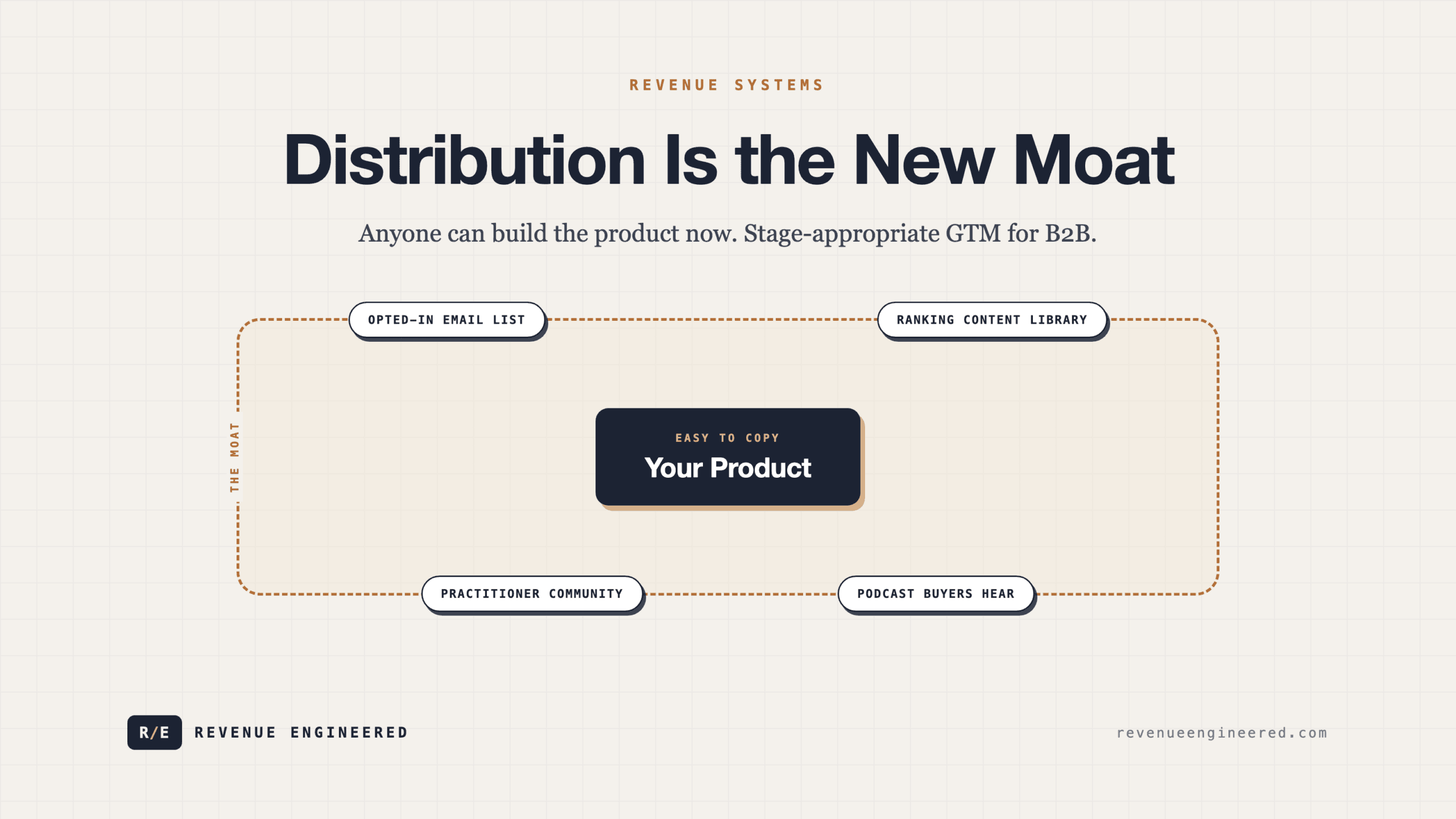
Distribution Is the New Moat: Stage-Appropriate GTM for B2B
Building is cheap. Distribution is expensive. The best GTM teams figured this out first.
The cost of building software is approaching zero. With AI-assisted development, open-source infrastructure, and cloud platforms that abstract away most of the hard parts, a competent team can ship a functional product in weeks. This describes the current state of things, not a forecast. And it changes everything about where competitive advantage actually lives.
If anyone can build it, the question stops being “can we build this?” and becomes “can we get this in front of the right people, repeatedly, at a cost that makes the business work?” That is distribution. And for B2B companies at every stage, distribution is now the only durable moat worth investing in.
The rented audience problem

Rented channels decay. Owned assets compound..
Most B2B companies build their go-to-market on rented ground. They run LinkedIn ads through a platform that changes its algorithm quarterly. They buy intent data from providers who sell the same signals to every competitor. They post on social channels where organic reach declines predictably each year. They build pipeline on platforms they do not control, and then act surprised when the economics shift underneath them.
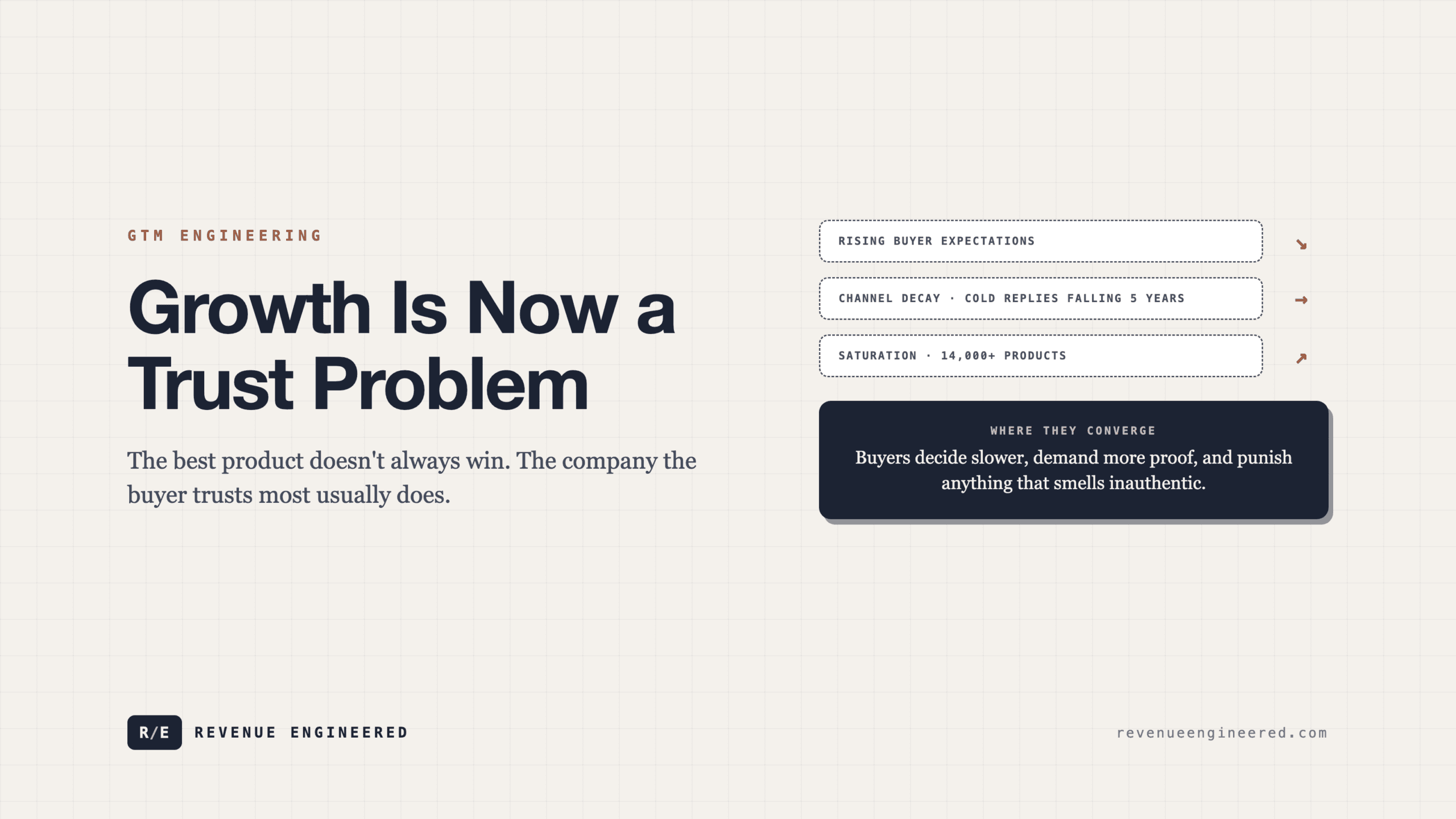
This is not a new problem, but it has become a more expensive one. The average cost per lead on LinkedIn has risen 30% year-over-year for three consecutive years. Google Ads CPCs in B2B SaaS verticals have doubled since 2022. And the response rates on cold outbound continue to fall as inboxes get noisier and spam filters get smarter. The playbook that worked in 2021, where you could buy a ZoomInfo list, send 10,000 emails, and fill a pipeline review, does not produce the same results at the same cost. In many verticals, it no longer produces results at all.
The companies that are growing efficiently right now share a common trait. They own their distribution. They have built systems that generate demand without depending entirely on third-party platforms or paid channels. They treat distribution like infrastructure, not like a line item.
What owned distribution actually looks like
Owned distribution is a specific set of assets and systems that a company controls directly, not a marketing buzzword. An email list of 15,000 qualified subscribers who opted in because the content was worth their time. A podcast that decision-makers listen to on their commute. A community where practitioners share workflows and occasionally ask about your product. A content library that ranks for the terms your buyers search when they have the problem you solve.
These assets share two properties. First, they compound. Each new subscriber, each new ranking page, each new community member adds to the system permanently. You do not have to re-buy their attention every quarter. Second, they are defensible. A competitor can copy your ad creative overnight. They cannot copy your 50,000-subscriber newsletter or your community of 3,000 active practitioners.
The distinction matters because it changes how you think about GTM investment. Paid channels are operating expenses. They deliver returns only while you keep spending. Owned distribution is a capital asset. It delivers returns that increase over time, even as marginal investment stays flat.
Stage-appropriate GTM

The right distribution system depends on stage..
The mistake most companies make is building the wrong distribution system for their current stage, not ignoring distribution altogether. A seed-stage startup does not need a media operation. A Series C company cannot afford to rely on the founder’s personal network. The distribution system has to match the company’s stage, and it has to evolve as the company grows.
Pre-product-market fit
Before PMF, the only distribution that matters is direct conversation with potential buyers. Not at scale. Not automated. Not optimized. Just the founder in the room, on the call, in the Slack channel, talking to people who have the problem and listening to how they describe it.
At this stage, content is a tool for learning, not for lead generation. Write about the problem space. Share what you are hearing from conversations. Put out a point of view and see who responds. The goal is not to build an audience. The goal is to build understanding. The audience, if you are paying attention to what resonates, comes as a side effect.
The companies that struggle most at this stage are the ones that try to scale before they have something worth scaling. They hire a demand gen team before they understand their ICP. They run paid campaigns before they can articulate why someone should care. They invest in distribution infrastructure when they do not yet have a message that converts in a one-on-one conversation. If it does not work in a room with five people, it will not work in front of five thousand.
Growth stage
After PMF, the game changes. You have a message that resonates, a product that retains, and a rough understanding of who buys. Now the question is how to reach more of those people without proportionally increasing spend.
This is where owned distribution becomes a strategic priority. The best growth-stage companies build one primary owned channel and invest in it disproportionately. Not three channels at 33% effort each. One channel at 80% effort, with the others receiving whatever is left.
Which channel depends on where your buyers spend attention. For developer tools, that might be technical content that ranks for the queries engineers search when solving problems. For revenue operations, it might be a community where practitioners share stack configurations and workflows. For security, it might be a research publication that CISOs read because the analysis is better than what analysts publish.
The common thread is that the channel produces value independent of the product. People engage with it because it helps them, not because it sells to them. Pipeline is the outcome, not the pitch.
At growth stage, email becomes the bridge between content and pipeline. Every piece of owned distribution should have a mechanism for capturing contact information from people who found it worth their time. Not a gate that blocks access. A natural next step for people who want more. The difference matters. Gating a white paper behind a form produces a list of people who wanted the white paper. Offering a weekly breakdown of what is changing in their space produces a list of people who trust your perspective. The second list converts at 3-5x the rate of the first.
Scale stage
At scale, distribution becomes a system of systems. The company has multiple owned channels, each producing pipeline. The challenge shifts from “how do we reach people” to “how do we orchestrate across channels without creating noise.”
Scale-stage distribution requires three things most companies underinvest in. First, attribution infrastructure. Not last-touch attribution from your CRM, but real understanding of how buyers move through your ecosystem before they raise their hand. Most B2B buying journeys involve 20-30 touchpoints across 3-6 months. If you only measure the last one, you will systematically underinvest in the channels that create demand and overinvest in the channels that capture it.
Second, content operations. At scale, content is infrastructure, not a marketing function. You need editorial processes, production workflows, and quality standards that can sustain output without depending on any single person. The founder cannot write every post. The head of content cannot edit every article. The system has to produce consistently without heroics.
Third, channel diversification with portfolio logic. Not “let’s try TikTok” diversification. Deliberate expansion into channels that reach different segments of your buying committee, or that reach the same segment at a different point in their journey. Your technical blog reaches the practitioner. Your podcast reaches the VP. Your analyst partnerships reach the C-suite. Each channel has a specific job in the system.
Why “build it and they will come” fails at every stage
There is a persistent fantasy in B2B that a sufficiently good product will distribute itself. It will not. Products do not spread. Stories about products spread. Recommendations from trusted peers spread. Content that helps someone do their job better spreads. The product itself sits there, waiting to be discovered by someone who already knows what to search for.
Even product-led growth, which is often held up as the exception, is really a distribution strategy wearing a product hat. The free tier is a distribution mechanism wearing the costume of generosity. The invite flow is a viral loop dressed as a feature. The self-serve onboarding exists to drive the cost of acquisition toward zero for users who convert to buyers later; the convenience is just the cover story.
The companies that win at distribution do not treat it as something that happens after the product is built. They design for distribution from the beginning. They ask “how will people find this, and why will they tell others about it?” before they ask “what features should we build next?”
Distribution as strategic infrastructure

Distribution becomes a compounding asset..
The shift happening in B2B right now is that the best GTM teams are treating distribution the way engineering teams treat infrastructure. They are designing it, investing in it, measuring it, and iterating on it with the same rigor they apply to the product itself.
This means distribution has an architecture. There are data layers (who are we reaching, what do they care about), application layers (content, community, events, product), and deployment layers (channels, sequences, automation). Each layer can be improved independently, but they all need to work together.
It means distribution has SLAs. The content team ships on a cadence. The community team maintains engagement thresholds. The demand gen team hits pipeline coverage targets. Not as aspirations. As commitments with the same weight as uptime guarantees.
And it means distribution has a roadmap. Not a calendar of blog posts. A multi-quarter plan for building assets that compound, entering channels that reach new segments, and retiring tactics that have diminishing returns.
The companies that figure this out will have an advantage that is genuinely hard to replicate. Not because their product is better, though it might be. Because they built the system that puts their product in front of the right person at the right time, and they own that system entirely. In a world where anyone can build anything, that is the moat.
Enjoying this essay?
Written by

Elom
GTM, growth, and revenue systems operator with 12 years across Fortune 500s, fintech, and B2B startups. Building at the intersection of AI, data, demand, and revenue.
Get the next deep-dive in your inbox
Essays on demand creation, GTM, growth engineering, and revenue systems. Free.