The 35-Person Unicorn: How AI Breaks the Headcount-Revenue Curve
Why the relationship between headcount and revenue is breaking, and what it means for how we build companies
For the last thirty years, there was an unspoken formula in venture-backed software. You raise capital. You hire. Revenue follows headcount. A $100M ARR company needed 500-1,000 employees. The math was so reliable that investors used headcount growth as a proxy for business health. If you were hiring fast, you were probably growing fast. That assumption is now breaking in ways that are hard to overstate.
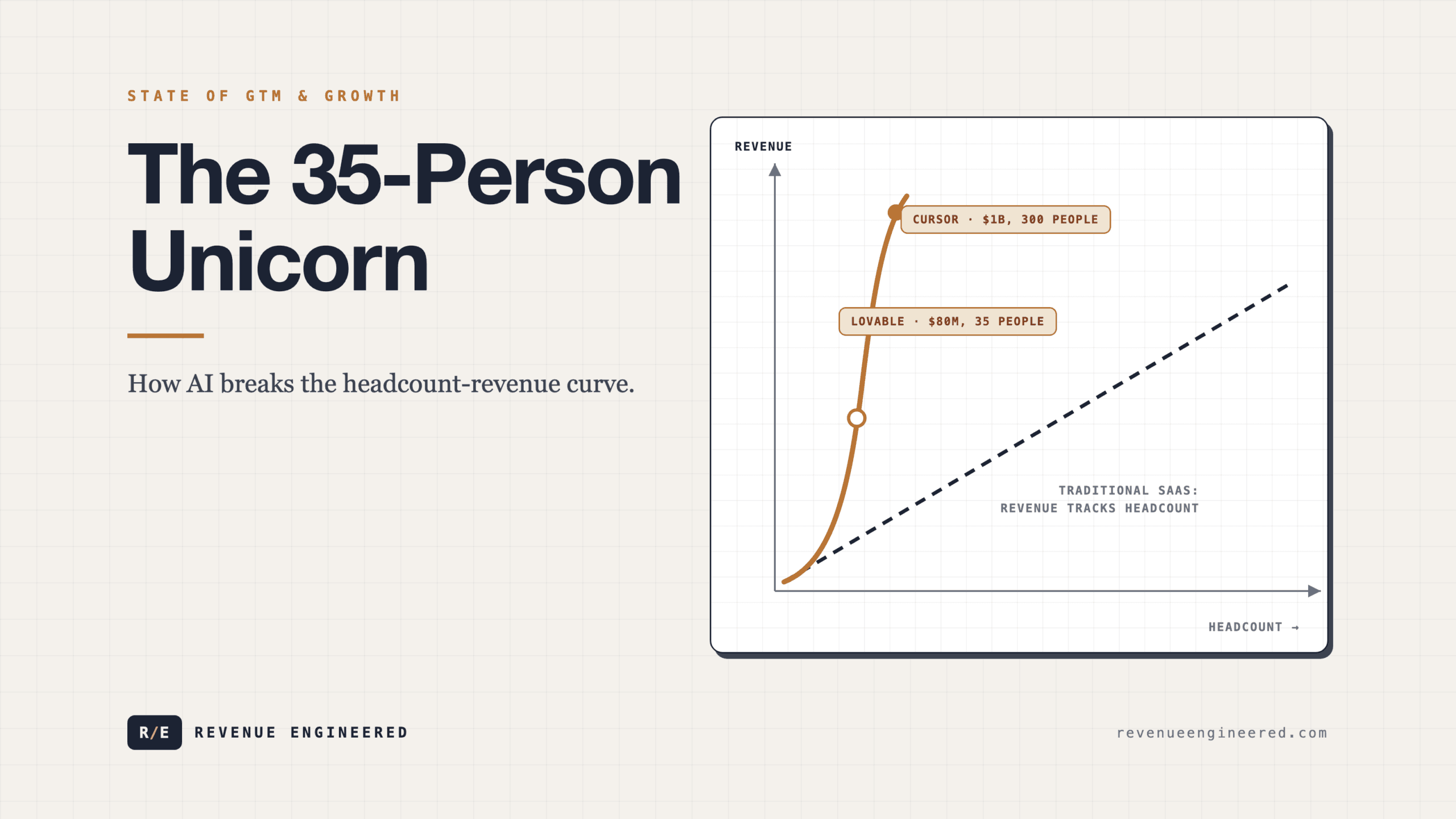
Midjourney generates $500M in annual revenue with roughly 100-160 people, depending on who’s counting. Cursor hit $1B in annualized revenue with about 300 employees. Lovable reached $80M ARR in seven months with 35 people. ElevenLabs crossed $330M ARR with 50 team members before scaling up to support their enterprise push. These are not edge cases. They represent a structural shift in how value gets created and captured in software companies.
The traditional SaaS benchmark for revenue per employee sits around $200K-$300K for well-run companies. The median across private SaaS is closer to $130K. The top AI-native companies are running at $3M+ per employee. That is an order of magnitude difference, not an incremental improvement, and it changes everything about how companies need to think about growth, org design, and go-to-market.
The old model: headcount as the growth engine

old model: headcount as the growth engine reframed as system design.
In traditional SaaS, the path to scale was people. You wanted to enter a new market segment, you hired a sales team for it. You wanted better customer support, you added headcount. You needed new features shipped faster, you recruited more engineers. Every strategic priority eventually resolved into a hiring plan, and every hiring plan eventually resolved into a burn rate.
This created a specific kind of organizational physics. Coordination costs scaled with headcount. Communication overhead grew exponentially. You needed managers to manage the people, then managers to manage the managers. Project timelines stretched because every initiative required alignment across five departments. A feature that should have taken a week took a quarter because it needed buy-in from product, engineering, design, legal, and marketing before anyone wrote a line of code.
The dependency drag was real but invisible. Nobody measured the cost of the meeting about the meeting. Nobody quantified how much velocity died when a growth lead had to file a ticket with the design team and wait six weeks for a mockup. The system felt normal because it was all anyone had ever known.
Revenue per employee at companies like Salesforce, HubSpot, and ServiceNow has hovered around $300K-$500K for years. These are excellent businesses. But they require thousands of people to produce billions in revenue. That ratio was treated as a law of nature. It turns out it was a constraint of the era, not a permanent feature of how software businesses work.
What changed
Two things happened almost simultaneously. First, AI models became capable enough to handle meaningful work. We’re talking about creative and analytical work, plus operational tasks that previously required skilled humans, not rote automation. Second, a new generation of builders emerged who treat AI as a default tool rather than an optional add-on.
That second point is worth pausing on. The gap between companies that “use AI” and companies that are “AI-native” is enormous. Using AI means bolting ChatGPT into your existing workflows. Being AI-native means your team defaults to AI for everything and only involves humans when the machine genuinely falls short.
We’re seeing this play out clearly at the fastest-growing AI companies. When someone on the team has an idea, they build it. They don’t write a brief. They don’t file a Jira ticket. They don’t schedule a meeting with the design team. They use AI tools and ship it. Internal tools, marketing pages, prototypes, production code, it all moves at a pace that traditional orgs simply cannot match, because the coordination tax has been removed.
The result is that a 35-person company can produce output that would have required 200+ people five years ago. And the output quality is comparable or better, because fewer handoffs mean fewer communication losses, and faster iteration means more shots on goal.
The revenue-per-employee gap in practice
The data on this is striking. Across the top AI startups, the average revenue per employee is roughly $3.5M, which is about 5.7x higher than the $600K average among leading traditional SaaS firms. Even excluding Midjourney as an outlier (their 11-person team generating $200M ARR in 2023 was genuinely unprecedented), the average for the next nine companies is still $2.5M per employee.
Some specific numbers worth sitting with:
Cursor reached $100M ARR in under 12 months with 20 people. By the time they hit $1B in annualized revenue, they had scaled to 300 employees, which means they achieved the milestone that most SaaS companies never reach at all, and did it with fewer people than a mid-size sales team at a traditional enterprise software company.
Lovable went from launch to $80M ARR in seven months with 35 people, then continued scaling past $200M ARR in under a year. Meanwhile, Shopify’s CEO posted a memo stating that his teams must prove AI cannot do a job before requesting new headcount. That memo went viral, but it was just putting words to what AI-native companies already practice by instinct.
Midjourney built a $10B business with no venture capital and a team small enough to fit in a conference room. The fact that this sentence can be written without exaggeration should make every operator reconsider their assumptions about what scaling requires.
What functions AI replaces vs. augments
There is a temptation to view this as a simple story of replacement: AI takes jobs, companies shrink. The reality is more nuanced and, frankly, more interesting.
AI genuinely replaces work in areas where the task is repetitive and well-defined, with no need for real-time human judgment. Content production at scale. Data entry and enrichment. Tier-1 customer support. Basic code generation. QA testing. Reporting and dashboard creation. These are functions where AI can operate at 80-90% of human quality with 10x the throughput, and for many use cases that tradeoff is a clear win.
But the replacement story has limits, and the Klarna example is instructive. They cut roughly 40% of their workforce and replaced customer service agents with AI at scale. The AI handled the work of 853 employees. The financial results looked great on paper. Then customer satisfaction cratered. Complaints spiked. The CEO eventually admitted they “went too far” and started rehiring humans. There are domains, particularly anything involving empathy, complex judgment, or ambiguous situations, where AI augmentation works but pure replacement fails.
The functions AI genuinely augments, making humans dramatically more productive without replacing them, are arguably more important. Engineering teams using Cursor-style AI coding tools are shipping 3-5x more code per developer. Growth operators are building and launching experiments that would have required a cross-functional team in a single afternoon. Marketers are creating campaigns, landing pages, and entire go-to-market assets without waiting in the design queue. The augmentation story is where the real leverage lives, because it means each human employee produces radically more output per dollar of compensation.
What disappears is the coordination layer. You don’t need program managers if there are no programs to manage. You don’t need a design review committee if the person with the idea can design it themselves. You don’t need a six-week sprint planning cycle if one engineer can ship the feature in a day. The middle management layer that existed primarily to coordinate between specialists gets compressed. The specialists themselves become more autonomous and more productive.
What this means for GTM teams specifically

What this means for GTM teams specifically as a maturity path.
This is where things get really practical. If your entire company is 35 people, how do you build a go-to-market motion?
The answer, based on what we’re seeing at the fastest-growing AI companies, is that traditional GTM org charts don’t apply. There is no VP of Marketing managing a team of 12. There is no SDR army of 30. There is no product marketing function with five people writing positioning documents.
Instead, the GTM motion at lean AI companies looks more like this:
The founder (or a single senior growth leader) owns the strategy and is the primary external voice. LinkedIn and social content from the founder becomes the top-of-funnel engine. This works because AI-native companies ship so fast that building in public becomes a natural distribution mechanism. When you’re launching features weekly, every release is content.
A small team of 2-4 growth engineers handles everything that would have been split across marketing, growth, product, and analytics at a traditional company. They run experiments, build landing pages, set up attribution, manage paid campaigns, and instrument the product. AI handles the production work. Humans handle the strategy and judgment calls.
Community replaces traditional marketing. At companies reaching $100M+ ARR with tiny teams, community engagement, Discord servers, user forums, and social channels often generate more pipeline than any paid campaign. The cost is near zero. The compounding effect is massive.
Sales, when it exists at all, is product-led. The product does the selling. Humans step in for enterprise deals where procurement processes require a human counterpart. But the motion is fundamentally different from building a 50-person sales org with territories and quotas.
The AI agent layer is starting to handle outbound, nurturing, and qualification. We’re seeing early-stage companies deploy AI agents that handle the work that would have required 5-10 SDRs. The agents don’t replace the strategic selling, but they handle the volume work of prospecting, sequencing, and qualifying at a fraction of the cost.
The uncomfortable implications
There is something genuinely unsettling about watching a 35-person company reach a valuation that took previous generations 1,000 employees to achieve. The implications for the labor market are real and worth being honest about.
The mid-level coordinator role, the person whose job is to sit between teams and make sure information flows, is the most exposed category. Project managers, program managers, mid-level marketing managers whose primary value is coordination rather than creation. When teams shrink from 200 to 35 and output stays the same, the people who were managing the complexity of the 200-person org are no longer needed, because the complexity itself is gone.
The hiring calculus has fundamentally shifted. Tobi Lutke’s memo at Shopify made this explicit: before requesting new headcount, teams must demonstrate why AI cannot do the job. That’s a structural change in how companies think about growth. The default is no longer “we need more people.” The default is “can AI handle this?” and hiring only happens when the answer is genuinely no.
For individual operators, the implication is clear. The premium is on people who can operate autonomously and use AI as a multiplier. A growth engineer who can build a landing page, write the copy, set up tracking, run the paid campaign, and analyze the results, all using AI as a co-pilot, is worth more than a team of five specialists who each do one of those things and spend 40% of their time in coordination meetings.
Where this breaks down

Where this breaks down translated into operating choices.
I want to be honest about the limits because the hype around lean AI companies sometimes obscures real constraints.
Regulation-heavy industries (healthcare, finance, government) cannot operate with 35-person teams serving millions of customers, because compliance requirements create organizational overhead that AI cannot eliminate. Someone has to sign the audit. Someone has to testify before the regulator. Someone has to maintain the paper trail.
Enterprise sales with long procurement cycles still require humans. When a Fortune 500 company takes nine months to buy your software and involves 12 stakeholders, an AI agent cannot manage that process. The relationship-building, the internal championing, the navigating of committee politics, these remain human skills.
And the Klarna cautionary tale applies broadly. Any company that goes too far on AI replacement in customer-facing roles risks discovering that their “efficiency gain” was actually a customer experience loss. The math looks good until churn spikes.
The new operating model
What we’re watching is not a temporary anomaly. The structural economics of software companies are being rewritten. The median time to $1M ARR for AI companies is 11.5 months versus 15 months for traditional SaaS. Time to $5M ARR is 24 months versus 37 months. And these companies are reaching those milestones with a fraction of the people.
The implication for founders is that the venture model itself may need updating. If you can reach $100M ARR with 50 people, you don’t need $200M in funding to build a $500M sales org. The capital efficiency of AI-native companies changes the fundraising calculus, the board composition, and the exit math.
The implication for operators is that the skills that matter are shifting. Coordination skills are worth less. Execution skills, specifically the ability to use AI tools to produce complete work products autonomously, are worth more. The growth leader of 2028 looks less like a VP managing a team of 20 and more like a senior individual contributor who ships more than entire departments used to.
The companies that figure out this operating model first will have a structural advantage that compounds over time. Not because they found a clever growth hack, but because they fundamentally require fewer resources to produce the same or greater output. When your competitor needs 500 people to do what you do with 50, their cost structure becomes a permanent strategic disadvantage.
The headcount-revenue curve served as the operating model for an entire era of software. That era is ending. What replaces it will look nothing like what came before, and the transition is happening faster than most organizations are prepared to admit.
Enjoying this essay?
Written by

Elom
GTM, growth, and revenue systems operator with 12 years across Fortune 500s, fintech, and B2B startups. Building at the intersection of AI, data, demand, and revenue.
Get the next deep-dive in your inbox
Essays on demand creation, GTM, growth engineering, and revenue systems. Free.