Domain Depreciation Schedules: Running Email Infrastructure Like an Asset Portfolio
Most companies treat sending domains as set-and-forget. Operators at scale treat them as depreciating assets with predictable lifecycles.
I manage outbound email infrastructure across accounts that collectively touch over 200,000 inboxes per month. At that scale, you stop thinking about email domains the way most companies do, which is as a thing you set up once and forget about until deliverability craters. You start thinking about them the way a portfolio manager thinks about depreciating assets.
Every domain has a lifecycle. It warms up, performs, plateaus, then eventually degrades. The degradation isn’t random. It follows patterns that are as predictable as wear on manufacturing equipment. The companies that run outbound at 50% deliverability treat domains like permanent infrastructure. The ones running at 90%+ treat them like consumables with known shelf lives and planned replacement schedules.
This article covers the system I use. It is unglamorous, operationally tedious, and the single biggest differentiator between outbound programs that produce pipeline and outbound programs that produce spam complaints.
The depreciation curve

depreciation curve reframed as system design.
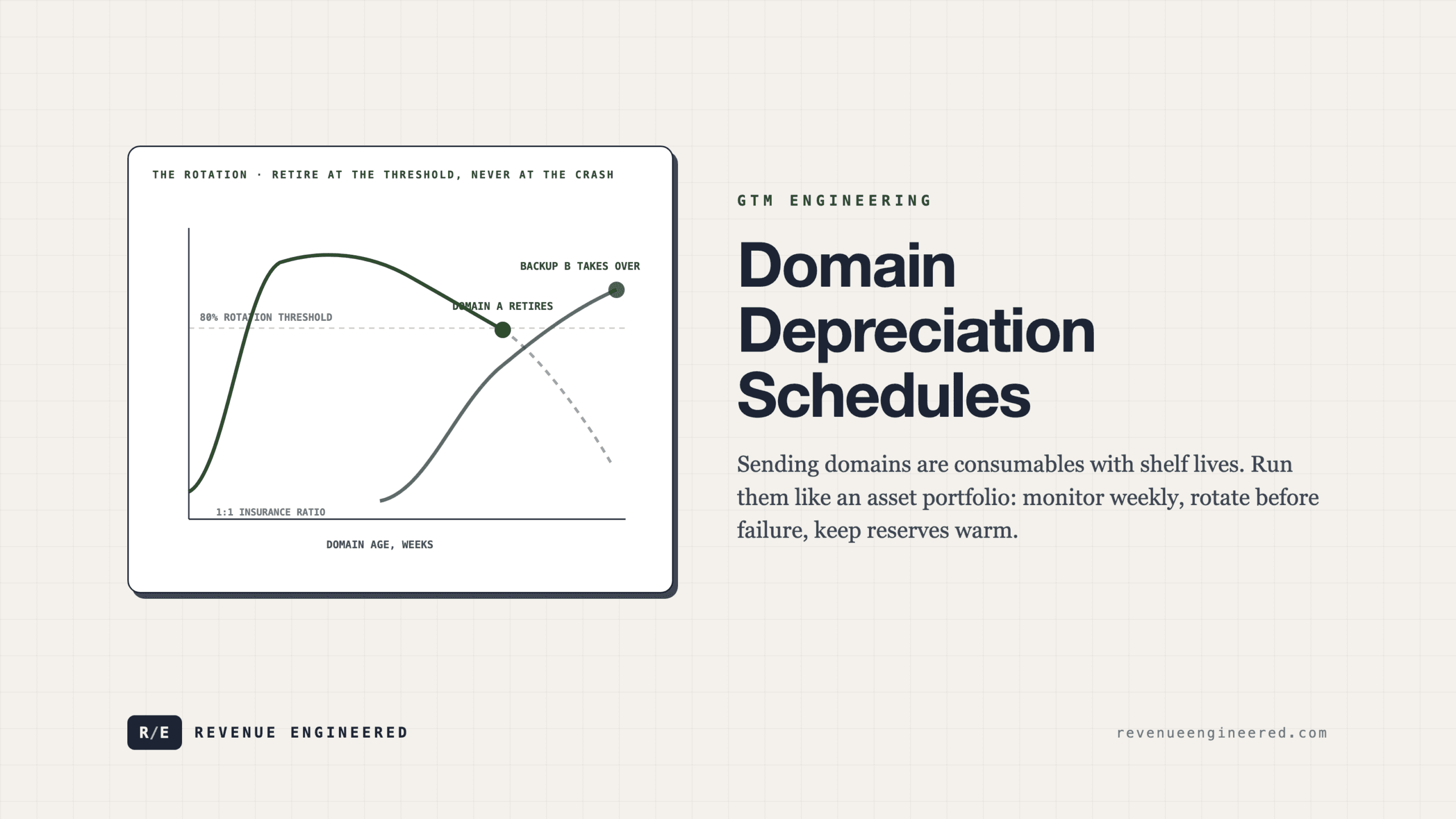
A new sending domain follows a predictable arc. Weeks one through four are the warmup period. You’re sending low volumes to highly engaged contacts, building sender reputation from zero. Domain authentication (SPF, DKIM, DMARC) is configured, and mailbox providers are learning to recognize you. During this phase, deliverability is artificially high because volume is low and recipients are curated.
Weeks four through twelve are the performance window. The domain is warmed, reputation is established, and you can push volume to operational levels. This is peak performance. Inbox placement rates sit between 85% and 95% for a well-managed domain. Reply rates are at their highest because the domain has no negative history.
Weeks twelve through twenty-four are the plateau. Performance is still good but beginning to soften at the edges. Spam complaints accumulate. Some recipients mark you as junk. Blocklists start flagging the domain intermittently. You can see the degradation in the data if you’re tracking it weekly. Inbox placement drops from 90%+ to the 75-85% range.
After week twenty-four, the decline accelerates. The domain has accumulated enough negative signals that mailbox providers are throttling it. Inbox placement drops below 70%. Bounce rates creep up. Some providers route you straight to spam. At this point, the domain is functionally burned. You can try to rehabilitate it with months of low-volume, high-quality sending, but the economics of rehabilitation rarely justify the effort when a fresh domain costs $12 and four weeks of warmup.
These timelines vary by volume, content quality, and list hygiene. A domain sending 500 emails a day to a clean list might last eight months. A domain sending 5,000 a day to a mixed list might burn in three. But the shape of the curve is consistent. Every domain depreciates. The only variable is how fast.
The 1:1 insurance ratio
The principle that changed how I think about domain infrastructure is simple: for every active sending domain, maintain one warming backup domain. I call this the 1:1 insurance ratio.
If you’re running outbound on four active domains, you should have four backup domains in various stages of warmup at all times. When an active domain degrades past your performance threshold, a backup is ready to replace it. There is no gap in capacity, no scramble to warm a new domain, no week of reduced output while you figure out what happened.
This feels expensive when you first hear it. It is cheap when you do the math. Eight domains at $12 each is $96 per year. The warmup tooling (services like Instantly, Warmbox, or manual warmup sequences) costs $30-50 per domain per month. Total annual cost for eight domains with warmup: roughly $3,500. Compare that to the revenue impact of a week of degraded deliverability at scale. One bad week can cost more than a year of the insurance program.
The rotation schedule works like this. Every Friday, I audit all active domains. Any domain with inbox placement below 80% for two consecutive weeks gets flagged. Any domain flagged for two consecutive audits gets rotated out and replaced with the most mature backup. The retired domain goes into a cooldown period, sending nothing for thirty to sixty days, before optionally re-entering the warmup cycle. Most of the time, I don’t bother re-warming retired domains. Fresh ones are cheap and perform better.
The Friday audit protocol
The weekly audit is the operational heartbeat of the whole system. Skip it for two weeks and you won’t notice a difference. Skip it for four and you’ll be debugging deliverability problems that could have been prevented.
The audit takes thirty minutes. I check five things for each active domain.
First, inbox placement rate. This is the percentage of sent emails that land in the primary inbox rather than spam, promotions, or getting bounced. I track this with seed-based testing, sending test emails to a panel of seed addresses across Gmail, Outlook, and Yahoo, and checking where they land. Any domain below 80% gets flagged.
Second, bounce rate. Hard bounces above 2% indicate list quality problems. Soft bounces above 5% indicate reputation problems. Either one above threshold triggers investigation.
Third, spam complaint rate. Google and Microsoft both publish complaint rate data through their postmaster tools. Anything above 0.1% on Google or 0.3% on Microsoft is a warning sign. Above 0.3% on Google is an emergency.
Fourth, blocklist presence. I check each domain against the major blocklists (Spamhaus, Barracuda, SORBS, UCE Protect). A single listing doesn’t require rotation, but it requires investigation and delisting within 48 hours. Multiple simultaneous listings mean the domain is done.
Fifth, warmup pipeline status. I confirm that backup domains are progressing through their warmup schedule on track. A backup that stalls during warmup is a backup that won’t be ready when you need it.
The whole audit is a spreadsheet. Nothing sophisticated. Domain names in rows, these five metrics in columns, color-coded red/yellow/green. The point isn’t sophisticated tooling. It is consistent observation.
Multi-provider email waterfall

Multi-provider email waterfall as a maturity path.
Domain infrastructure is one half of the problem. The other half is email discovery, actually finding the right email address for each prospect. At scale, no single email finding provider has sufficient coverage. The solution is a waterfall architecture that cascades across multiple providers.
The waterfall works like this. For each prospect, you start with your highest-confidence provider. If that provider returns a verified email, you use it. If it returns nothing or an unverified result, you fall through to the next provider. Then the next. Until you either find a verified address or exhaust all providers.
My current waterfall runs four deep: Apollo first (largest database, decent verification), then a dedicated email finding service, then a data enrichment provider, then a specialized verification tool for catch-all domains. The combined coverage is about 85% for North American B2B contacts. Any single provider alone tops out around 55-65%.
The order matters. You want to start with the provider that has the best combination of coverage and accuracy, because every subsequent lookup costs time and money. The ordering should be re-evaluated quarterly as providers update their databases and change their verification methods.
One thing I learned the hard way: never trust a provider’s “verified” flag without independent verification. Run every email through a dedicated verification service (Debounce, MillionVerifier, NeverBounce) before it enters your sending queue. A “verified” email from a discovery provider that actually bounces does more damage to your domain reputation than an unverified email that you never sent.
DNS and authentication as maintenance
Most companies set up SPF, DKIM, and DMARC when they configure a domain and never look at them again. This is a mistake that becomes more expensive over time.
SPF records have a ten-lookup limit. Every time you add a new sending service (marketing automation, transactional email, CRM, calendar booking tools), you’re adding DNS lookups to your SPF record. Exceed ten and your SPF fails silently, which means mailbox providers can’t authenticate your emails. I’ve seen companies with fifteen or twenty services in their SPF record, all of them failing authentication, none of them aware.
DKIM keys should be rotated every six to twelve months. Most companies never rotate them. This doesn’t cause immediate problems, but a compromised or leaked DKIM key can be used to send authenticated email from your domain, which is a catastrophic reputational event. Key rotation is fifteen minutes of work twice a year. The downside of not doing it is severe enough that it should be on every domain audit checklist.
DMARC reporting is the most underutilized tool in email infrastructure. Setting your DMARC policy to p=quarantine or p=reject with reporting enabled (rua=) tells you exactly who is sending email from your domain, including unauthorized senders. Most companies set DMARC to p=none during initial configuration and never tighten it. This is like installing a security camera and never turning it on.
Common failure modes

Common failure modes translated into operating choices.
After running this system for over two years, the failures I see most often follow predictable patterns.
The most common is the “it was fine yesterday” failure. A domain that was performing well suddenly craters. This almost always traces to a list quality issue. Someone uploaded a purchased list, or a scraping tool produced bad addresses. The fix is retroactive list cleaning and proactive controls on what enters the sending queue. Every new contact list should pass verification before touching a live domain.
Then there’s warmup impatience. A new domain enters the warmup cycle, and week two, someone starts pushing real campaign volume through it because “we need the capacity.” The domain burns before it ever reaches operational maturity. Warmup cannot be rushed. The timelines are set by mailbox provider algorithms, not by your pipeline targets. Pushing a half-warmed domain is worse than having no domain at all, because the resulting reputation damage takes months to repair.
The sneakiest is authentication drift. SPF, DKIM, and DMARC all validated at setup. Then six months later, someone adds a new tool that sends email from the domain without updating SPF. Authentication starts failing for a portion of sends. Deliverability drops. Nobody connects the drop to the tool change because it happened three weeks apart. This is prevented entirely by treating authentication as a living configuration that gets reviewed in every Friday audit.
The portfolio mindset
The core shift I’m advocating is philosophical more than technical. Stop thinking of email infrastructure as a utility and start thinking of it as a portfolio.
Utilities are binary. They work or they don’t. You plug in a lamp, and either the light turns on or it doesn’t. When companies treat email domains like utilities, they assume the domain works until it doesn’t, and then they panic.
Portfolios are probabilistic. Each asset has an expected return, a cost of maintenance, and a projected lifespan. You diversify to manage risk. You monitor performance continuously. You rotate underperforming assets before they drag down the whole portfolio. You maintain reserves for replacement.
The operating costs are real but manageable. Domain registration, warmup services, verification tools, seed testing, and the thirty minutes per week for the Friday audit. Total cost for a mature system running eight to twelve domains is roughly $5,000-8,000 per year. At the scale where this matters (5,000+ emails per day), that cost is trivial compared to the pipeline it protects.
The difference between 50% and 90% inbox placement at 5,000 emails per day is 2,000 additional emails reaching the primary inbox every day. Over a month, that is 60,000 additional opportunities for a reply. Even at a conservative 2% reply rate, that is 1,200 additional conversations per month. At a 10% meeting conversion rate, that is 120 additional meetings. For any B2B company with an ACV above $10K, those meetings are worth more than the entire annual cost of the infrastructure system.
Most outbound teams will never operate at this scale. But the principles apply at every level. Even a two-person SDR team sending from a single domain benefits from having a backup warming in the background and a Friday check on deliverability metrics. The difference is scope, not philosophy.
Run your email infrastructure like a portfolio. Maintain it weekly. Rotate assets before they fail. Keep reserves warm. The math is unambiguous.
Enjoying this essay?
Written by

Elom
GTM, growth, and revenue systems operator with 12 years across Fortune 500s, fintech, and B2B startups. Building at the intersection of AI, data, demand, and revenue.
Get the next deep-dive in your inbox
Essays on demand creation, GTM, growth engineering, and revenue systems. Free.