Growth Marketing Is Not GTM
The conflation that’s warping org charts, budgets, and hiring, plus what the GTM engineer role tells us about where this is heading
The fastest way to derail a go-to-market conversation is to use “growth marketing” and “GTM” interchangeably. It happens constantly. A founder says they need a “GTM strategy” and means they want more leads from paid ads. A VP of Marketing says they’re “owning GTM” when they control one-third of the pipeline. A board member asks about “growth” and nobody in the room is sure whether they mean revenue growth, user growth, marketing growth, or the growth team’s OKRs.
This isn’t a semantics problem. When an organization can’t distinguish between a function and the system that function operates within, it builds the wrong org chart, hires the wrong people, and misallocates budget. I’ve watched this play out at enough companies to believe it’s one of the most expensive blind spots in B2B right now.
Two different things that share a word

Two different things that share a word reframed as system design.
Growth marketing is demand generation, channel optimization, conversion rate work, and experimentation. A growth marketer runs paid campaigns, optimizes landing pages, builds lead scoring models, tests acquisition channels. The function split off from traditional marketing about a decade ago, moving away from brand-and-awareness toward something more directly tied to pipeline.
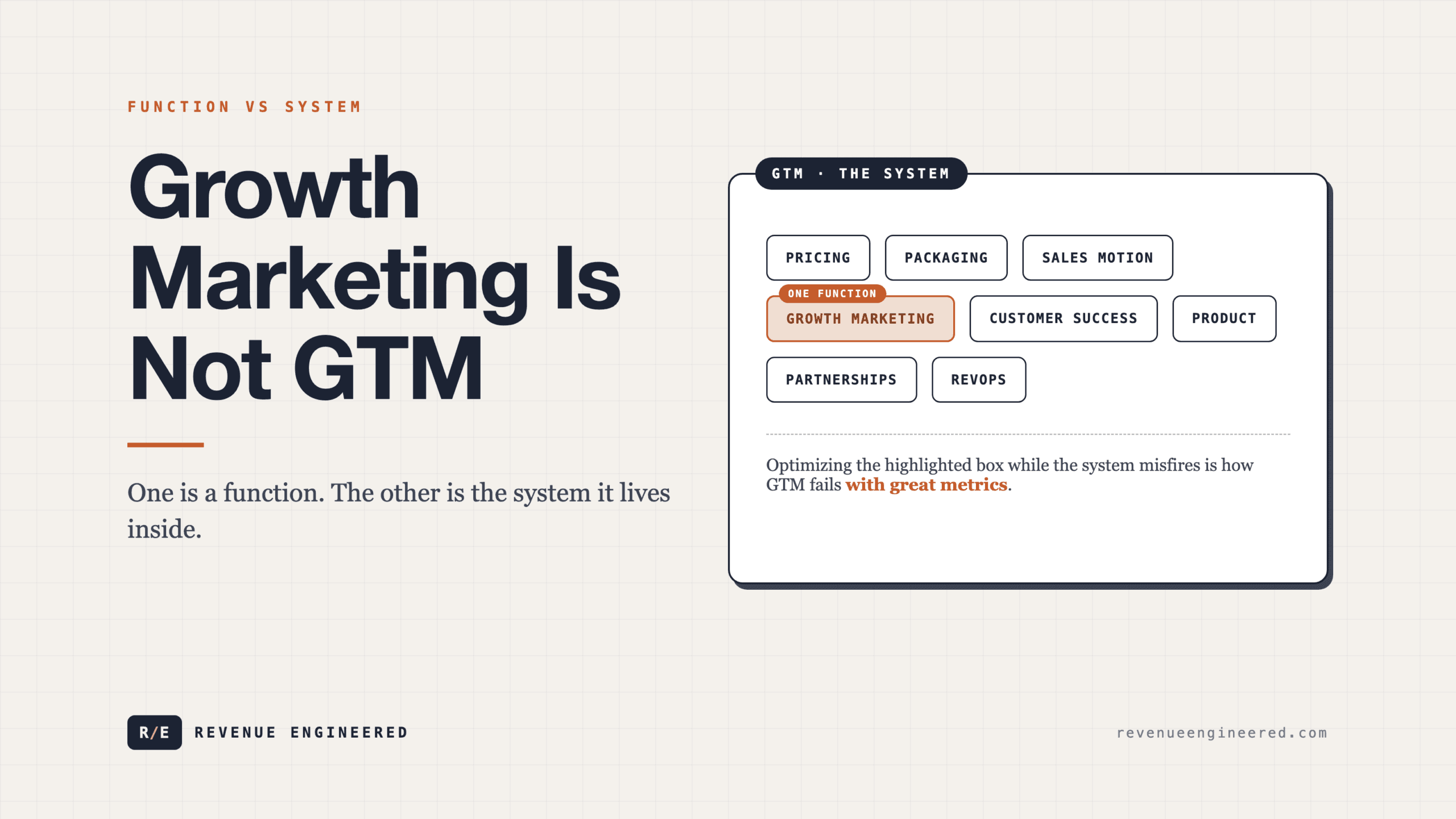
Go-to-market is the full system. It’s how a company creates, captures, and expands revenue. GTM includes growth marketing, but it also includes sales motions, product-led acquisition, channel partnerships, pricing strategy, market positioning, customer expansion, and the orchestration layer that ties all of it together. GTM is the architecture. Growth marketing is one subsystem within it.
The distinction matters because you can optimize a subsystem locally and still lose at the system level. A growth marketing team can drive record MQLs while the company misses revenue targets because the sales handoff is broken, or because the product’s activation experience loses 60% of signups before they reach value, or because pricing creates friction that no amount of demand gen can overcome.
Take activation. It increasingly belongs to product teams, not growth teams. If you’re thinking at the growth marketing level, you’re optimizing acquisition. If you’re thinking at the GTM level, you’re asking whether acquisition even matters yet.
The data says the distinction is real
A 2025 survey of 195 B2B software companies identified six dominant GTM motions: inbound, outbound, product-led growth, account-based, paid digital, and partners. But the more useful finding was not which motion won. There was no statistical correlation between GTM motion and growth rate. The same research also found that the average software company was running five core GTM channels plus another 5.5 experiments on top. The result is a crowded operating system, not a clean GTM strategy.
Read that again. The motion doesn’t predict growth. A product-led company isn’t inherently faster than an outbound-led one. An inbound-heavy company doesn’t necessarily outperform a partner-led one. What predicts growth is the coherence of the system, not how well any individual channel performs.
Growth marketing asks “which channel should we invest in?” GTM asks “how do these channels work together, and is the combined system producing the right outcomes?” The 195-company dataset says the second question is the one that actually matters.
A separate study of 30 B2B SaaS companies reinforces this from a different angle. Every product-led growth company in the sample eventually added sales. All 30. PLG on its own wasn’t a complete strategy. It was an acquisition channel that needed sales, customer success, and expansion motions layered on top to produce full revenue outcomes. The companies that treated PLG as their entire GTM hit ceilings they couldn’t break through with product alone.
Why the confusion is getting more expensive
Three forces are making this conflation costlier than it used to be.
First, AI is breaking traditional growth playbooks. By some estimates, 60-70% of traditional growth tactics don’t work for AI-native companies. The conventional growth marketing toolkit (SEO, paid ads, content marketing, email nurture) was built for a world where products required learning curves and evaluation periods. When an AI product delivers value in the first session, the growth funnel compresses. Acquisition and activation happen almost simultaneously. The growth marketer’s job doesn’t disappear, but the scope of what they can influence shrinks. The interesting decisions move upstream: pricing models, expansion triggers, when to layer sales onto a PLG motion, how to build network effects. Those are GTM decisions, not growth marketing decisions.
Second, buyer behavior has shifted upstream. Survey data shows that 70% of product marketers believe they’re doing GTM wrong. The core issue is that buying decisions are forming before the growth marketing machine even touches the prospect. Buyers do their own research, form preferences through peer networks, and arrive at vendor shortlists without ever entering a marketing funnel. Growth marketing optimizes the funnel. GTM has to address the full buyer journey, including the 80% that happens before the funnel starts.
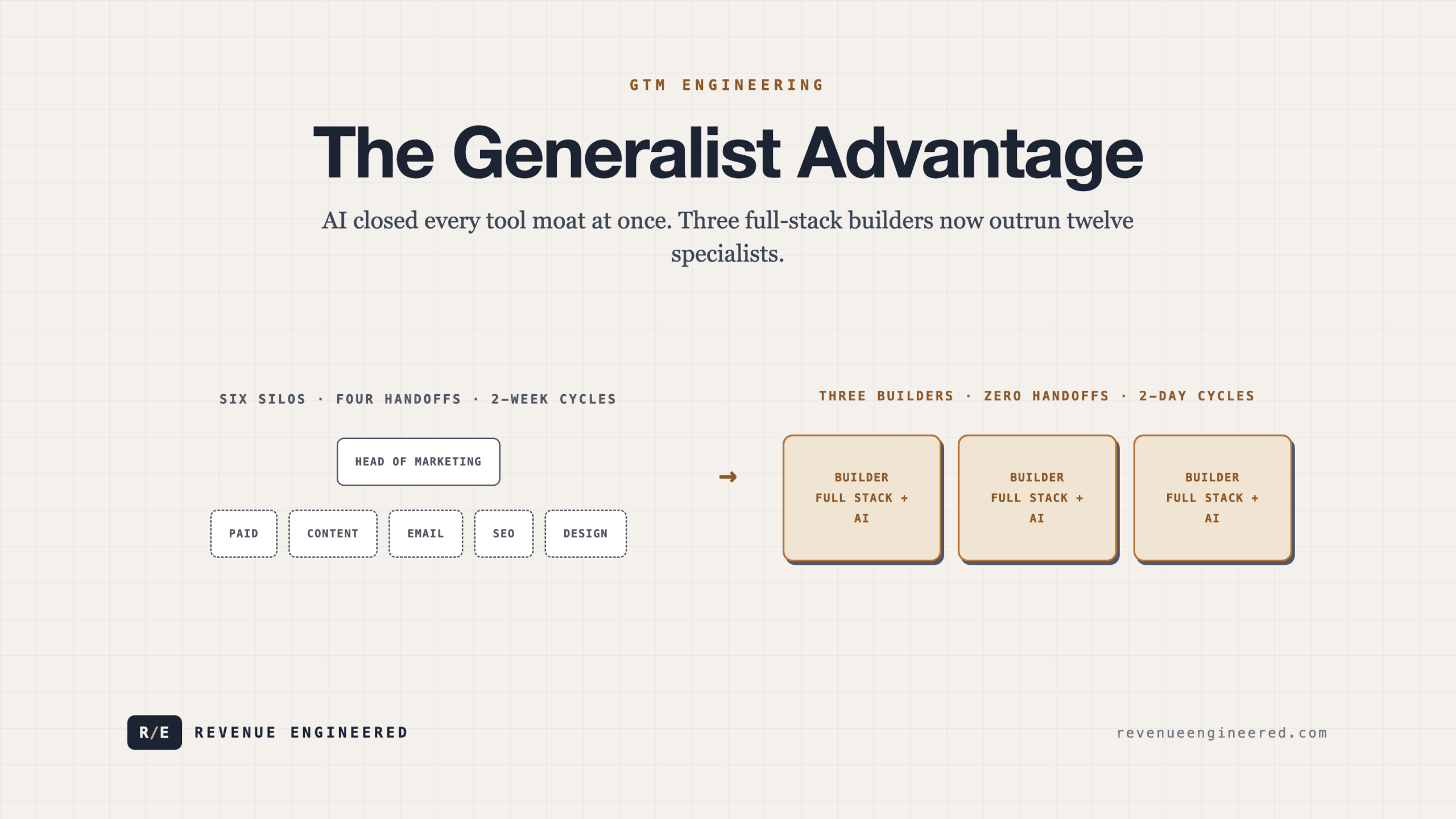
Third, the org chart is catching up. There’s a growing argument for what some are calling the “generalist marketer,” a role that replaces the marketing specialist with someone who operates across the full GTM surface. AI tools are eliminating the need for dedicated paid ads managers, dedicated email marketers, dedicated content writers. What replaces them is a smaller number of people who understand how all the pieces connect. The specialist optimizes a channel. The generalist thinks in systems.
The GTM engineer is the tell

GTM engineer is the tell as a maturity path.
If you want proof the industry is reckoning with this distinction, look at hiring data. LinkedIn job postings for “GTM engineer” grew from roughly 1,400 in mid-2025 to over 3,000 by January 2026. Compensation sits between $120K and $300K OTE. These aren’t marketing hires and they aren’t sales hires. They’re infrastructure people.
A GTM engineer wires up the intent signals, the scoring models, the routing logic, the enrichment pipelines, and the orchestration layers that make the full system work as one thing rather than a pile of disconnected tools. The role didn’t exist five years ago because the systems it builds didn’t exist five years ago. It exists now because companies realized they needed someone who could think at the system level.
This is the market telling you, through job postings and salary bands, that growth marketing and GTM are different disciplines. If they were the same thing, you wouldn’t need a new role. You’d promote your best growth marketer. But the skill set is different. Growth marketers optimize channels. GTM engineers design systems. Both matter. They solve different problems.
What this means for how you build

What this means for how you build translated into operating choices.
If you’re running a B2B company, the practical implications are straightforward.
Name things correctly. Your growth marketing team owns channels and campaigns. Your GTM function owns the system that connects those channels to revenue. Calling one the other creates confusion about scope and accountability that compounds over time.
Hire for the right problem. When you need someone to fix your paid acquisition costs, hire a growth marketer. When you need someone to figure out why your MQLs aren’t converting to revenue, hire for GTM. The first is a channel problem. The second is a system problem. Applying channel solutions to system problems is how companies end up cycling through three heads of demand gen in eighteen months while the actual issue sits in the handoff between marketing and sales.
Budget at the system level. Most B2B companies allocate marketing budget by channel: X for paid, Y for content, Z for events. Then they’re surprised when the channels perform well individually but the overall pipeline doesn’t grow proportionally. System-level budgeting asks different questions. What does it cost to generate a qualified opportunity, not a lead? What does it cost to activate a user to the point where they convert? Where are the bottlenecks across the full journey from awareness to expansion revenue?
Measure the right things. MQL volume is a marketing metric. Pipeline velocity is a GTM metric. Cost per click is a marketing metric. CAC payback period is a GTM metric. Both sets are useful. Only one tells you whether the business is actually working.
The split is permanent
Growth marketing will continue to exist. Companies will always need people who are excellent at running paid campaigns, optimizing funnels, and testing acquisition channels.
But the conversation has moved to the system level, and I don’t see it going back. The companies producing outsized results aren’t the ones with the best growth marketing. They’re the ones where growth marketing is wired into a coherent GTM system that includes product, sales, success, and data. The GTM engineer role, the generalist marketer concept, the research showing that motion type doesn’t predict growth: it all points the same direction.
“Growth marketing” and “GTM” were never synonyms. The cost of treating them like synonyms is going up every quarter.
Enjoying this essay?
Written by

Elom
GTM, growth, and revenue systems operator with 12 years across Fortune 500s, fintech, and B2B startups. Building at the intersection of AI, data, demand, and revenue.
Get the next deep-dive in your inbox
Essays on demand creation, GTM, growth engineering, and revenue systems. Free.