The Zero-Click Reality: Why Your Content Strategy Needs a Systems Overhaul
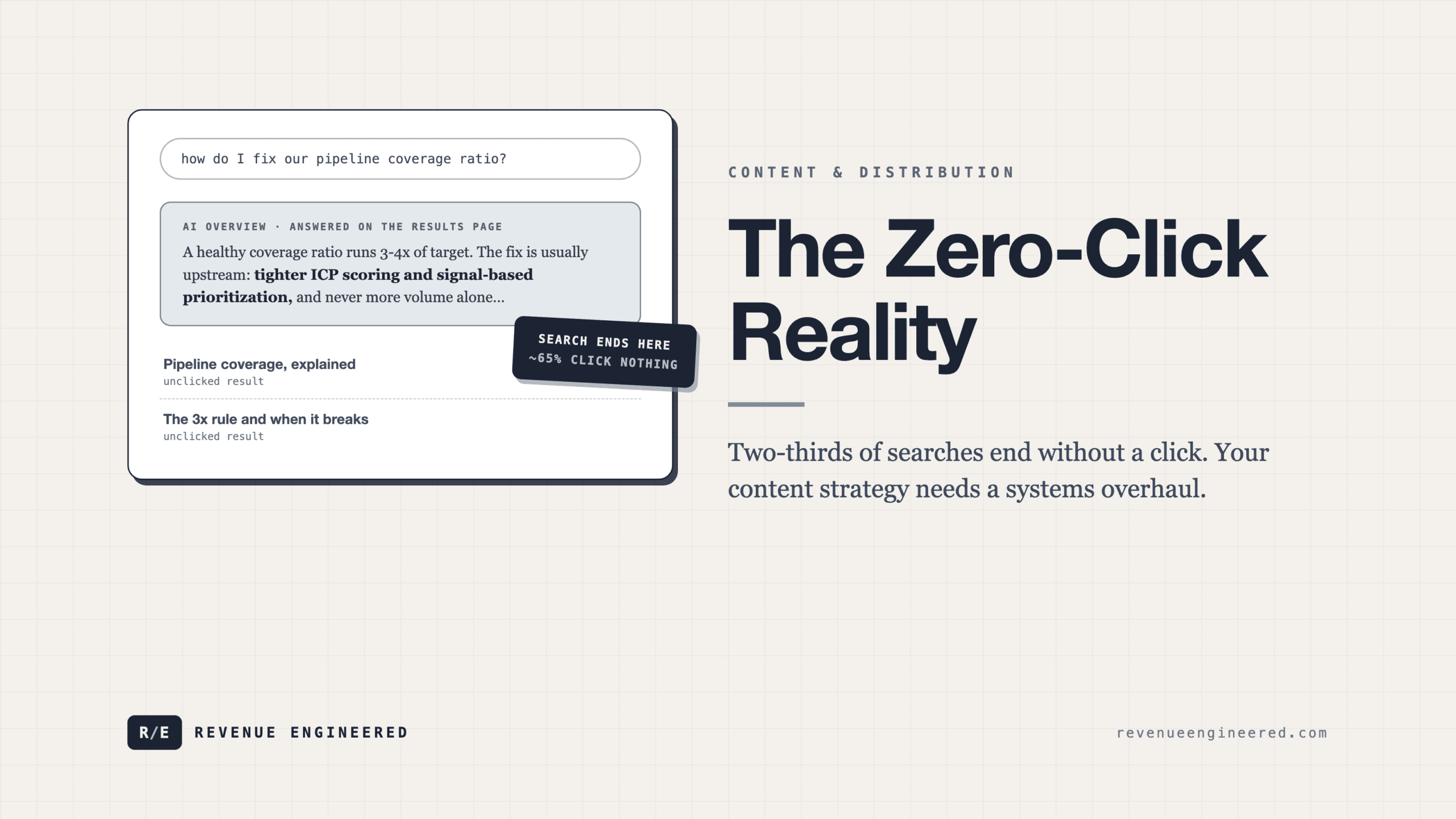
Two-thirds of searches end without a click. The implications for B2B content are bigger than most teams realize.
The content playbook most B2B teams are running was designed for a world that no longer exists. It assumes people search, click, read, and convert in a tidy linear sequence. It assumes that ranking on page one means capturing demand. It assumes that a blog is a growth engine.
None of those assumptions hold up anymore. Two-thirds of Google searches now end without a click. Social platforms actively suppress outbound links. The places where content actually spreads — group chats, Slack channels, DMs — are invisible to every analytics dashboard. And AI-generated content has flooded the internet with competent noise at a scale that makes the old volume game unwinnable.
We are living through a structural shift in how organic content generates business value. Not a trend. Not a temporary algorithm mood. A permanent rewiring of the relationship between content, distribution, and revenue. The companies that recognize this early will build systems that compound over years. The ones still optimizing blog post titles and publishing cadence calendars will wonder why nothing moved.
This article is about infrastructure decisions, not tactical SEO. Those decisions determine whether content becomes a durable growth asset or an expensive content library that nobody visits.
The math nobody wants to confront

Search value moved before the website visit..
Here is the number that should reorganize every content strategy conversation: roughly 65% of Google searches produce zero clicks. The searcher types a query, gets an answer from a featured snippet or AI overview or knowledge panel, and leaves. No click. No visit. No pageview. No conversion event in your analytics.
For informational queries, the number is worse. Google has become very good at answering questions directly inside the search results page. “What is account-based marketing” does not need your 3,000-word explainer anymore. Google already told the searcher.
This does not mean search is dead. It means the value of search has shifted from traffic acquisition to brand positioning. When your company’s name, framework, or perspective appears in a featured snippet or AI-generated overview, you are building trust at scale without earning a single click. The searcher sees your authority. They file it away. Three months later, when they have budget and a real problem, they remember who kept showing up with answers.
Most marketing teams have not updated their measurement systems to reflect this. They still report on sessions, pageviews, and keyword rankings as primary indicators of organic performance. These metrics are incomplete rather than wrong. They miss the majority of the value that search now generates.
The teams that understand this are measuring share of SERP, not just rankings. They are measuring brand recall, not just sessions. They are thinking about search as a trust-building channel that occasionally produces traffic, rather than a traffic channel that occasionally builds trust.
This is a systems-level distinction. It changes what you publish, how you structure it, where you invest, and what you measure.
Domain authority as a gating function

Authority first, then content..
Before any content strategy conversation, there is a prerequisite that most teams skip. Your domain authority determines whether Google will even consider showing your content. A domain rating below 15 means your content is functionally invisible. You could publish the single best article ever written about your topic, and it would sit on page six because your site has not earned the right to be displayed.
This is why the majority of content marketing programs fail. Teams spend six months building content calendars, hiring writers, producing 40 polished articles, and optimizing every meta tag. Total organic traffic after six months: negligible. They did not fail at content. They failed at sequencing.
The correct sequence is authority first, then content. Spend the first 60 days building foundational links. Directories. Partner pages. Supplier listings. Guest contributions. Do not publish a single blog post during this phase. It feels wrong. Every instinct says start publishing. But those 60 days of foundation work change the underlying math so that content published afterward actually has a chance to rank.
Content published at a domain rating of 5 might take six months to rank, if it ever does. The same content published at a domain rating of 25 might rank in six weeks. Same words. Different foundation. The patience required in the foundation phase is the highest-leverage investment in the entire system, and almost nobody makes it because it produces no visible output.
The compounding math here is worth sitting with. At a domain rating of 15, new content might rank in 12 weeks. At 30, six weeks. At 45, two to three weeks. At 55 and above, some content ranks on the day of publication. Every link you earn during the authority phase lifts every piece of content you will ever publish. The investment is multiplicative, not sequential.
The death of the pillar page
For years, the SEO playbook said: build massive pillar pages. Write the definitive 5,000-word guide. Create a topic cluster around it. Interlink everything. Dominate through comprehensiveness.
That playbook worked when Google rewarded page length and topical breadth. It no longer does. Google now rewards pages that best match specific intent. Specificity beats comprehensiveness.
Think about how people actually search. Someone looking for “how to structure a cold email subject line” does not want a 5,000-word guide that opens with “What is cold email?” They want a direct answer to a narrow question, with examples, immediately. The pillar page forces them to scroll past 3,000 words of context they did not ask for to find the 200 words they need.
The replacement model is disaggregated content. Instead of one monolithic guide trying to answer every possible question about a topic, you map the search journey for that topic, identify every distinct intent along that journey, and create one precise piece for each stage. Each piece is 800 to 1,500 words. Each one answers one question completely. Each one links to the others.
Total traffic from disaggregated content: higher than the pillar page it replaced. Conversion rate: dramatically higher. Because every visitor lands on a page that matches exactly what they searched for, instead of landing on a giant guide and bouncing because they could not find the specific answer they needed.
This has direct implications for content investment. It means producing ten sharp pieces instead of one massive one. It means more upfront planning and less per-piece word count. It means the content brief matters more than the content length.
AI raised the floor and increased the noise
AI content tools collapsed the marginal cost of content production to near zero. Any operator with an API key can now produce more articles per week than a ten-person content team could produce five years ago. The floor of content quality has risen. Basic, competent, well-structured content is now table stakes.
This is the paradox: the tool that made content cheaper also drained its value. When every company can produce competent content at scale, competent content stops being a differentiator. The internet is drowning in well-organized answers to common questions, and most of it reads like it came from the same source, because it did.
The only defensible moat left is what AI cannot replicate. Original data from your own operations. Frameworks you named because you observed a pattern nobody else documented. Perspectives that come from actual failure, not theoretical analysis. Specific numbers from real projects, not industry benchmarks pulled from a report anyone can download.
This is where the content strategy conversation gets uncomfortable. Most B2B content programs were already thin on original insight before AI arrived. They were aggregating existing knowledge, repackaging it with branded headers, and calling it thought leadership. AI just exposed the hollowness of that approach by doing the same thing faster and cheaper.
The content that survives over the next three to five years will have a clear human fingerprint. Not in the writing style, which AI can mimic. In the underlying thinking, which requires lived experience that no model has access to.
The practical test is simple. Take any article your team published in the last quarter and ask: could a competent operator with an AI tool and 30 minutes reproduce 90% of this? If the answer is yes, the article has no moat. The 10% that cannot be reproduced is the only part that matters, and for most companies that 10% does not exist yet. Building it requires investing in original research, running experiments worth documenting, and developing points of view that come from doing, not from reading what others have done.
Distribution as the real moat

Create for the places attention already lives..
The traditional content workflow runs: create content, then figure out distribution. This sequence is backward.
Distribution is now the primary constraint on content ROI. The world does not lack content. It lacks distribution. Every platform is algorithmically hostile to outbound links. LinkedIn suppresses posts with URLs. Twitter deprioritizes tweets with links. Instagram and TikTok do not allow clickable links at all. Reddit buries link posts.
If your content strategy depends on someone clicking through to your website, you are optimizing for a shrinking percentage of available attention.
The teams generating real returns from content have inverted the workflow. They start with: where will this content live natively and how will it travel? Then they work backward to what to create.
This produces structurally different content. Zero-click social posts that deliver the full insight without requiring anyone to leave the platform. Newsletters where the email itself is the content, not a teaser linking to the blog. Search content optimized for featured snippets that build brand trust even when the searcher never visits the site.
The distribution question also reshapes format. Feeds are staging areas. Group chats are where content actually spreads. The posts that grow are posts that survive being screenshotted and dropped into a WhatsApp thread with zero context. If your content requires any explanation to make sense to someone who was not already following the conversation, it will not travel.
This is why distribution-first is a systems decision, not a marketing tactic. It changes how you structure content, how you hire, what you measure, and where you invest.
Specificity over volume
A consultant closed $42,000 in a single month from social media. Fewer than 3,000 followers. His approach: he identified 12 specific people. CMOs and founders with budget and a real problem. He studied what they posted about, what they engaged with, what frustrated them. Then he created content specifically for those 12 people for six weeks. Half of them initiated contact first.
This is the opposite of the volume playbook. Most content strategies aim for reach. More impressions. More traffic. More keywords. The assumption is that volume creates opportunity through probability. Publish enough, and someone who matters will eventually see something.
The specificity model works differently. It treats content as a targeted instrument rather than a broadcast signal. Write for a narrow audience with a real problem, and everyone who shares that problem resonates with it. Write for everyone, and nobody feels like it was written for them.
This applies to SEO content just as directly as it applies to social. The article that ranks and converts answers a specific question for a specific person so completely that they bookmark it, reference it in meetings, and send it to colleagues. Breadth and comprehensiveness lose to that kind of precision.
Volume still matters for compounding. You need a consistent publishing cadence to build the authority and distribution infrastructure that makes everything else work. But volume without specificity is just noise production. Two posts per week written for a defined audience will outperform ten posts per week written for nobody in particular. The math favors precision over quantity at every stage of the funnel.
What a systems overhaul actually looks like
The shift from legacy content strategy to a zero-click-aware system is a rearchitecture, not a set of tactical adjustments. The old system had content production at the center, with distribution and measurement bolted on as afterthoughts. The new system has distribution architecture at the center, with content production serving that architecture.
Concretely, this means building authority before publishing content, not simultaneously. It means creating ten precise pieces instead of one comprehensive guide. It means designing every piece for platform-native distribution before writing the first word. It means measuring brand trust and share of SERP alongside traffic and conversions. It means accepting that a significant portion of your content’s value will never appear in Google Analytics because it happens in zero-click environments and private channels.
The companies that make this transition early will have a compounding advantage that is extremely difficult to replicate later. Authority compounds. Distribution infrastructure compounds. Brand trust compounds. Each of these takes 12 to 18 months to build, and each one makes everything else in the system work better.
The companies that wait will spend the next two years publishing content into an environment that has structurally moved against them, wondering why the playbook that worked in 2021 produces nothing in 2027.
The zero-click reality is a condition to build for, not a problem to solve. And the teams that build for it now will own the organic channel for the next decade.
Enjoying this essay?
Written by

Elom
GTM, growth, and revenue systems operator with 12 years across Fortune 500s, fintech, and B2B startups. Building at the intersection of AI, data, demand, and revenue.
Get the next deep-dive in your inbox
Essays on demand creation, GTM, growth engineering, and revenue systems. Free.