The Enterprise AI Adoption Chasm Is Wider Than You Think
Most organizations are performing AI adoption. A small percentage are actually doing it. The gap between them is becoming structural.
Something strange is happening in enterprise AI adoption. The announcements are louder than ever. The budgets are bigger. The executive decks are full of transformation timelines and ROI projections. And yet, in the actual revenue organizations where pipeline gets built and deals get closed, almost nothing has changed.
We are now deep enough into the AI wave that the gap between teams that have genuinely integrated AI into their go-to-market motion and teams that have merely purchased AI tools is becoming visible in their numbers. Not slightly visible. Structurally visible. The kind of gap that compounds quarterly and becomes impossible to close with a late start.
The barrier is neither budget nor access. Every meaningful AI capability a GTM team needs in 2026 costs less than a single SDR’s monthly base salary. The barrier is mental models. And that is a much harder problem to solve.
The theater of adoption

Procurement is not adoption..
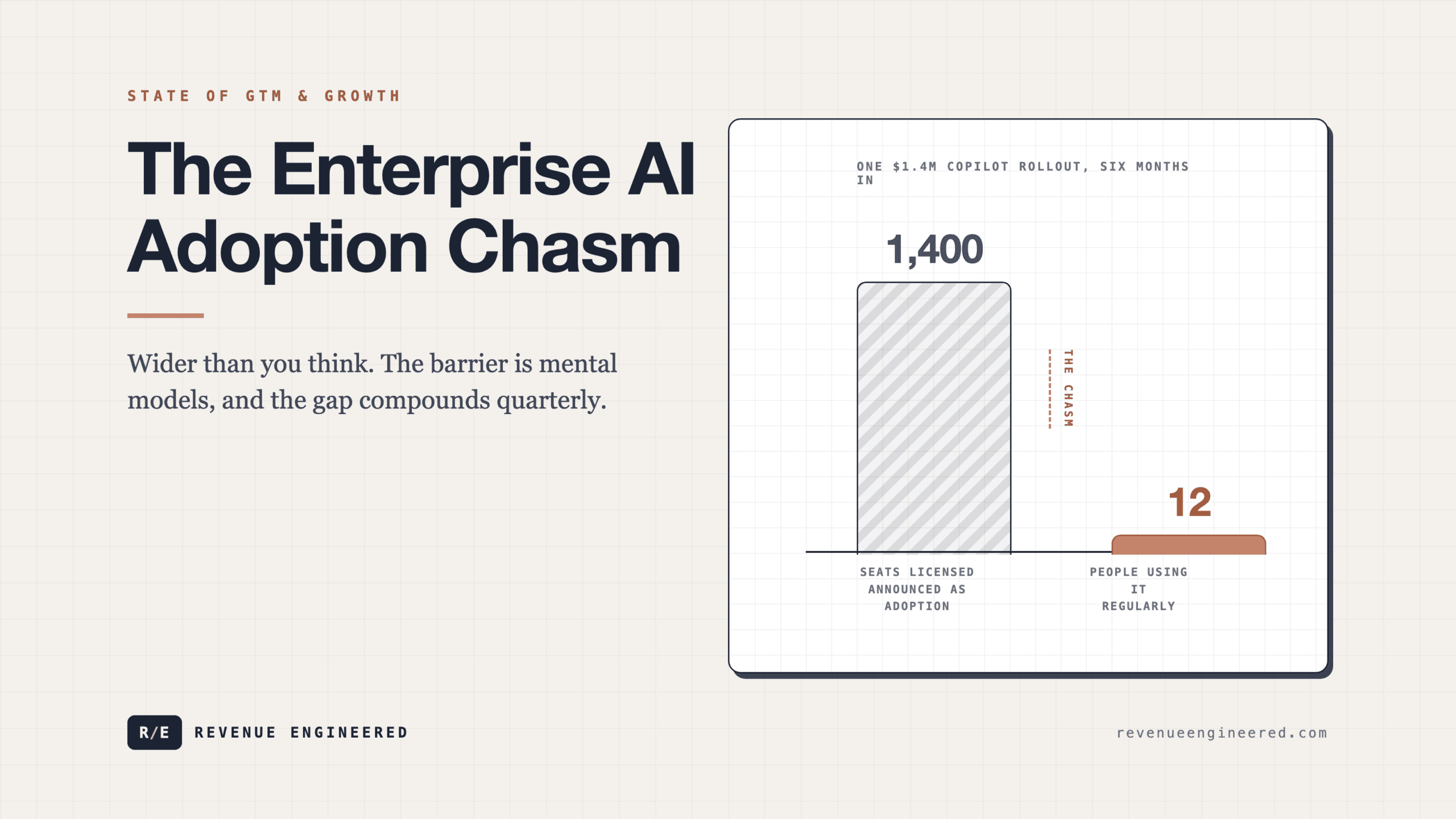
There is an enterprise somewhere that spent $1.4 million rolling out an AI copilot across its revenue organization. Fourteen hundred seats licensed. Training sessions scheduled. An internal Slack channel created. Six months later, twelve people use it regularly. Twelve. The rest opened it once during onboarding, decided it was not meaningfully better than their existing workflow, and never came back.
This story is the median outcome, not an unusual one. Most enterprise AI adoption follows the same pattern: executive enthusiasm, vendor selection, broad rollout, quiet abandonment. The licenses stay active because nobody wants to admit the initiative failed. The copilot sits in the toolbar like an unused gym membership, technically available but generating zero value.
What gets announced is adoption. What actually happened is procurement. These are different things, and the distance between them is where most AI investment goes to die.
The teams that break through this pattern share a common trait. They did not start with the tool. They started with a specific workflow that was slow, manual, and repetitive, and they asked whether AI could compress it. The tool came second. The workflow came first. This sounds obvious, but it is the opposite of how most organizations approach the problem. They buy the platform, then go looking for use cases to justify it.
Where the gap actually shows up

The gap shows up in operating ratios..
The difference between AI-native GTM teams and traditional teams has nothing to do with one group having better technology. One group simply operates on fundamentally different unit economics.
Consider what a well-integrated AI workflow does to outbound. A traditional team runs a sequence: identify accounts, research them manually, write personalized emails, send them, track responses, follow up. Each step involves human time. A team with properly integrated AI still does all of these steps, but the research phase that used to take forty minutes per account now takes three. The personalization that required a skilled writer for every message now requires a skilled writer for the template and the judgment to review outputs. The analysis of what is working, which used to happen weekly in a spreadsheet review, now runs continuously.
The math is not subtle. The AI-native team operates at a fundamentally different ratio of output to headcount. Call it a different order of efficiency, not a ten percent edge. They can work more accounts, test more messages, iterate faster on positioning, and redirect human attention to the parts of the sales process where human judgment actually matters. Conversations. Objection handling. Relationship building.
And here is the part that makes this a chasm rather than a gap: the advantages compound. The team running more experiments per week generates more data about what works. More data about what works means better templates and targeting. Better targeting means higher response rates. Higher response rates mean more conversations. More conversations mean more closed revenue. Which funds more investment in the process. The flywheel spins, and every rotation widens the distance from teams still doing it the old way.
The $20/month revolution that nobody is talking about
Somewhere in the discourse about enterprise AI, we lost track of a simple fact. The most powerful AI tools available to a GTM professional cost twenty dollars a month. Not twenty thousand. Not two thousand. Twenty.
For the price of a mediocre lunch, a single account executive can access an AI assistant that has read more sales methodology, more competitive intelligence, more industry analysis than any human could absorb in a lifetime. The assistant does not sleep, does not take PTO, and does not need to be managed. It writes first drafts that are good enough to edit rather than start from scratch. It summarizes call transcripts in seconds. It finds patterns across hundreds of conversations that no human would notice.
This is not a technology access problem. Any individual contributor on any GTM team in the world can sign up for these tools today and start using them tomorrow. The question is why so few do.
The answer is that individual adoption without organizational support creates friction rather than leverage. The rep who uses AI to write better emails still has to log activities in the same CRM the same way. The manager who uses AI to analyze pipeline still presents in the same format at the same weekly meeting. The AI-native workflow exists inside a container built for non-AI workflows, and the container constrains what is possible.
This is why the adoption problem is organizational, not individual. The 10-15% of GTM professionals who are genuinely AI-native right now are mostly working around their organizations, not with them. They are using personal subscriptions for work tasks, building their own prompt libraries, developing workflows that their managers do not fully understand. They are productive despite the system, not because of it.
Boring industries are the real opportunity
The AI conversation in GTM circles tends to orbit the same handful of industries. SaaS. Fintech. Developer tools. Companies selling to technical buyers who are already comfortable with AI.
But the actual opportunity is in the industries that nobody talks about at conferences. Wide open. Barely contested. Insurance. Logistics. Industrial distribution. Commercial real estate. Construction materials. Waste management.
These industries have GTM teams too. They have pipelines and quotas and territory maps and QBRs. And they are, almost without exception, running the same playbooks they ran in 2019. Not because they are unsophisticated, but because nobody has shown them what a different approach looks like in their specific context.
A GTM team selling commercial insurance that integrates AI into their research, prospecting, and proposal workflows will create a gap against competitors that is wider than any gap in SaaS, because the competitors are not even trying. In SaaS, everyone is experimenting with AI. In commercial insurance, the first team to do it properly will have the field to themselves for years.
The unglamorous work is where the returns are highest. The industries nobody is rushing to disrupt are the ones where disruption will be most decisive.
What actual adoption looks like

Start with the workflow, not the tool..
The organizations getting real value from AI in their GTM motion share a pattern that is different from what vendor case studies describe.
They did not transform everything at once. They picked one workflow and compressed it. Usually something in the research or preparation phase, because that is where AI delivers the most immediate and measurable time savings. They proved it worked with a small team. Then they expanded.
They treated AI outputs as drafts, not deliverables. Every piece of AI-generated content goes through human review. Not because the AI is bad, but because the human review step is where judgment, taste, and institutional knowledge get applied. The teams that skip this step produce volume without quality. And volume without quality in GTM is worse than useless. It burns your market.
They invested in the humans, not just the tools. The reps who get the most from AI are the ones who already had strong fundamentals. They know their market. They understand their buyer. They can tell the difference between a good email and a mediocre one. AI amplified their existing capability. It did not create capability from nothing.
This is the part that gets lost in the excitement. AI is a multiplier, and multipliers need something to multiply. A rep with strong skills and AI assistance is formidable. A rep with weak skills and AI assistance produces polished mediocrity at scale.
The mental model problem
The real barrier to AI adoption in GTM is neither technical nor financial. It is conceptual.
Most GTM leaders are still operating with a mental model where AI is a tool you use for specific tasks. Write this email. Summarize this call. Score this lead. This is the “AI as assistant” frame, and it caps the value at incremental efficiency gains. Useful, but not transformative.
The teams pulling ahead have a different frame. They see AI as infrastructure that changes what is possible. Not “write this email faster” but “what would our outbound motion look like if research cost zero?” Not “summarize this call” but “what would our coaching program look like if every call was analyzed automatically?” Not “score this lead” but “what would our targeting look like if we could evaluate every company in our TAM against our ideal customer profile continuously?”
The shift from “AI as tool” to “AI as infrastructure” is where the transformation happens. And it is a shift in thinking, not in spending. The same twenty-dollar subscription supports both mental models. The difference is entirely in what you ask of it.
This is why the chasm is wider than people think. The teams on the far side are there because they asked different questions, not because they spent more money or hired better engineers. And the organizations still on the near side cannot close the gap by purchasing what the far side purchased, because what the far side purchased is not what made them successful.
Where this goes
Over the next eighteen months, the gap between AI-native GTM organizations and traditional ones will become visible enough to force a reckoning. Win rates will diverge. Pipeline velocity will diverge. Revenue per headcount will diverge. And the divergence will be large enough that it cannot be explained by market conditions or product differences.
When that happens, there will be a rush to adopt. Budgets will appear. Consultants will be hired. Transformation programs will launch. Some of these will work. Most will reproduce the same pattern of procurement without adoption, because the fundamental barrier — the mental model shift — cannot be solved with a vendor contract.
The organizations that will thrive are the ones making the shift now, while the cost of experimentation is low and the competitive pressure is still manageable. Not by deploying enterprise-wide AI platforms, but by finding the three or four workflows where AI creates immediate, measurable compression, proving the value, and building from there.
The chasm is real. It is widening. And the ticket to cross it costs twenty dollars a month and a willingness to rethink what your GTM motion could look like if the constraints you have always accepted were no longer there.
Enjoying this essay?
Written by

Elom
GTM, growth, and revenue systems operator with 12 years across Fortune 500s, fintech, and B2B startups. Building at the intersection of AI, data, demand, and revenue.
Get the next deep-dive in your inbox
Essays on demand creation, GTM, growth engineering, and revenue systems. Free.