Workflows First, Then Agents: The GTM Automation Decision Tree
Most teams are deploying agents where workflows would do. Here’s how to decide.
Something strange is happening across GTM organizations right now. Teams that were manually sending cold emails eighteen months ago are suddenly trying to deploy autonomous AI agents to manage their entire pipeline. They’re skipping three or four rungs on the automation ladder and landing, predictably, on their face. The agent crashes, nobody can figure out why, the cost per task is 50x what a simple API call would have been, and the team retreats to doing everything manually again. We’re watching this pattern repeat across dozens of companies.
The rush to agents is understandable. The demos are stunning. An AI that can research a prospect, draft a personalized email, analyze the response, and adjust its follow-up strategy in real-time. That sounds like it replaces your entire SDR team. In practice, what actually happens is closer to giving a new hire the keys to the company on day one and leaving the building. The output is unpredictable, the cost is opaque, and when something breaks at 2 AM, there’s no error log that makes sense to anyone on the team.
Here is the less exciting but more honest framing: before you deploy agents, you need well-designed workflows. And before you build workflows, you need to understand which problems actually require intelligence and which ones just need reliable execution. Most GTM tasks fall into the second category. The automation maturity ladder exists for a reason, and the teams that climb it methodically are outperforming the ones that try to skip to the top.
The automation maturity ladder

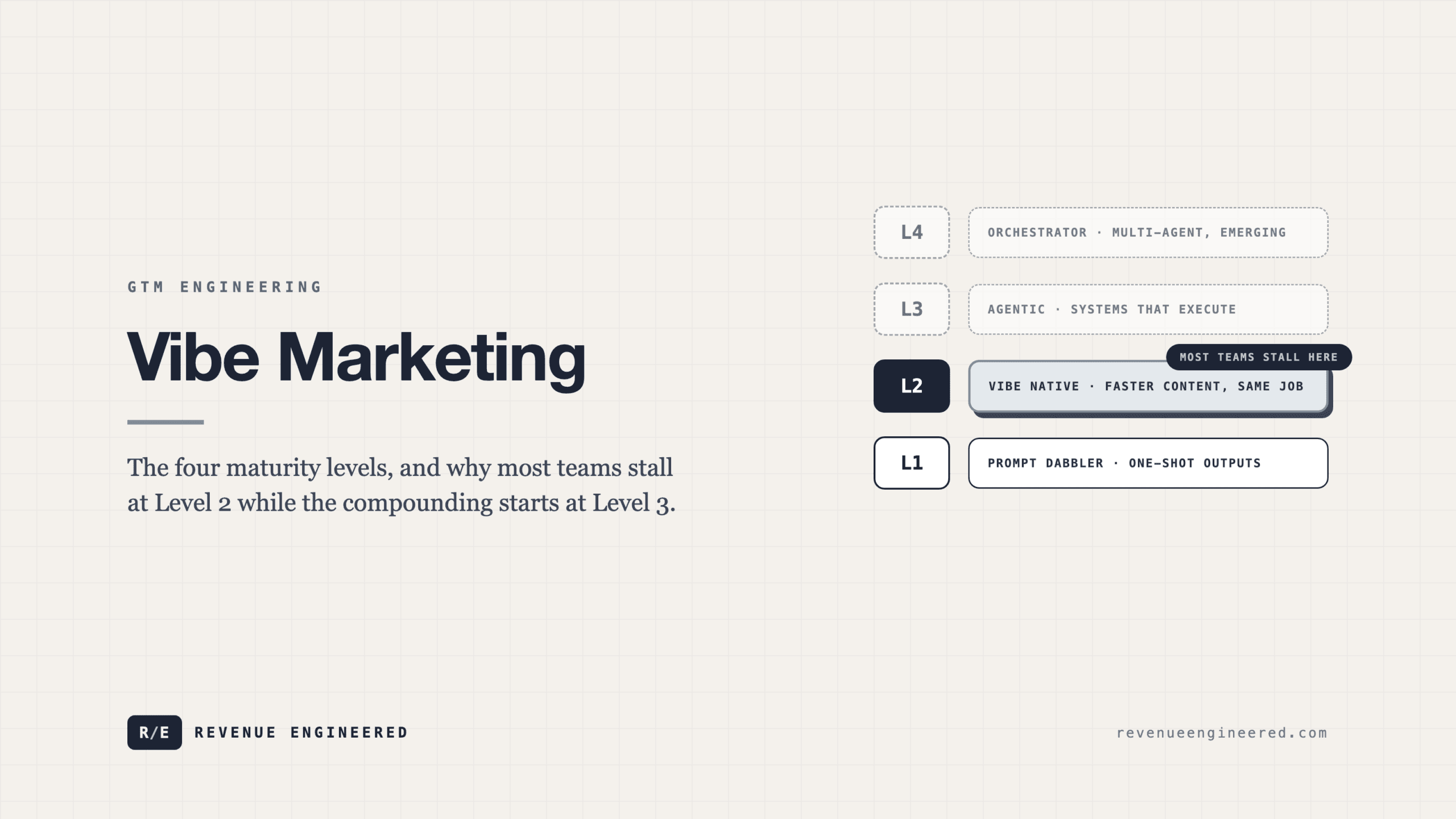
automation maturity ladder reframed as system design.
There are six levels of GTM automation maturity. The differences between them are not cosmetic. Each level has distinct cost characteristics, failure modes, and appropriate use cases. Conflating them is how teams waste six-figure budgets on problems that a $20/month Zapier plan could solve.
Level 1: Manual. A human does the task from scratch every time. Your rep opens LinkedIn, finds prospects one by one, types each email individually, logs the activity in the CRM by hand. This is where roughly 60% of GTM teams still operate for most of their core motions, according to survey data from late 2025. The cost is time. The failure mode is human error and fatigue. But the advantage is full context and judgment at every step.
Level 2: Templatized. The task is still manual, but the human follows a template. Email sequences with placeholder fields. Call scripts with branching paths. Qualification checklists. This is the first real efficiency gain, typically 2-3x throughput improvement with minimal investment. The failure mode is template drift, where reps modify templates until they’re unrecognizable, and nobody audits the mutations.
Level 3: Workflow automation. The task runs on triggers without human initiation. When a lead fills out a form, the CRM record is created, the lead is scored, the account owner is notified, and the first email sends automatically. Tools like Zapier, Make, or n8n handle this well. The cost per execution is fractions of a cent. The failure mode is integration breakage, usually an API token expiring or a field mapping changing upstream. But these failures are deterministic. They produce error codes. They can be debugged by looking at logs.
Level 4: Rule-based automation. The workflow includes conditional logic. If the lead score is above 80 and the company has more than 50 employees, route to sales. If below 80, add to nurture sequence. If the domain matches an existing account, merge and notify the account executive. This is where most GTM teams should be spending the bulk of their automation energy. The logic is explicit, auditable, and cheap to run. A well-designed rule-based system handles 70-80% of the decisions that teams think require “AI.”
Level 5: AI-assisted automation. An LLM handles a specific subtask within a larger deterministic workflow. The workflow identifies the prospect, pulls their recent activity, and passes that context to an LLM that drafts a personalized opening line. The human reviews the output before it sends. Or the LLM classifies inbound inquiries by intent, and a rule-based system routes them accordingly. The LLM does one thing, in a bounded context, with a human or a validation step downstream. Cost per call is $0.01-0.10 depending on model and prompt length.
Level 6: Autonomous agent. The agent receives a goal (“research this account and identify the best entry point”), selects its own tools, decides what information to gather, makes judgment calls about what matters, and produces a synthesis. It runs in a loop until it decides the task is complete. It maintains context across steps. The cost per task is $0.50-5.00 or more, depending on the number of tool calls and the model used. The failure mode is the most dangerous kind: the agent confidently produces wrong output, and because it operates autonomously, nobody catches it until the damage is done.
Most teams we work with should be focused on levels 3 and 4 for 80% of their GTM automation. Levels 5 and 6 have real applications, but they should be reserved for the 15-20% of tasks that genuinely require them.
The cost math nobody talks about
Here is where the “just deploy an agent” mentality runs into hard numbers. A simple webhook-triggered workflow in n8n or Zapier costs effectively nothing per execution. The infrastructure cost is the monthly subscription, and each individual trigger-action chain uses negligible compute.
An AI-assisted step, where you call Claude or GPT-4 to do something specific, costs $0.01-0.10 per call depending on input/output length and model tier. That’s manageable for targeted use. If you’re enriching 500 leads per week with an AI-generated personalization line, you’re spending maybe $25-50/month. Reasonable return on investment if it lifts reply rates.
An autonomous agent, though, is a different animal. A single agent task might make 10-30 LLM calls as it reasons through a problem, plus additional API calls to tools. We’re seeing $1-5 per agent task as a realistic range, with complex research tasks hitting $10+. If you’re running that agent on every inbound lead, every prospect in your pipeline, every deal that needs attention, you’re looking at infrastructure costs that exceed the salary of the human the agent was supposed to replace.
One team we observed deployed an agent to handle lead qualification. The agent was thorough. It researched each company, checked recent news, analyzed their tech stack, read their job postings for buying signals, and produced a beautiful qualification memo. Cost per lead: roughly $3.50. They were processing 2,000 inbound leads per month. That’s $7,000/month on qualification alone, for a task that a well-designed rule-based scoring system (using firmographic data from an enrichment API at $0.03/lead) could have handled at 90% accuracy for $60/month.
The math only makes sense when the task genuinely requires the intelligence that an agent provides and when the value of getting it right is high enough to justify the cost. Qualifying a $500K enterprise deal? An agent spending $10 to produce deep research is a bargain. Qualifying an inbound free trial signup? That is a workflow problem, not an agent problem.
What happens when you skip steps
The failure modes of premature agent deployment are specific and predictable. We see the same patterns across different teams and industries.
Overspending on commodity tasks. The most common failure. Teams deploy agents for tasks that have deterministic solutions. Routing leads, updating CRM fields, sending follow-up emails on a schedule, syncing data between systems. These are solved problems. An agent adds cost, latency, and unpredictability to a task that was already working fine as a workflow.
Hallucination in production. Agents generate plausible-sounding output that is factually wrong. A research agent reports that a prospect company raised a Series B when they actually didn’t. A writing agent attributes a quote to someone who never said it. In a demo, this is a curiosity. In a production GTM workflow that sends output directly to prospects, this is a reputation risk. The rate of factual errors in agentic outputs is materially higher than in bounded, single-call LLM tasks because the agent’s context grows with each step, and errors compound.
Debugging nightmares. When a workflow breaks, you look at the step that failed, check the error code, and fix the integration. When an agent produces bad output, the debugging process is archaeological. You have to reconstruct the agent’s reasoning chain: what did it decide at step 3 that led to the wrong conclusion at step 12? Was it a tool failure, a context window overflow, a prompt ambiguity, or a genuine reasoning error? Most GTM teams do not have the technical sophistication to debug agent behavior, and they shouldn’t need to for the majority of their automation tasks.
The “silent failure” problem. Workflow failures are loud. The Zapier step errors out, the n8n node turns red, the webhook returns a 500. Agent failures are quiet. The agent completes its task, reports success, and delivers output that looks correct but isn’t. One practitioner described it well: the infrastructure failures nobody writes about. Two weeks of silent payment processing errors because a webhook never registered. No alerts, no error codes, just empty inboxes. These silent failures erode trust in the entire system.
The decision tree

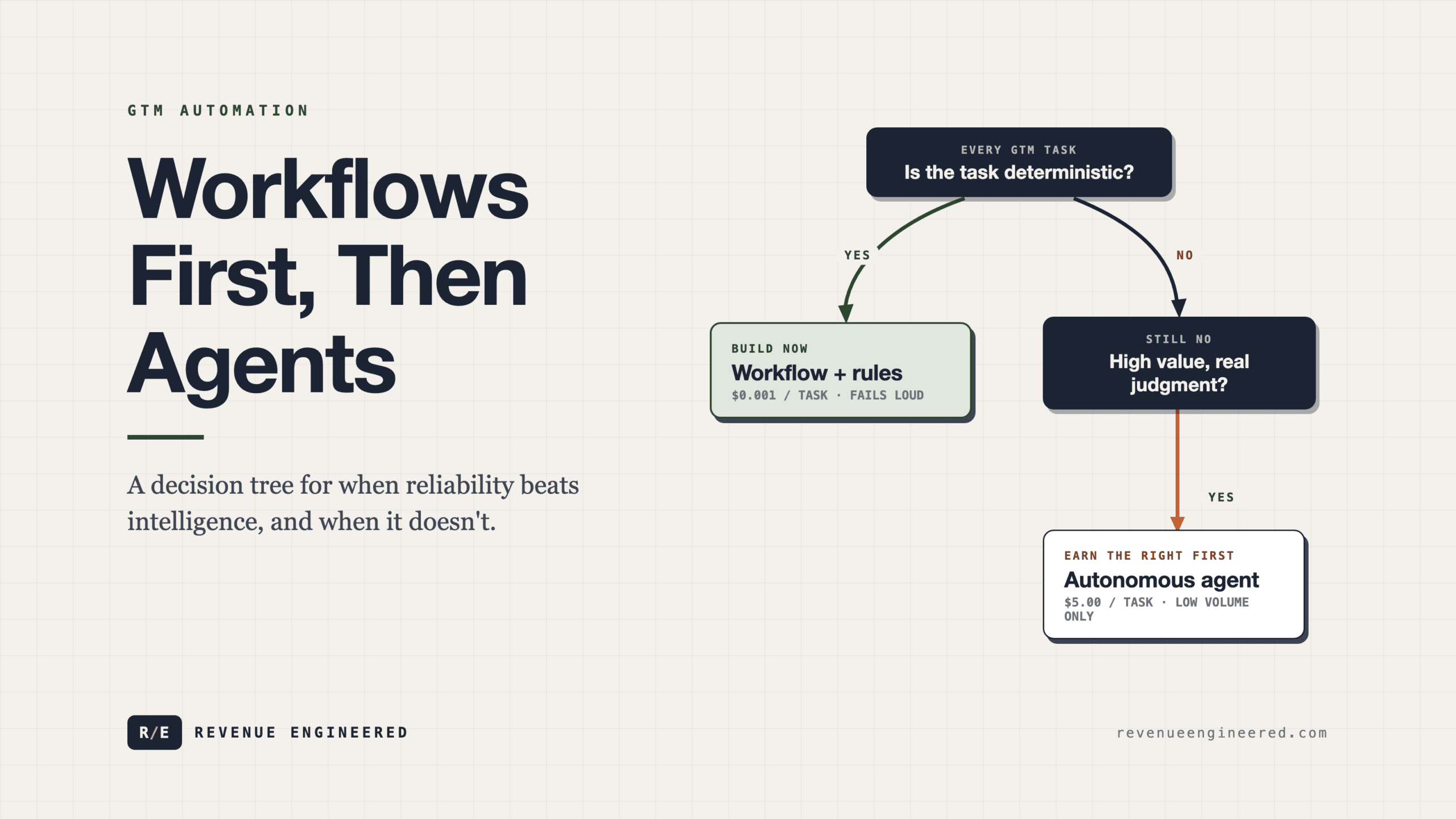
decision tree as a maturity path.
When a GTM task needs automation, run it through this framework. Each question narrows you toward the right level of the automation ladder.
Does the task have a fixed sequence of steps? If yes, it is a workflow. Build it in n8n, Zapier, or Make. Lead routing, data sync, notification triggers, scheduled reports. These are workflow problems.
Does the task require conditional logic but with known conditions? If yes, it is a rule-based automation. Lead scoring, territory assignment, deal stage advancement based on activity thresholds. The conditions can be defined in advance. No intelligence required.
Does the task require generating or transforming natural language? If yes, consider AI-assisted automation. Use a single LLM call within an otherwise deterministic workflow. Email personalization, intent classification, summary generation. The LLM handles one bounded step. The workflow handles everything around it.
Does the task require judgment about what to do next based on what was discovered in the previous step? If yes, this might actually be an agent task. Competitive research where the next source depends on what the first source revealed. Account strategy where the recommendation depends on synthesizing multiple signals. Creative work where the brief is ambiguous and the output requires iteration.
What is the cost of getting it wrong? If the downside is a slightly awkward email, AI-assisted automation is fine. If the downside is sending incorrect information to a $200K prospect, you either need a human review step or you need to be very confident in your agent’s accuracy.
What is the task volume? High-volume tasks favor lower-cost automation tiers. If you’re running a task 10,000 times per month, even a $0.50/task agent cost is $5,000/month. Make absolutely sure that a $50/month workflow couldn’t handle it.
The practical answer for most GTM teams is a layered architecture. Workflows handle the plumbing: data movement, triggers, routing, notifications. Rule-based logic handles the decisions that can be codified. AI-assisted steps handle the handful of subtasks that genuinely benefit from language understanding. Agents are reserved for high-value, low-volume tasks where the cost of intelligence is justified by the value of the outcome.
Building workflows that agents can eventually replace

Building workflows that agents can eventually replace translated into operating choices.
The irony of the “workflows first” argument is that well-designed workflows are also the best foundation for eventual agent deployment. An agent that takes over a poorly documented manual process will inherit all of that process’s ambiguity and dysfunction. An agent that takes over a well-designed workflow inherits clear inputs, defined outputs, explicit decision criteria, and measurable success metrics.
The progression looks like this in practice. You start by mapping the manual process. You identify which steps are pure execution (move data, send message, update record) and which steps require judgment (decide priority, assess fit, choose approach). You automate the execution steps as workflows first. You document the judgment steps as explicit rules where possible. The remaining judgment steps, the ones you genuinely cannot reduce to rules, are your agent candidates.
This approach has two benefits. First, it forces you to be honest about how much of the process actually requires intelligence. In our experience, teams consistently overestimate this. When you sit down and try to write the rules, you discover that 80% of the “judgment” was pattern matching that a conditional workflow handles perfectly. The remaining 20% is where agents earn their cost.
Second, it creates the evaluation infrastructure you need to deploy agents responsibly. If you have a workflow that routes leads based on explicit rules and you know it produces 85% accuracy, you can deploy an agent alongside it, compare outputs, and measure whether the agent actually improves outcomes. Without that baseline, you’re deploying an agent into a void with no way to tell if it’s performing.
Where the industry is heading
The automation maturity ladder is not permanent. Model costs are dropping roughly 10x per year. Tasks that are too expensive for agent-level automation today will be cost-effective within 12-18 months. The question is not whether agents will eventually handle most GTM tasks. They will. The question is whether your team will be ready when that happens, or whether you’ll still be trying to debug your first agent deployment while competitors are on their third iteration.
The teams that will be best positioned are the ones investing in workflow architecture now. Not because workflows are the final destination, but because they are the prerequisite. Clean data flows, explicit decision logic, measurable baselines, well-defined task boundaries. These are the foundations that make agent deployment possible when the economics and reliability catch up.
Right now, the playbook is straightforward. Audit your GTM process. Identify every task that involves moving data, following a sequence, or applying known rules. Automate those as workflows. For the remaining tasks, the ones that require genuine judgment, context synthesis, or creative adaptation, evaluate whether the cost and reliability of current agent technology justify the investment. For most teams, the honest answer today is that 80% of their automation opportunity lives in levels 3 and 4 of the maturity ladder.
The exciting future is agents. The profitable present is workflows. Build the second while preparing for the first.
Enjoying this essay?
Written by

Elom
GTM, growth, and revenue systems operator with 12 years across Fortune 500s, fintech, and B2B startups. Building at the intersection of AI, data, demand, and revenue.
Get the next deep-dive in your inbox
Essays on demand creation, GTM, growth engineering, and revenue systems. Free.