Why Your Best Cold Email Copy Will Not Save You From AI Search
The outbound community is optimizing copy, deliverability, and personalization. But when a VP of Sales asks ChatGPT for recommendations before opening their inbox, copy quality becomes secondary to LLM visibility.
Why Your Best Cold Email Copy Will Not Save You From AI Search
Cold email is not dying. Let me get that out of the way first because I know how the outbound community reacts to any headline that even hints at it.
The tactical innovations happening in outbound right now are genuinely impressive. One GTM engineer recently shared data showing that including images in cold emails, screenshots, Loom thumbnails, and annotated diagrams, generated 126 replies versus 80 for the same campaign without images. That is a 57% lift. The conventional wisdom says images hurt deliverability. His argument: worse deliverability multiplied by higher conversion still nets more total replies. The math holds up.
Another practitioner shared a case where a five-paragraph “love letter” email, deeply personal, research-heavy, and intentionally long, crushed their optimized short template. Everything the cold email playbook says about brevity and mobile-first formatting, thrown out the window by someone who wrote an email that felt genuinely human.
These are real innovations. They work. And they are solving for a surface area that is structurally shrinking.
The Structural Shift Underneath the Tactics
Here is what the outbound community is not talking about enough.
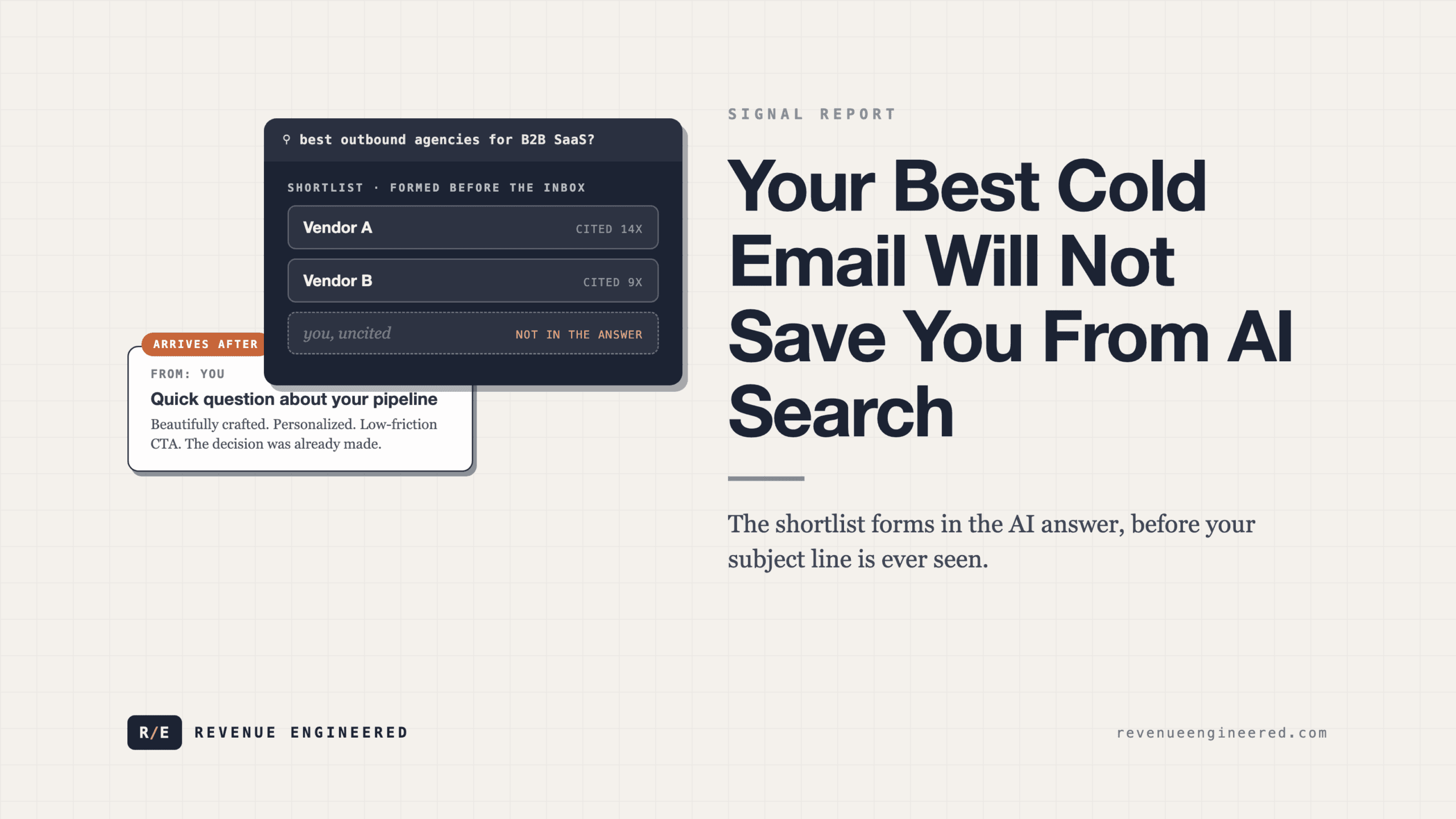
When a VP of Sales at a 200-person SaaS company needs to evaluate outbound agencies, what do they do in 2026? Increasingly, they open ChatGPT or Perplexity and ask: “What are the best outbound agencies for B2B SaaS?” or “Who are the top cold email consultants for startups?” or “Compare outbound-as-a-service providers for mid-market companies.”
They get a list. They read the summaries. They click on two or three of the recommended options. They shortlist based on what the AI told them.
Then they open their inbox.
Your cold email arrives. It is beautifully crafted. Personalized. The opening line references a recent company event. The offer is specific. The CTA is low-friction.
But the decision was already made. They have their shortlist. Your email is competing against a choice framework that was established before they ever saw your subject line.
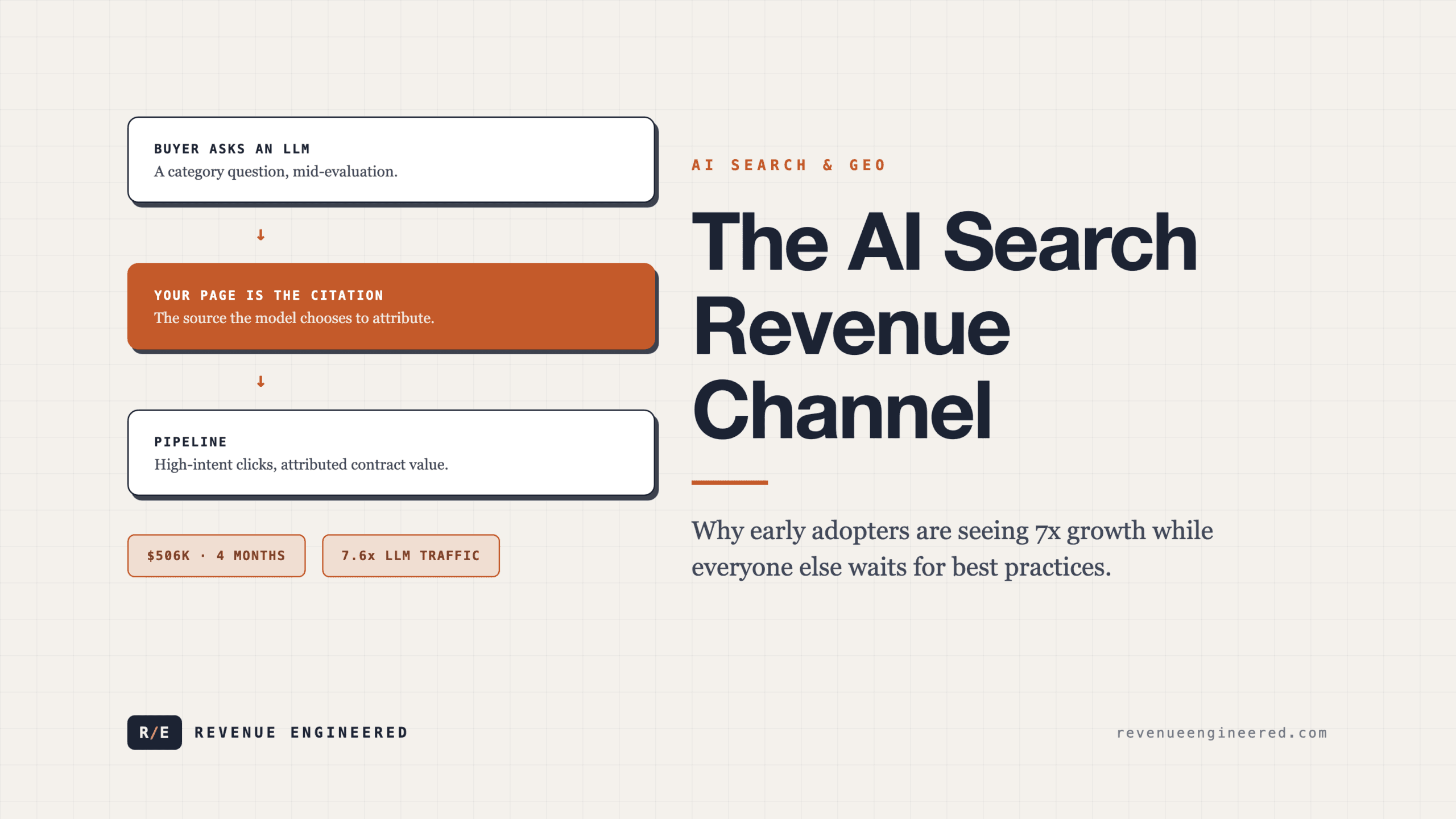
This is not a hypothetical scenario. One agency reported $506K in contract value over four months from LLM-optimized content alone, with a 7.6x increase in LLM referral traffic. That revenue did not come from cold email. It came from being the answer the AI gave when buyers asked.
The cold email did not fail because of copy quality. It failed because it arrived after the buying decision had already been shaped by a channel the sender was not visible on.

The shortlist now forms before the inbox.
Why the Tactical Innovators Are Still Solving for a Shrinking Surface
I want to be fair to the outbound community because the people pushing tactical boundaries are doing excellent work. Let me walk through the current innovation wave and then explain why it is necessary but not sufficient.

Tactics win opens. Visibility shapes shortlists.
Images in cold email. The data is real. Images increase reply rates when used correctly. Screenshots of a prospect’s website with annotations, Loom video thumbnails, and custom diagrams all add a layer of personalization that text alone cannot match. The 126 vs. 80 reply comparison is significant. But this innovation optimizes for conversion within the inbox. It assumes the prospect opens the email and considers the offer. If the prospect already has a shortlist from AI research, the image might get a reply like “Thanks, but we’re already in conversations with another firm.” That reply counts in the 126, but it does not count as pipeline.
Long-form emails. The “love letter” approach works because it signals genuine effort and human investment. In a sea of two-sentence automated templates, a five-paragraph email with specific research stands out. I genuinely think this is one of the smarter tactical shifts in outbound right now. But it is also more expensive per email. You cannot write five custom paragraphs at the same volume as a short template. So the total addressable outreach drops. If the inbox is becoming a secondary decision-making channel, reducing your total reach in exchange for higher per-email conversion might not be the trade you want to make.
Hyper-personalization. Tools like Clay, at 71% adoption among GTM leaders in a recent survey, have made it possible to personalize at scale. Pull a prospect’s company data, their tech stack, their recent funding round, their LinkedIn activity, and weave it into a template that feels hand-written. This is powerful. But personalization only matters if the prospect does not already have a preference. And AI search is creating preferences before the outreach ever starts.
Deliverability engineering. The outbound world has gotten extremely sophisticated about domain warming, inbox placement, sender reputation, and infrastructure. Multiple sending domains, IP rotation, warmup sequences, SPF/DKIM/DMARC authentication. This is table stakes. And it is necessary. But perfect deliverability into an inbox where the buyer has already decided is just a faster route to the same outcome.
Every one of these innovations is valuable. Every one of them improves cold email performance. And every one of them optimizes for a channel whose influence on buying decisions is declining relative to AI search.
The Data Points That Should Worry Outbound-Only Teams
Let me lay out the numbers that frame this structural shift.
AI search adoption among B2B buyers. Multiple surveys from late 2025 and early 2026 show that 40-60% of B2B buyers now use AI tools as part of their vendor research process. Among buyers under 40, that number is closer to 70%. These are not replacing Google entirely. They are adding a new research layer that happens before any other channel engagement.
LLM traffic growth for optimized sites. The 7.6x growth figure I cited earlier comes from a single agency’s experience over four months. But the pattern is consistent across early adopters. Companies that invest in generative engine optimization are seeing LLM referral traffic grow at rates that make traditional organic search growth look glacial.
Cold email reply rates are flat or declining. Despite all the tactical innovation, aggregate cold email reply rates across the industry have not improved meaningfully in the last 18 months. The median positive reply rate for B2B cold email campaigns sits around 1-3%. Individual practitioners are beating those numbers with clever tactics, but the overall trend line is flat. This suggests that the problem is not the emails. It is the channel dynamics.
Tool consolidation reflects uncertainty. The GTM tool survey data showing Clay at 71%, n8n at 48%, and Instantly at 35% adoption tells an interesting story. Teams are consolidating toward fewer, more integrated tools. They are reducing the number of moving parts in their outbound stack. This is rational behavior when you sense that the channel’s ceiling is lowering. You optimize for efficiency when you cannot rely on growth.
Free tools as top-of-funnel are winning. One agency built free tools on their website using Claude Code and now generates 100K+ visitors per quarter, with 30% coming from SEO. They are creating value that buyers encounter during their research process, before any cold email is sent. The tools serve as both a lead capture mechanism and a trust signal that LLMs can reference.
All of these data points converge on the same conclusion: the outbound channel is not broken, but its relative influence in the buying process is declining. And the companies that recognize this early have a chance to build a compounding advantage on the AI search side while continuing to run outbound as a supporting channel.
How AI Search Changes the Buying Sequence
The traditional B2B buying sequence for services looks something like this:
- Buyer identifies a need
- Buyer searches Google for solutions
- Buyer reads blog posts, review sites, comparison pages
- Buyer gets cold emails from vendors (or asks peers for referrals)
- Buyer evaluates shortlisted vendors
- Buyer makes a decision
Cold email operates at step 4. It can also create awareness at step 1 if the timing is right. In this sequence, cold email has a clear role: it puts your name in front of buyers who might not find you through organic channels.
The AI search version of this sequence is different.
- Buyer identifies a need
- Buyer asks ChatGPT/Perplexity/Claude: “What are the best options for [my situation]?”
- AI provides a curated list with summaries, pros/cons, and recommendations
- Buyer visits 2-3 of the AI-recommended options
- Buyer evaluates and decides
Cold email can still intersect this sequence. But notice where it falls. It now competes with a step 3 that is far more efficient and trusted than the old step 3 (manually reading 10 blog posts and review sites). The buyer’s shortlist is formed faster, with less effort, and often before they ever open their inbox.
The practical consequence: if you are not on the AI’s recommended list at step 3, your cold email at step 4 is fighting an uphill battle against an already-formed preference set. You are not just competing with other emails. You are competing with the AI’s recommendation.
The Architecture Argument: Why Outbound and GEO Are Layers, Not Competitors
I do not think outbound is dead. I do not think you should stop sending cold emails. I think you should change how you think about the relationship between outbound and AI search visibility.

Outbound and GEO are layers, not rivals.
The most effective go-to-market architectures in 2026 are layered systems. They are not single-channel bets. The companies generating the most pipeline are the ones that appear across multiple surfaces in a buyer’s research journey.
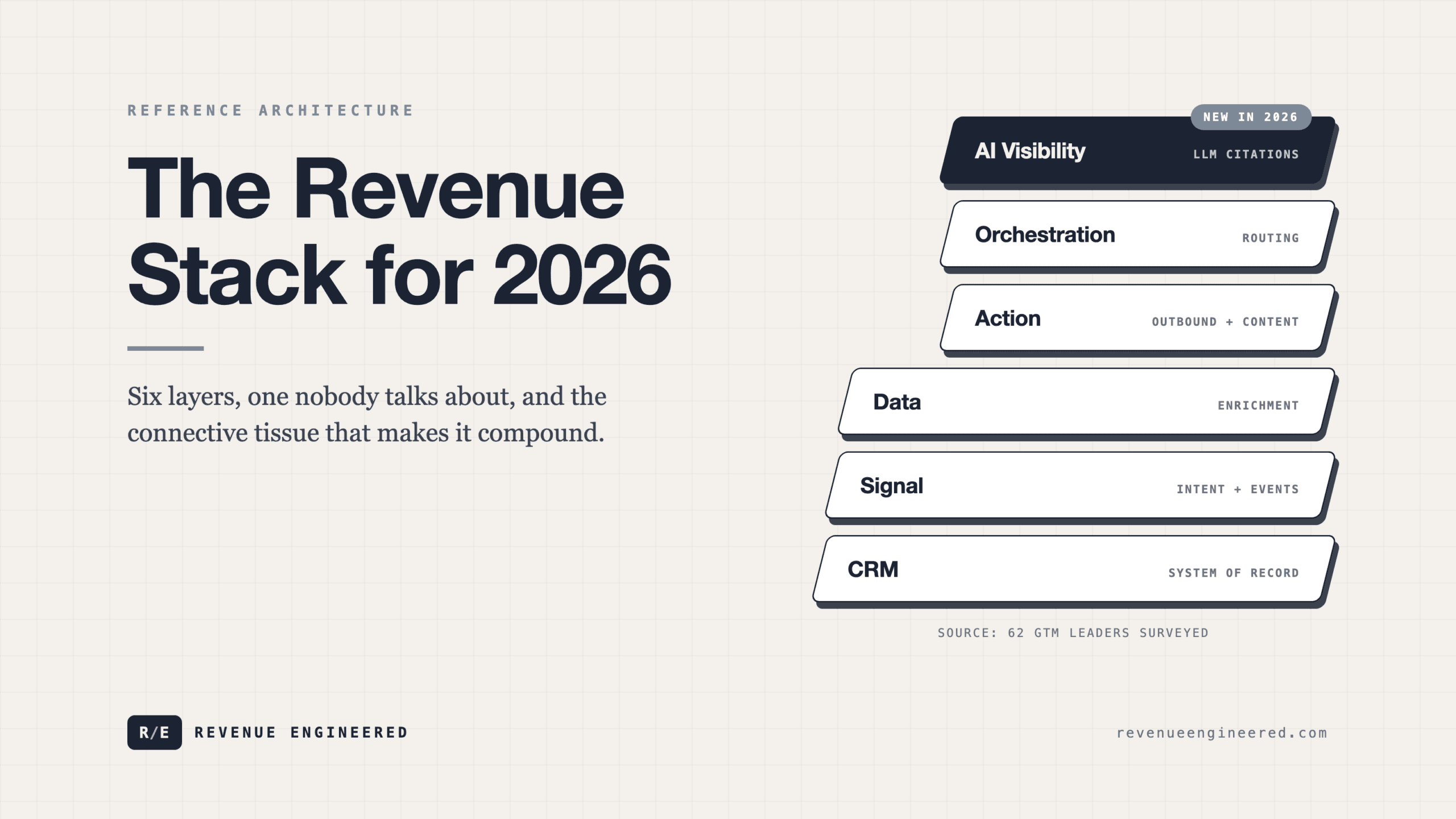
Think of it as a five-layer revenue stack.
Layer 1: Signal detection. You identify which accounts and individuals are showing buying intent. Job changes, funding rounds, tech stack changes, content consumption patterns. Tools like PredictLeads, Common Room, and manual LinkedIn monitoring feed this layer.
Layer 2: Data enrichment. You pull detailed information about those accounts and contacts. Firmographics, technographics, org charts, email addresses, phone numbers. Clay dominates this layer for good reason.
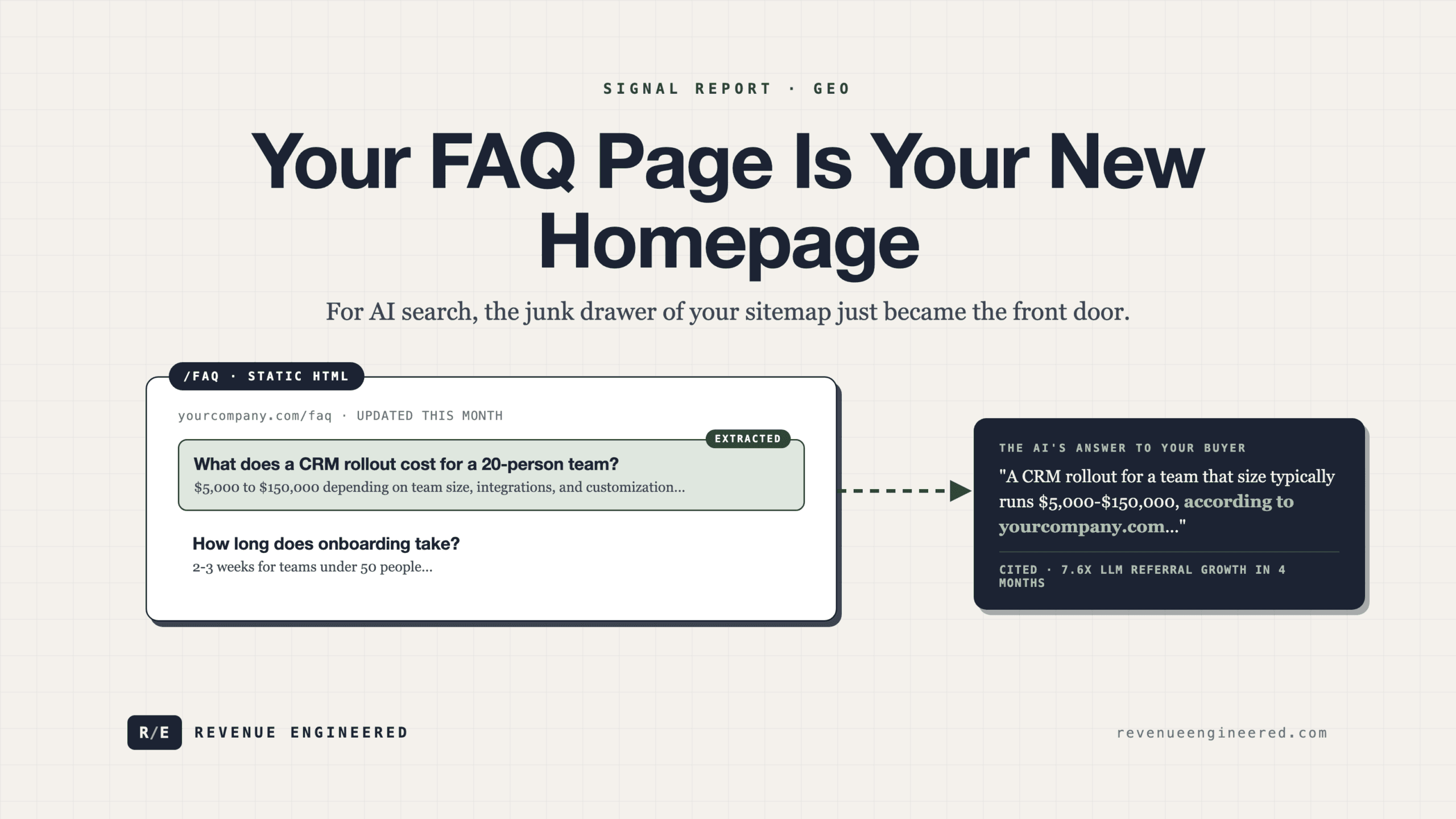
Layer 3: AI search visibility. This is the new layer. Your company appears in LLM responses when buyers in your target market research solutions. Your FAQ page, your structured content, your entity clarity across the web, all contribute to whether the AI recommends you. This is the GEO layer.
Layer 4: Outbound activation. You reach out to the contacts you have identified and enriched. Cold email, LinkedIn outreach, cold calling. The tactical innovations I described earlier live here.
Layer 5: Orchestration and CRM. You manage the entire process in a unified system. Sequences, pipeline stages, follow-ups, handoffs.
In this architecture, outbound and GEO are not competitors. They are complementary layers. GEO warms the buyer before the outbound touch arrives. When a VP of Sales gets your cold email and thinks “I’ve heard of them” because ChatGPT mentioned your company during their research, your reply rate goes up. Your time-to-meeting goes down. Your close rate improves.
The companies running outbound without GEO are playing Layer 4 without Layer 3. They are reaching out to buyers who have never heard of them, who have already formed a shortlist through AI research that did not include them.
The companies running GEO without outbound are building visibility without activation. They are getting recommended by AI but not proactively reaching out to the buyers who match their ideal customer profile.
You need both. But if you are only investing in one, and you choose outbound, you are building on a narrowing foundation.
The Employee LinkedIn Army and Why It Connects
One more data point that ties these threads together. A leading GTM agency turned 24 employees into LinkedIn creators through an internal competition with cash prizes. Over 90 days, they produced 581 posts. The result: 27 new clients and $153K in monthly recurring revenue attributed to the program.
Why does this matter for the outbound-vs-GEO conversation?
Because those 581 posts are not just social content. They are training data. They are indexed content. They are entity signals that language models consume and factor into their recommendations. When 24 people from the same company are consistently publishing expertise about outbound, GTM engineering, and cold email strategy, the models learn to associate that company with those topics.
The LinkedIn army is a GEO play disguised as a social play. The direct engagement (likes, comments, DMs) is the visible output. The LLM training signal is the invisible compounding asset.
This is the kind of strategic thinking that most outbound-focused teams are missing. They see LinkedIn as a distribution channel for content. They do not see it as a way to shape how AI models perceive their brand.
What I Would Do If I Ran an Outbound Agency Today
If I ran an outbound agency and my entire business was built on cold email, here is how I would think about the next 18 months.
First, I would keep running outbound. The channel works. The tactical innovations (images, long-form, hyper-personalization) are producing real results. Stopping outbound would be foolish. But I would stop thinking of outbound as my primary growth engine and start thinking of it as an activation layer.
Second, I would invest 20-30% of my content resources into GEO. Build a comprehensive FAQ page optimized for LLM citation. Create structured content that answers the exact questions my target buyers are asking ChatGPT. Ensure my entity signals (company name, services, differentiators, client outcomes) are consistent across every page on my site.
Third, I would build free tools. The 100K+ visitors per quarter from free SEO tools is not just a traffic play. Those tools generate backlinks, social shares, and entity mentions that all feed into LLM source authority. A free email deliverability checker or a cold email grader or an ICP scoring calculator creates a searchable, citable asset that AI models can reference.
Fourth, I would start tracking LLM mentions. Set up monitoring for how your brand appears in ChatGPT, Perplexity, and Claude responses. What queries trigger your mention? What competitors appear alongside you? What questions come up where you should appear but do not? This is the new competitive intelligence layer.
Fifth, I would reframe the pitch to my clients. Instead of “we send cold emails,” I would position as “we make your company the answer before the inbox.” Outbound becomes one element of a larger visibility architecture. GEO becomes the strategic foundation that makes outbound more effective.
The Companies That Win Will Do Both. The Ones That Lose Will Only Do One.
The outbound community is full of talented, data-driven operators. The contrarian cold email experiments, the deliverability engineering, the personalization at scale. These are real skills that produce real results.
But the companies that will win the next three years of B2B growth are the ones that recognize a structural shift when they see one. AI search is not a fad. It is a new layer in the buying process that is here to stay and growing in influence every quarter.
If your entire revenue engine runs on outbound and you have zero AI search visibility, you are one model update away from irrelevance. Not because cold email will stop working. But because the buyers who receive your emails will have already made their decisions somewhere else.
Outbound and GEO are not competitors. They are layers. But if you are only investing in one, you are building on a foundation that gets narrower every month.
The best cold email in the world loses to the company that the AI already recommended. That is not a commentary on your copy. It is a commentary on where your buyers are making decisions.
Be the answer before the inbox.
Enjoying this essay?
Written by

Elom
GTM, growth, and revenue systems operator with 12 years across Fortune 500s, fintech, and B2B startups. Building at the intersection of AI, data, demand, and revenue.
Get the next deep-dive in your inbox
Essays on demand creation, GTM, growth engineering, and revenue systems. Free.